<?xml version="1.0" encoding="utf-8"?><feed xmlns="http://www.w3.org/2005/Atom" ><generator uri="https://jekyllrb.com/" version="3.10.0">Jekyll</generator><link href="https://elisparry.github.io/feed.xml" rel="self" type="application/atom+xml" /><link href="https://elisparry.github.io/" rel="alternate" type="text/html" /><updated>2026-09-15T19:44:50+00:00</updated><id>https://elisparry.github.io/feed.xml</id><title type="html">?pam</title><subtitle>&apos;Pam&apos; means why in Welsh. Spam means &quot;to bombard...with unsolicited and unwanted material over the internet&quot;. And, in reverse, it reads &apos;map&apos;. These words describe what I share here quite well: finding your why and matters such as running, the environment, meditation, technology, and sobriety.</subtitle><author><name>elis parry</name><email>elis.parry@proton.me</email></author><entry><title type="html">Digging Deep</title><link href="https://elisparry.github.io/2026-06-23/digging-deep" rel="alternate" type="text/html" title="Digging Deep" /><published>2026-06-23T00:00:00+00:00</published><updated>2026-06-23T00:00:00+00:00</updated><id>https://elisparry.github.io/2026-06-23/digging-deep</id><content type="html" xml:base="https://elisparry.github.io/2026-06-23/digging-deep"><![CDATA[<p>Passing through the small fishing village of Kannoura, I felt full to the brim with the omurice that I had eaten for lunch. Not being able to resist the temptation of eating the snack bar I’d been given, I enjoyed it as I walked through Kannoura. I walked past a few inlets where fishing boats were tied up, the sun shining, and the reflections on the water’s still surface as clear as any I’d seen. Like most other fishing villages, this one was also quiet, with the occasional small Japanese car or truck passing by and a local tending to their garden. Turning the corner, I passed the Germans that I shared lunch with as they took a break overlooking the small docks. I wished them good luck for the rest of the journey and told them to make sure that they protect their skin. The Japanese sun was starting to become more intense and their pale complexion meant that they were starting to show signs of burning.</p>

<p>After passing the two German Henro, my mind started falling into a comparison trap. I kept going round in circles in my head, wondering whether I was doing the pilgrimage the wrong way. Maybe I was walking too far every day, pushing my body too much. Maybe I should find some people to tag along with so that I would no longer be walking alone. But then I tried to remind myself why I was doing the pilgrimage and how I wanted to do it. I wanted to be alone for hours at a time, in my own head, to have to face the truth. I wanted to be walking for most of the day - simply eating, sleeping, and walking. I wanted to strip things back to the essential. I remembered that there is more than one way to skin a cat, and that I should trust my intuition on these things. Continuing without comparing was what I had to do.</p>

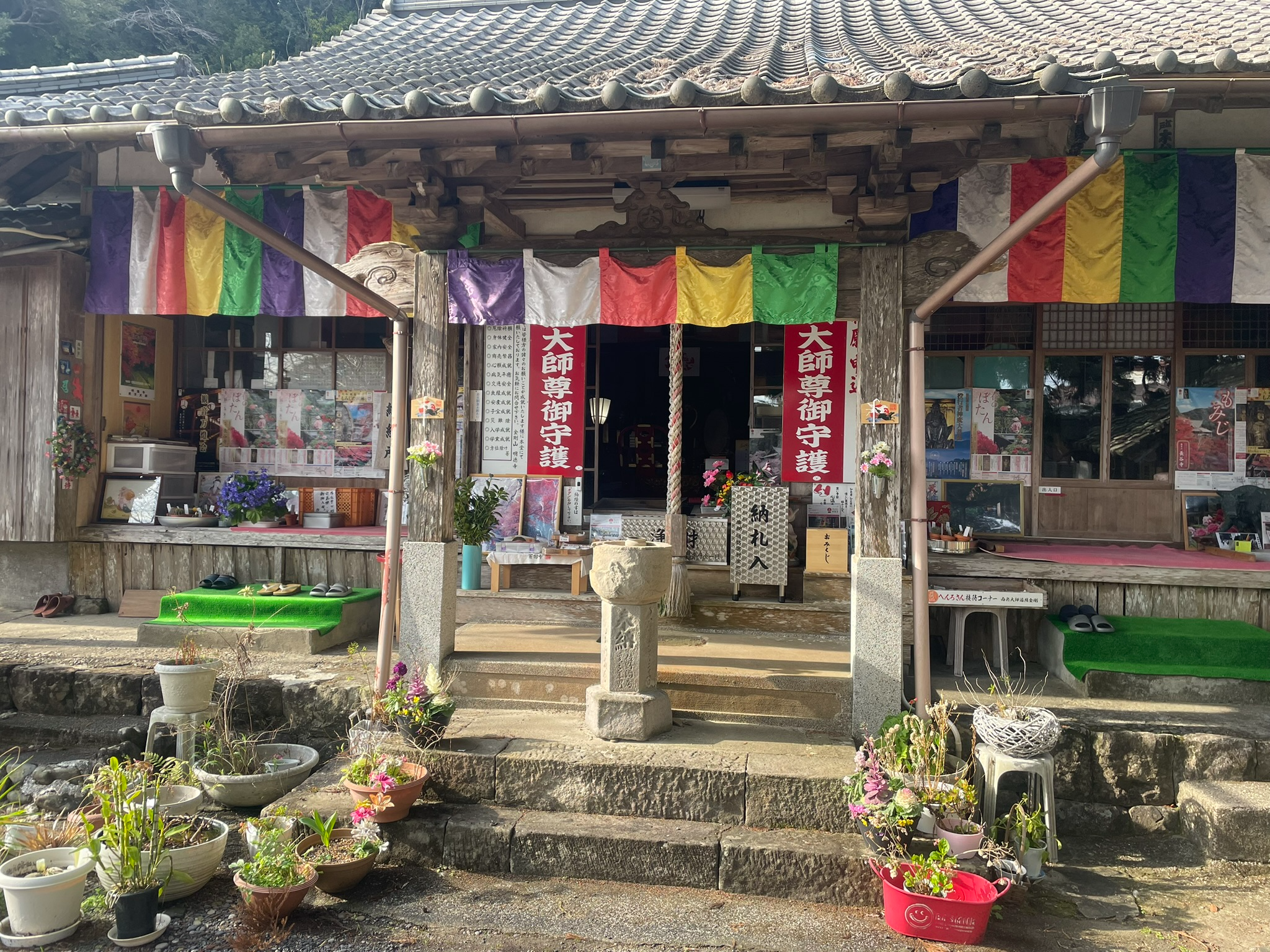
<p>Walking along in a daydream, the monotony of the coastal road offering a different type of mental challenge, I passed a cool looking Daishi, Myotokuji, which supposedly had a Zenkonyado where pilgrims could stay. The multicolored prayer flags, representing the five elements, created a contemplative energy and the flora surrounding the temple added to the atmosphere. But it was still early in the afternoon and I had no food for dinner, so I decided to press ahead. I didn’t feel hungry, but wanted to keep my body stocked up with good stuff. Regardless, Zenkonyados, by tradition, should only be used as a last resort by pilgrims who happen to have found nowhere to stay for the night, but I already knew where I was staying that night.</p>

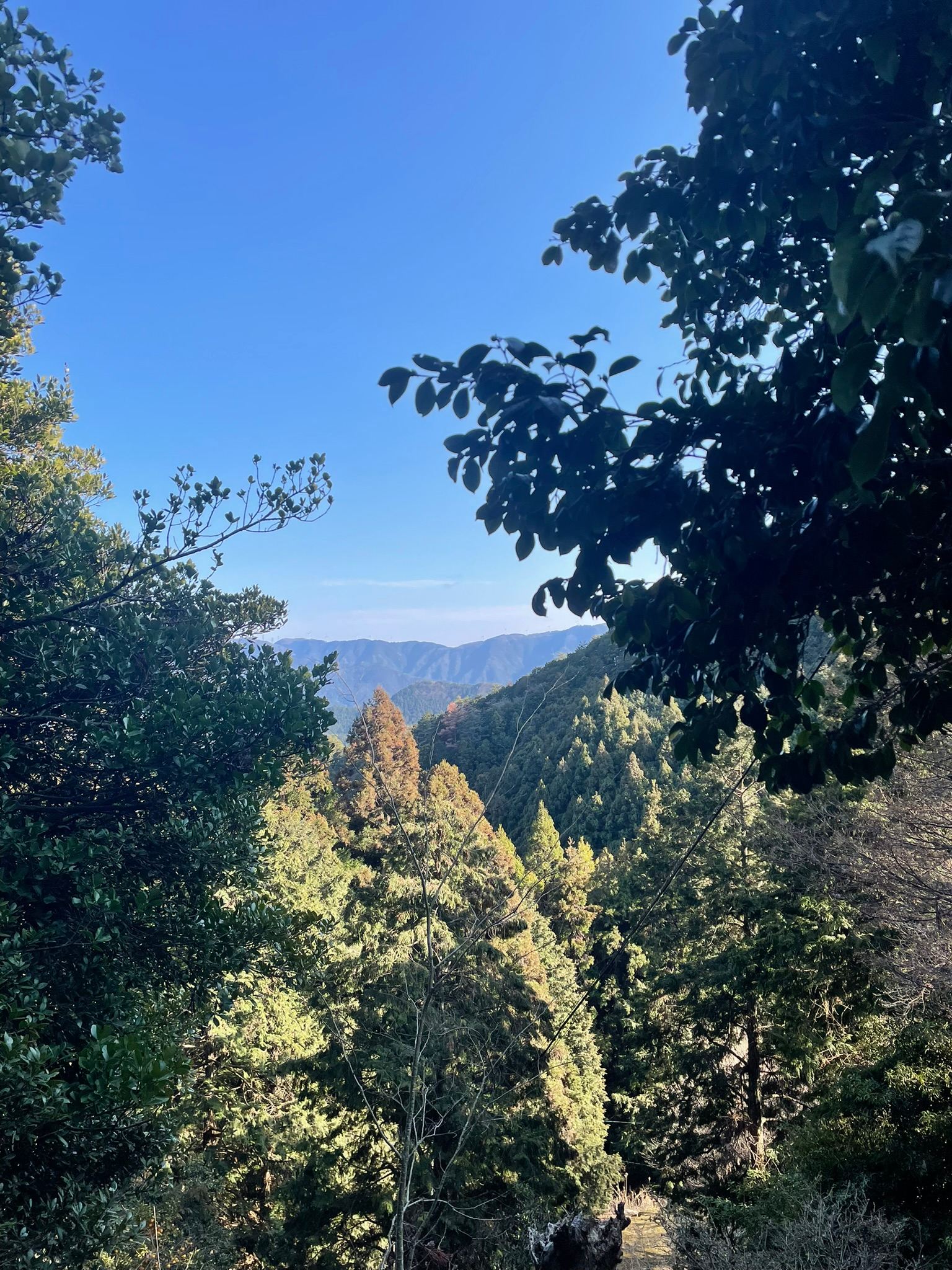
<p style="text-align: center;"><img src="/assets/images/temple_colourful.png" alt="Colourful temple" width="500" /></p>

<p>After leaving Myotokuji, I crossed into Toyo Town. Soon, I would start the Gorogoro-ishi section, a difficult section where pilgrims used to have to navigate slippery and dangerous sections of coastline before the present road was built, its name standing for the rumbling sound (gorogoro) of rocks (ishi). I was a little disappointed that this section was now far easier for pilgrims to walk, however, according to my guide book, the lack of places to stop for food and drink meant that it was still deceptively difficult to this day.</p>

<p>Hitting the coastal road that hugged the East side of Cape Muroto, I settled into a rhythm that I could maintain for a couple of hours. I walked on the left side of the road so that I was nearer the sea. The road was quite literally hugging the coastline, with the salty spray of the sea as it crashed into the rocks providing a refreshing sea mist to help cool me down. The sun setting to my right, I was now shaded, for the most part, so could walk without my sedge hat. Despite being a nice idea practically, I was starting to find that this traditional style of hat had its downsides, one of which being its stability in winds. Given that I was now on the coast, the hat would often decide that it wanted to take flight off my head whenever a stronger gust of wind blew. This meant that it had primarily been retired to be hanging off the back of my rucksack, serving only as a placard to show that I was indeed a Henro.</p>

<p>As the kilometers went by, I couldn’t help but walk with a big smile on my face. ‘Feeling Good’ by Michael Buble was ringing in my head and, given that I was practically the only one around other than the cars that passed by, I sang from the top of my lungs as I walked along the Gorogoro-ishi. Perhaps a different style to the pilgrims who walked this coast a thousand years ago, but one that worked in its own strange way for me. As I walked, I focused on the waves as they neared the coast, finding it genuinely amazing how beautiful waves are. I loved how they built up inertia before hitting a tipping point where the peak of the wave would collapse onto itself. The section felt exposed enough to make me feel lucky to be alive, with the tsunami section warning signs making me feel a subtle adrenaline rush as I walked. The waves also reminded me of an important thing, that despite the chaos and churning of the waves, the rocks that formed the shoreline were as stable and undisturbed as ever. A rock would be poking out, a wave would come and capture it in its waters, and, soon after - with a periodicity that I quickly became attuned with -, it would reappear above the water’s surface. No different to life, I thought to myself. Where we live in a world that’s as chaotic and busy as ever, where we try hard to feel a semblance of control. However, the reality is that much of what happens is far outside our control and that, by going inward, we can be similar to the rocks that show stability amongst such noise. That there’s no need to try to control the external, but instead come to peace with observing and knowing that for every peak in our life, a trough will inevitably arise.</p>

<p>Caught up in perhaps leaning too much towards the philosophical, from afar, I could see another person heading toward me on the other side of the road. It looked like he was pulling a trolley full of shopping, but as he neared, it was clear that he was a Henro, his white vest a marker of this. He saw me, and stopped to start crossing towards me, but I decided to head to his side of the road, where there was a pavement that we could safely talk. He looked weathered, which I thought to myself was understandable given that he was likely a good month or two into his anticlockwise pilgrimage. But he had a huge smile on his face, and spoke perfect English. I looked at his cart, which had a few bags on it, a big foam roll mat, some cooking equipment, and some dandelion roots hanging off the side. I told him that I was impressed by his ingenuity, and he told me to pull the cart to see how heavy it was. It was heavy! Far heavier than my rucksack. On his feet, he wore shoes that had <em>less</em> shoe than shoe left to them, his laces holding together what was left of the upper fabric. Given that I’d started to complain in my head about the tread of my shoes already wearing, and that I’d likely have to purchase new ones in Kochi City, I decided that I needed to toughen up and suck things up. There and then, I decided I’d make my shoes last the whole way.</p>

<p>After talking for a minute or so, the man mentioned that he’d been walking around the island continuously for - if I remember correctly - the past twenty years. He would alternate clockwise and anticlockwise around the island, sleeping outside every night and foraging as much of his food as possible. He told me how he’d picked up the Thermarest atop his cart for 500 yen, which is around £2.50. Despite not having many teeth left, I could see nothing but life radiate through his eyes, with his mind as sharp and young as could be. He was happy. He had no attachments nor work to pin him down. He simply walked and walked, towing everything that he owned behind him. Little did he know that he proved to be a big inspiration to me for the rest of my trip - a living, embodied example of many of the values that were important to me.</p>

<p>Both needing to push on for an hour or so before the light faded, we said our goodbyes and wished each other good luck. Leaving him, I felt as if I’d just met a celebrity along the Henro. I couldn’t imagine that many others had been walking continuously for two decades…</p>

<p>Pushing on to where I’d be staying that night, the road felt never ending. Looking at my map, I was convinced that I’d hit the campsite around the next bend, but I was wrong a few times. My mind was broken, and my body tired, so I slowly made my way along the final stretch, stopping regularly to rest and find some energy from within. Finally, ahead on the left, I could see what looked like a run-down set of garages. It must be Riders Paradise - the motorbike shop slash café slash campsite that I’d pay 250 yen to pitch my tent at that night.</p>

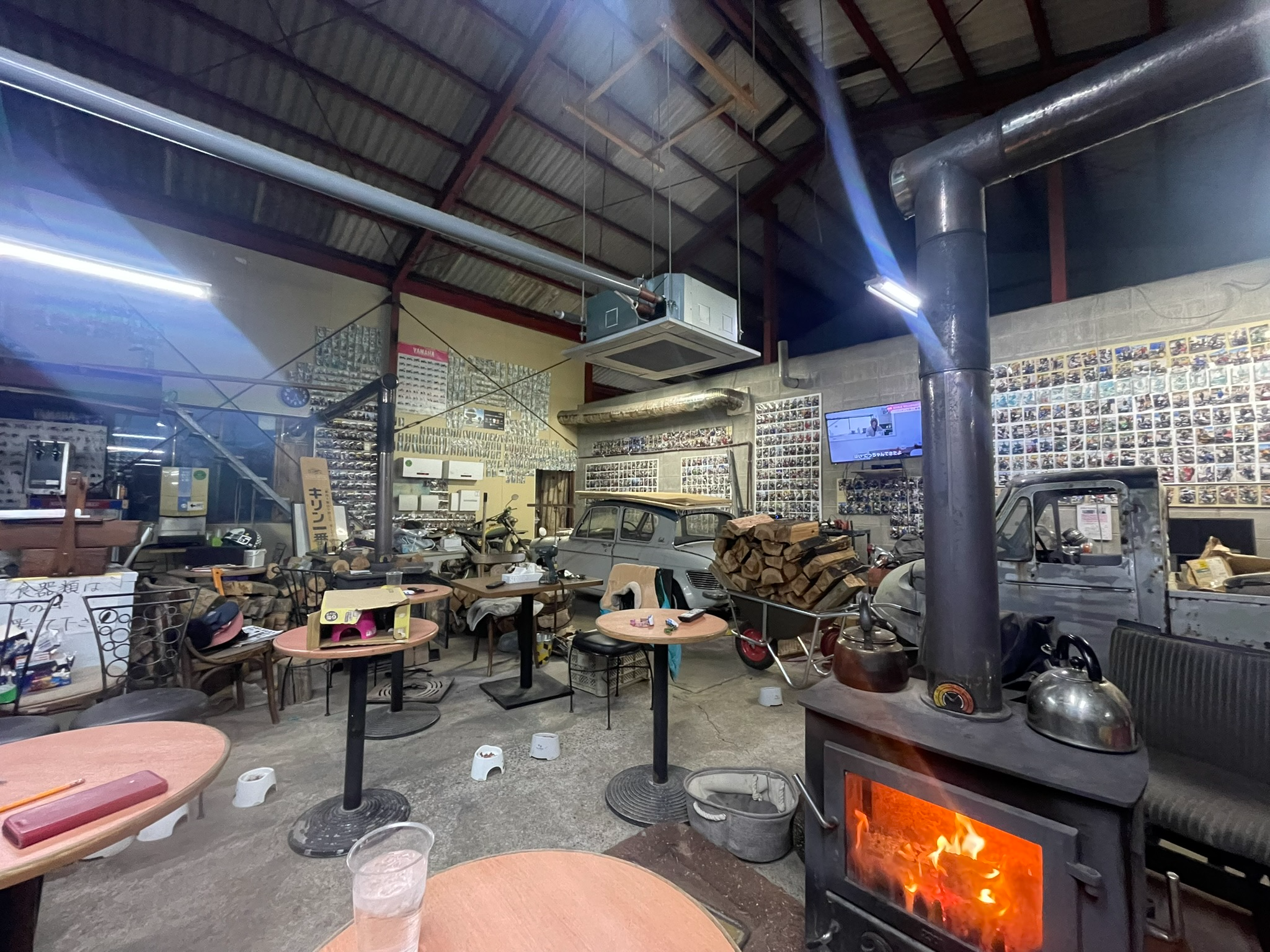
<p>Relieved that I’d arrived, I looked for a door that might resemble and entrance to a reception of some sort. I walked across the yard and could see no other tents around, but I assumed they would be in a field nearby or something. I headed towards the big Reggae-inspired stripes covering one of the exterior walls and, seeing a sliding door half open, I knocked and called “Sumimasen, konban wa” - excuse me, good evening in Japanese. A lady shouted from across the room saying that she’d be with me in a moment. She then opened the door, and I was both amazed and confused as to what was inside. There were motorbikes all over the place and random bits and bobs like a coffee machine and a load of pictures with people on the walls, but then in the middle of the room there were two of the biggest log burners I’d ever seen, with a couple of tables and chairs beside them.</p>

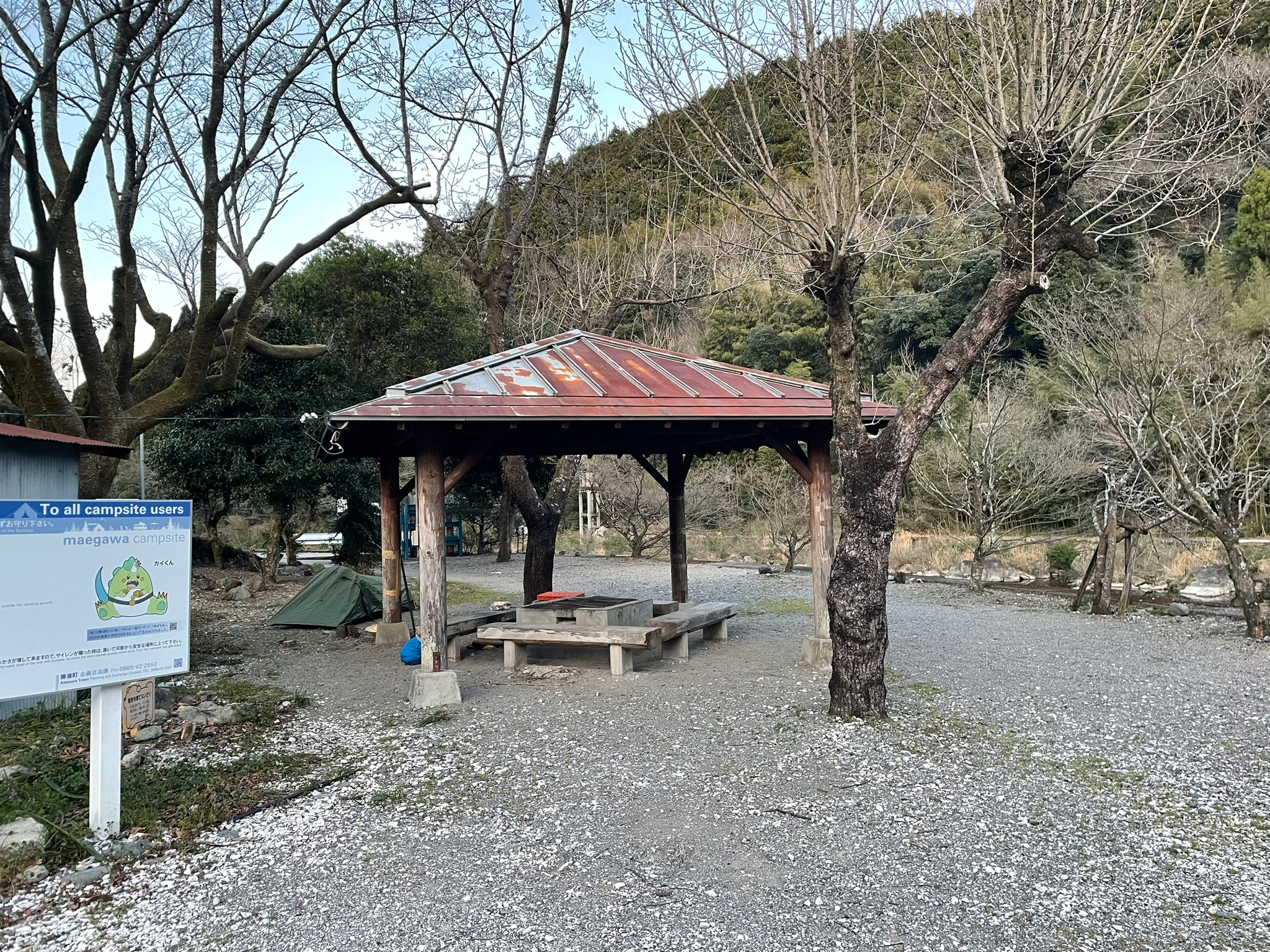
<p style="text-align: center;"><img src="/assets/images/motorbike_shed.png" alt="Bike shed" width="500" /></p>

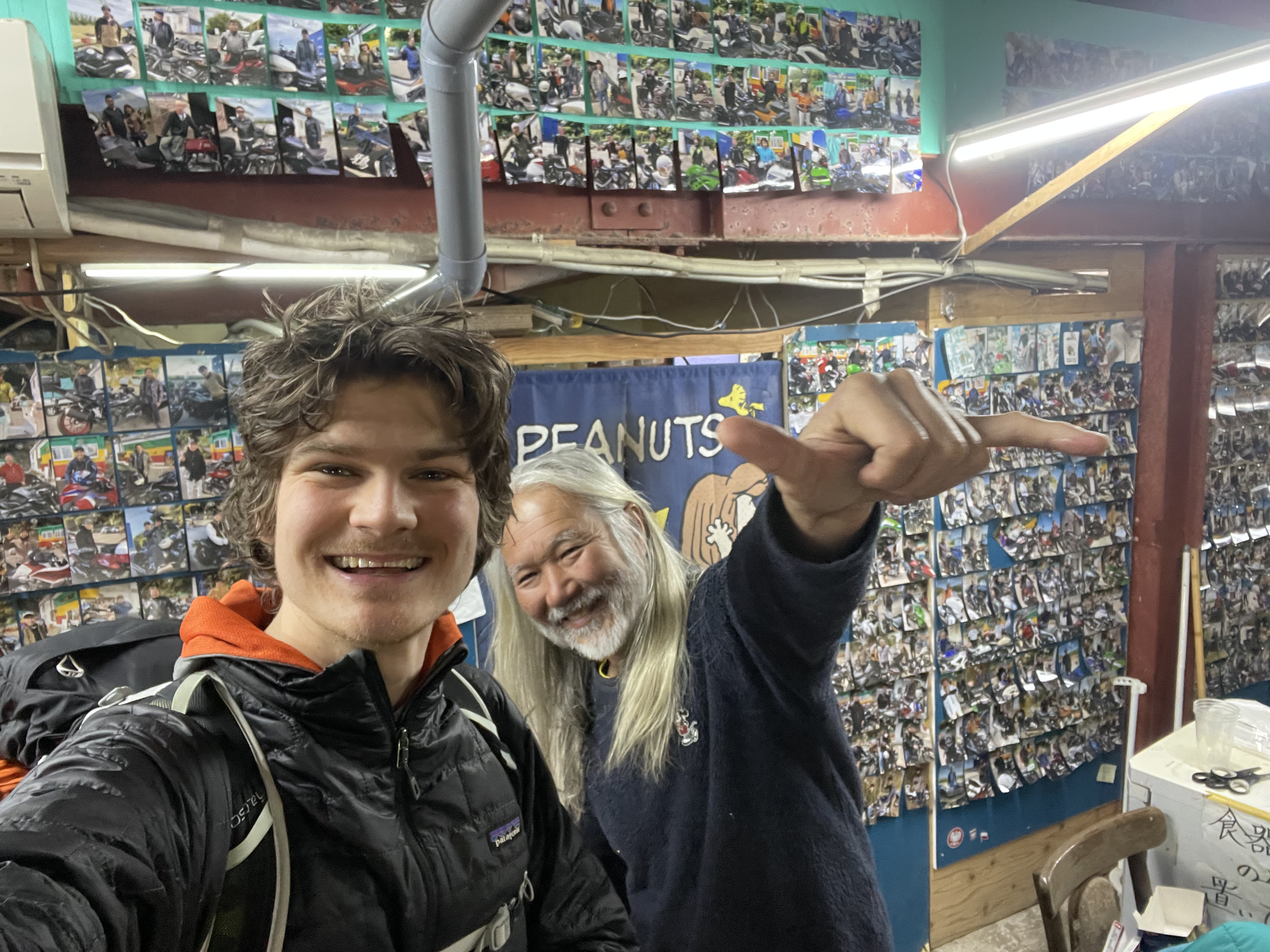
<p>I asked for the lady’s name. She was called Mami-san. After sitting down, she proceeded to bring me a glass of water and told me to get comfortable in front of the warm fire. I immediately felt at home and, soon, Mami-san’s husband, Hakimi-san walked in. He looked everything like a surfer, motorcycling dude - long silver hair, a tan that one only develops by being weathered when surfing the waves, and a big smile on his face. I asked him where I would be camping that night, so that I knew where to pitch my tent once the sun had set. He took me out to the yard and walked me to the other end, where there was a questionably level patch of grass and dirt that he said people usually pitched their tents on. Around the corner, there was a long, slightly flatter and softer patch of grass that overlooked the sea, however, I didn’t fancy camping there as the winds were blowing strong that evening. I told him that I’d pitch between the hedge that divided the beach and the yard, and he pointed out the porta-potty behind his bike garage.</p>

<p>Hoping that I could still eat something, I asked Hakimi-san whether there was any chance I could still buy some food. Thankfully, he said yes, and asked what I wanted while pointing to the small menu on a chalkboard sign. Given my limited Japanese, I picked the top thing on the menu, to which he replied - “small, medium or large”. Not knowing where the next place to eat along the cape was, I went with the large. He then asked if I wanted breakfast in the morning, an offer I couldn’t turn down. He did some sums on a piece of paper and I paid him the 1450 yen for the two meals and place to pitch. I asked how long he’d had the shop for and where he lived. He said that he used to live further down the cape in a village called Ozaki, but that the costs of running a bike shop in Japan had become so high that he’d decided to sell his house, now living on the side of the shop with his wife. I asked him where his favourite surf spot was, to which he replied ‘Ozaki’. I could tell that his heart was still in this little surf village down the coast.</p>

<p>Ten or so minutes later, Mami-san came out with a huge plate of food, telling me that it was <em>yaki soba</em>, a traditional Japanese dish of fried soba noodles and veg with a thick brown sauce and some Japanese omelette on top. I tucked into the mammoth plate of noodles and the saltiness was exactly what I needed after a long day of walking in the sun. I slowly slurped the noodles, appreciating having my first warm dinner of the trip. Before someone asks, <em>not</em> slurping is actually considered rude in Japan, as slurping and the sound that comes along with it is a way of showing the cook that you are enjoying your food. This was very different to the UK, where one slurp would have the whole café casting their eyes on you.</p>

<p>After eating my food, I had some important video calls to make with the two prospective supervisors for the PhD programmes I’d been offered places on. The first was at 7:30 pm Japanese time - around 10:30 am in the UK. I logged into my emails and hopped on a video call with the first supervisor. I was so elated with joy, sat in front of a warm fire with my feet out, that I found it a little difficult to talk about anything but the first few days of the trip. Luckily, the supervisor has done her fair share of long cycling and hiking trips, so she understood the beauty of living in such a simple way. Wanting to take things seriously, as the decision would be regarding what I’d do for the next four years, I asked some questions that were on my mind about the project. Hitting 8 pm, I dropped off my first call and moved outside to sit on a log to make my second video call - Hakimi- and Mami-san, rightly so, wanting some alone time. I called the second supervisor and sat under the light of my head torch, asking equally serious questions about the proposed project. Coming off the call, I now had a decision to make, but I think my gut already knew what was right. Regardless, both projects and supervisors were amazing, so I couldn’t really go wrong either way. Pitching my tent in the dark, I lay down staring at the roof of my tent and made a decision about the PhD. I would be spending the next chapter of my life looking at heatwaves. But, for now, I could go back to being a pilgrim.</p>

<hr />

<p>Waking up, my body was stiff from sleeping on such solid ground. But, since I’d promised to be sat at the table for breakfast at 6:15 am, I got my stuff together and changed while lying down before packing down my tent. You see, I’d had this tent for nearly a decade by now. It has been a great tent, with one of it’s strengths being how low down it was, meaning that it was good in strong winds and easy to stealth or wild camp in without disturbing the surroundings. The downside of this, however, was that I had to do anything in the tent lying down. To read, I’d either have to hold the book above my face until my arms were tired, or lie on my stomach with it in front of me. To change, I’d have to rustle about finding my clothes and put them on, taking care not to hit the outer of the tent to avoid being wet with condensation. However, it did have some advantages, one of them being that I could easily kneel in my tent at night, open the small door, and relieve my bladder without having to leave the tent at all. I’d grown to love this tent over the years, and was not ready to retire it, yet…</p>

<p>Packed up, I headed into the garage again and sat down to eat my breakfast. An egg, some salad, sweet bread, banana, and a strong black coffee would be more than enough fuel for a good part of the day. Before leaving, I asked Hakimi-san whether he could show me around the rest of the buildings. He first took me around the side to the other half of the current shed, where there were all kinds of old cars and bikes, one of them being an original Subaru 360 in light blue. In two adjacent corners of the shed, I could see some mattresses laying on top of some platforms with some transparent blinds surrounding them like one of those canopy beds that wealthy people have, except these were cooler and more rustic. I asked if this is where he slept, and he explained that these were in fact the rooms of the guesthouse - where people could come and sleep on a comfortable mattress for 500 yen a night. I kicked myself for not knowing last night, but then comforted myself by reminded myself of my goal to sleep in uncomfortable places. But this must have been the coolest, most eccentric guesthouse I’d ever seen. Heading across the yard, there was another shed full of bikes and cars. This one was three-stories and on the top lay a café - this being the <em>actual</em> café that daytime customers enjoyed relaxing at. There were big windows with views over the pacific, and the whole place just screamed the word ‘chill’. Heading back outside, I picked up my bag and said goodbye to Mami and Hakimi. I thanked them for their hospitality, and started walking with a refreshed sense of hopefulness.</p>

<p style="text-align: center;"><img src="/assets/images/IMG_0498.png" alt="Hakimi-san" width="500" /></p>

<p>That morning, I continued making my way towards the tip of Cape Muroto. The long road section continued for the best part of the morning and I tried my best to stay positive despite the monotony of the walking. I passed Ozaki beach, seeing a person enjoying the morning surf and imagining Hakimi-san doing the same. I walked for an hour or so, before stopping to rest the legs and fill up my water from a sink in a toilet. Approaching the end of the cape, I decided to take the scenic path onto the dyke. The area was a Unesco World Geopark due to its precious topography and geology, with many signs along the dyke with information about certain geological features. Despite being in awe with the beauty of the coastline, as always, I found it difficult to comprehend the timeframes in question when discussing the age of these rocks. 100 million years is a number that I don’t think humans can really resonate with, as it’s so much larger than the time that we are alive. I guess it puts our insignificance into perspective, though - that we’re merely a collection of atoms that constitute an organism that lives only for a snippet of time in the bigger picture.</p>

<p>At some point along the dyke, I tried to record a short video discussing how good the socks that my sponsor had kindly supplied me for my trip. But I struggled to do so, as I felt a strong misalignment internally between my values and what I was doing. I didn’t want to feed into the consumption narrative and tell people how good things were so that they are then more likely to buy them, but that’s exactly what I was doing. With this in mind, I decided not to share those marketing videos, even though the socks were pretty good. I’d only organically advertise the socks by wearing them for my activities.</p>

<p>Shortly before swinging back on myself at the tip of the cape, I detoured into the geopark once more and was clearly amused by the rocks, writing “cool volcanic rocks” in my guidebook. Having been a while since I visited a temple, in my tired and daydreamy state, I missed a turning to cross the road to the path that wiggled up the hillside to the next temple, Hotsumisakiji. At most, I had to walk back on myself for four hundred meteres, but at the time, I became a little frustrated with myself for going off track. But then I reminded myself that I was not partaking in anything remotely resembling a race. That I was on a pilgrimage to become a better person, with getting frustrated at petty things not being conducive to this overarching goal. Getting lost, after all, was an integral component of the pilgrimage.</p>

<p>Picking myself up and pausing to slowly drink some water, I soon started making my way up the punchy climb to the twenty-fourth temple. A few hours earlier, it had started to spit lightly on and off with rain, so I had my waterproofs on just to be safe. Up to now, I’d been lucky and not had any heavy rain during the whole trip, but I’d been warned by others that I’d passed along the trail that heavy rain was on its way. The issue is, however, that as soon as you start climbing anything remotely steep with a big heavy bag on your back, then waterproofs start performing the opposite function - you start sweating profusely and becoming soaked with sweat from the inside out. Underestimating the climb, I stopped at a round wooden rest hut halfway up to strip my waterproofs off, leaving me wearing only my t-shirt on top for the last push.</p>

<p>Cresting the hill, I arrived at the main temple gate and made my way to a bench outside the temple office to sit and relax out of the rain. Sitting down, I started speaking to a girl who was about to leave. She was called Kari - originally from Germany, but travelling Japan to fulfil her dream of visiting the land of anime. She was doing the Henro using a mix of transport modes - using trains and buses, also completing long sections on foot. She explained that she wouldn’t be able to finish the pilgrimage, as she’d be meeting a couple of friends in a few days time and continuing her travels around Japan with them. I told her that this was fine, that there’s no real need to have to finish everything, so long as you get <em>something</em> out of <em>your</em> journey. Perhaps it could be an important lesson in realising that imperfect is more often than not just fine. That there’s no need - not that it would be at all possible - to close the loop with everything that we do in life.</p>

<p>Thinking about food, I asked Kari whether she knew of anywhere to eat along the trail before the next temple. Unsurprisingly, as someone who was as far away from being local as I was, she had no suggestions. So we said our goodbyes and I imagined what could have been - sharing a nice lunch with a cool German girl who was closer in age to me than any Henro I’d met so far. Oh well, I’m sure another opportunity will present itself. I completed my rituals and quickly left the temple as I’d started to get a little cold having stopped when soaked through with sweat. I wound down the tarmac road before hitting the small road that hugged the West coast of Cape Muroto.</p>

<p>As I walked through a small village, I passed a small fruit shop beside the road, so nipped in to buy some snacks to tick me over until I could find a more substantial meal. I brought some oranges, kiwis, and tempeh, immediately eating the whole block of tempeh outside the shop and snacking on the fruit as I walked. Leaving the shop, the heavens really decided to open, and I now realised what people mean by Japanese rain - it was heavy, persistent, and cold. A little built up with energy, I tried swinging off the route to a restaurant marked on my map. Crossing the football pitch sized car park, I arrived at a door with a closed sign hanging in the window. I felt a little stressed, so decided to take a pause for a couple of minutes under the roof of a toilet block before going back out into the rain. I continued walking along the road, weaving my way through the quiet coastal communities, until I happened upon a building that looked like a café or restaurant. The door half open, I poked my head in to ask whether they were open for food. The kind old lady signalled for me to come in and to sit down beside a table. The place was warm and cosy, with hot plates in the centre of each table radiating their heat and Japanese television playing in the background. I asked her to pick what she wanted for me, explaining that vegetarian would be ideal, but that I was not too fussy about my food. She fired up her griddle, threw together some cabbage and noodles, before mixing in some more of that sticky sweet brown sauce. I’d be having yaki-soba again.</p>

<p>Having made the most of the warmth of the café, I started making my way to the next temple. As I walked, however, my stomach began to feel very strange, as if I was cramping up and feeling sick at the same time. I wasn’t sure what was going on, and thought that I was perhaps just digesting all the noodles I’d consumed. But it soon became apparent that my stomach was off. My pace slowed right down as I slowly made my way to Shinshoji, the twenty-fifth temple. Arriving, who else was sat next to the Daishi hall but Kari, the girl I’d met at the last temple. I explained that my stomach was playing up and that I wasn’t sure if I could walk any longer that day. Thinking on my feet, after mentioning an Izakaya that she’d seen on her phone, I asked whether she wanted to spend the rest of the afternoon together, not that I’d be the best company. We both needed to head to the supermarket anyway, so we decided that we’d go to the shops followed by a meal at the local Izakaya. In no rush, we sat at the temple talking for some time, discussing what we were both up to in life, our aspirations, why we were doing the Henro. She explained how she was an exhibition designer, which I hadn’t heard of before. They’re the people who design and curate exhibitions for galleries, museums, and other places alike. She explained that it was tough at the top, but we agreed that if you have a dream and something that you love doing, then you should set your heart to it and never look back. Having talked in reasonable depth about things we’d both clearly been contemplating on our pilgrimages, we picked up our bags and headed to find some food.</p>

<p>After shopping for breakfast and lunch for the next day, we headed to the Izakaya. I’d never been to one before, but Kari explained that they were bar-like places where you could also eat some light bites. We walked in and were taken through a sliding wooden door to a room with sunken seats forming a booth. This was pretty cool, I thought to myself - we’re even allowed to kick our shoes off! Although I wasn’t sure if week old smelly socks were the most pleasant of smells. I just had to hope that Kari understood… Sitting down, Kari explained that the ordering was all done through the tablet in front of us. I said I’d eat anything, so we proceeded to order an array of traditional Japanese dishes for us to share. Despite feeling hungry, my stomach was not playing ball and I had to hand most of the eating over to Kari as I popped in and out of the bathroom. In the interludes, however, she mentioned how she loved travelling, especially planning out her travels and researching things to do before heading to somewhere. She showed me her stamp book, filled with stamps from the various places she’d been to - temples included - in Japan. She talked about how she loved photography, and often created scrapbooks upon returning home. As far away from my style of travelling as possible, but a refreshing style, nonetheless, and I left the restaurant feeling inspired. The different perspective and her love and passion for travel was intoxicating. We paid our bill, walked to the nearest bus stop, and said our goodbyes as she hopped on the bus up the coast to a hotel she was staying at that night.</p>

<p>Feeling groovier than earlier in the afternoon, I enjoyed walking in the dark for a few kilometers to a Henro hut that was marked in my guidebook. The dark was fun, allowing me to go more inward and to contemplate some important things. Not long after, I arrived at the hut to see what I assumed to be another pilgrim sleeping on one of the benches under the hut. Not wanting to scare him, I lightly tapped on his shoulder and asked whether it was OK for me to sleep on the concrete floor next to him. He said yes, no problem. I felt tight for waking him up, but knew that I’d be a bit freaked out if I woke up in the middle of the night to see a stranger sleeping next to me. Tired, I put down my sleeping pad, unpacked my sleeping bag, and slept like log for most of the night. It’s interesting how you can become cosy sleeping on a concrete floor after just a week or so…</p>

<hr />
<p>Waking up with the sun, both I and the other Henro started packing up our stuff and getting changed. His name was Daisuke Yagi-san, and he’d taken time off work as a care worker to walk the pilgrimage. He’d got caught in the heavy rain the day before atop the hill that the next temple lay, so decided to turn back to sleep at this rest hut, having spotted it before heading up to the temple. That morning, he’d press ahead to the twenty-seventh temple, having no need to reclimb the hill. Hungry, I ate my breakfast, and gave him a banana. He returned the gesture by handing me a strange jelly looking thing, explaining that it was red bean jelly - a great snack for the road, packing a lot of punch for its size. I read the back, and he certainly wasn’t wrong. Both itching to get going to dent a good part of the day in the morning, we parted ways for the time being.</p>

<p>I swung up and down the hill, stopping at Kongochoji along the way, before hitting the road that hugged the coast once more. I bathed in the monotony of the walking, using it as an opportunity to observe the surrounding nature. I was starting to notice subtler and subtler things around me, with even the smallest of flowers bringing the biggest of smiles to my face. The colours of spring were beginning to appear and, soon, the famous Sakura blossoms of Japan would join the show. I followed the road to Hane, before hitting a trail that took a more direct, scenic way across a small peninsula. Soon, I was at Nahari Town, which had a couple of bigger shops that would open in 10 minutes time at 10 am. I sat outside the entrance of Sunshine - a Japanese supermarket - to wait for it to open, before going in and stocking up on food. I sat outside, eating what I wrote in my guidebook as my “first proper salad”. Perhaps I’d forgotten what I’d been eating at the start of the pilgrimage, given that I thought I’d started eating these super salads earlier on. Regardless, this salad was clearly a good one, and I felt full of energy and strength to tackle the next section of the pilgrimage that would see me slowly make my way along a slightly more populated - although nowhere near as populated as the North coast - part of Shikoku.</p>

<p>Walking through Yasuda Town, I decided to head into the Nagomi - a small community community centre) - to ask whether they knew of anywhere I could stash my bag at the bottom of the mountain before heading up to the next temple - Konomineji. I could see on my map that it was an out and back that would take a couple of hours, so I thought that it would be silly not to stash my bag at the bottom of the climb. The two ladies at the centre were lovely, but they were a little concerned and amazed at the same time by what I was doing. They didn’t know how I could cover such distances in a day, especially without a sim card, and how I was able to sleep outside on such a thin sleeping mat. I reassured them, however, that despite looking irresponsible from the outside, I was in fact wholly responsible and comfortable; that we need less luxuries than we think. I digress. They said that there was a shop called Konomine that I’d likely be able to leave my bag at, so I thanked them and made my way to the bottom of the mountain. Unable to see anything representing a shop, I realised that I’d gone to Konomine <em>Jinja</em>, this being a shrine, not a shop. Oh well, as I said, there’s never an abandoned house too far off, so I quickly found a building to stash my bag behind, covering it with an old tractor tyre. Packing my wallet, a jacket, and some water into my packable rucksack, I started galloping my way up the road, now feeling ridiculously light.</p>

<p>Starting to feel an energy that I was certain was highly spiritual, I enjoyed working a little harder as I climbed toward the twenty-seventh temple. On the way up, I passed a few older Japanese Henro, and was starting to notice something interesting - many of the pilgrims were older Japanese people, often in their 70s and 80s. I was told that this was because it is difficult to book enough time off to complete the Henro on foot when working a job, so many pilgrims set foot on the journey following retirement. But this didn’t change the fact that there were people of this age undertaking such a big feat of mental and physical endurance. These pilgrims were as healthy and as sprightly as ever, walking up steep mountain paths and long staircases exactly how we <em>should</em> - in a healthier society - be able to do at that age. I now understood what people meant when they say that the Japanese are healthy - these pilgrims were concrete examples.</p>

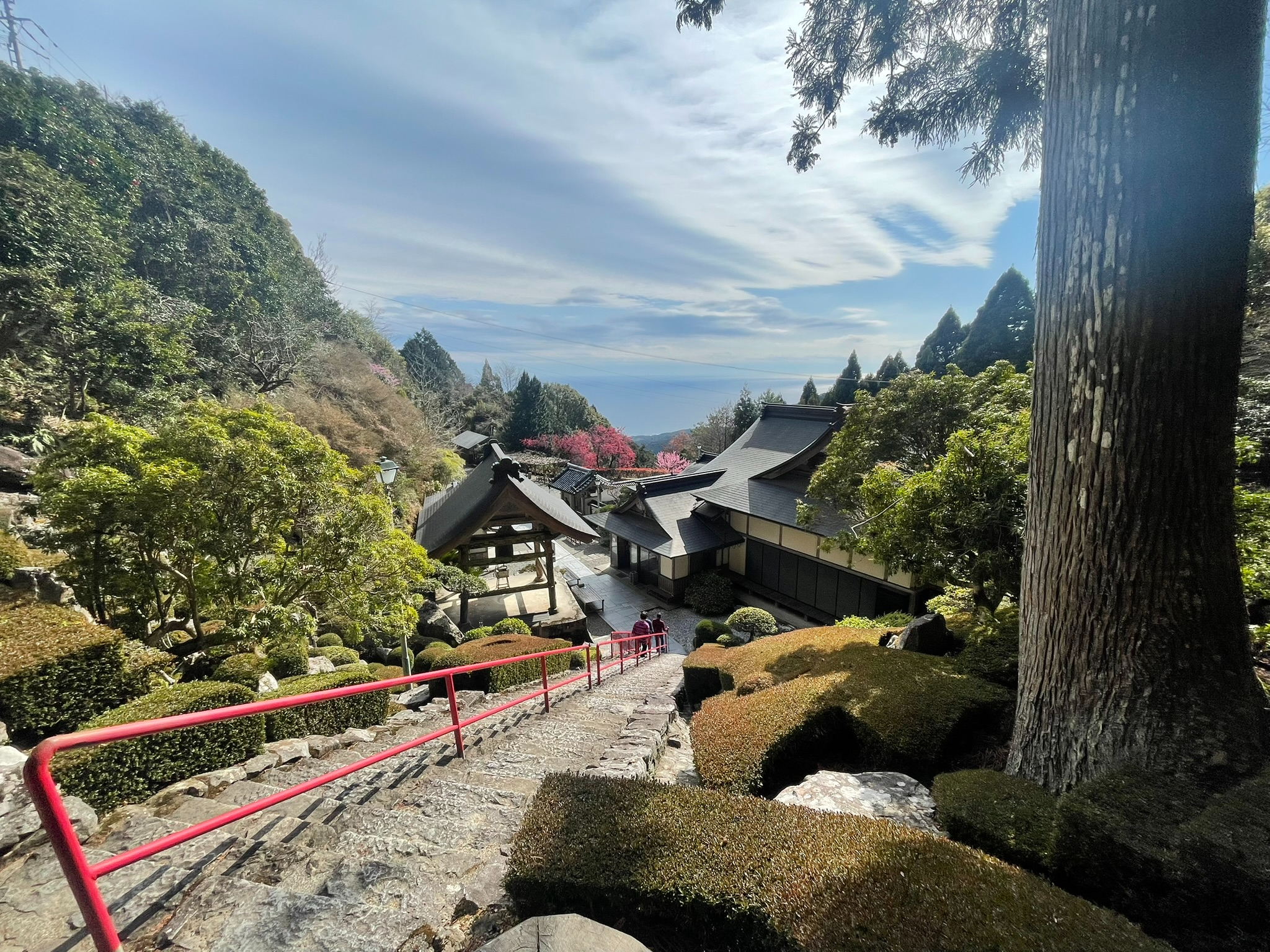
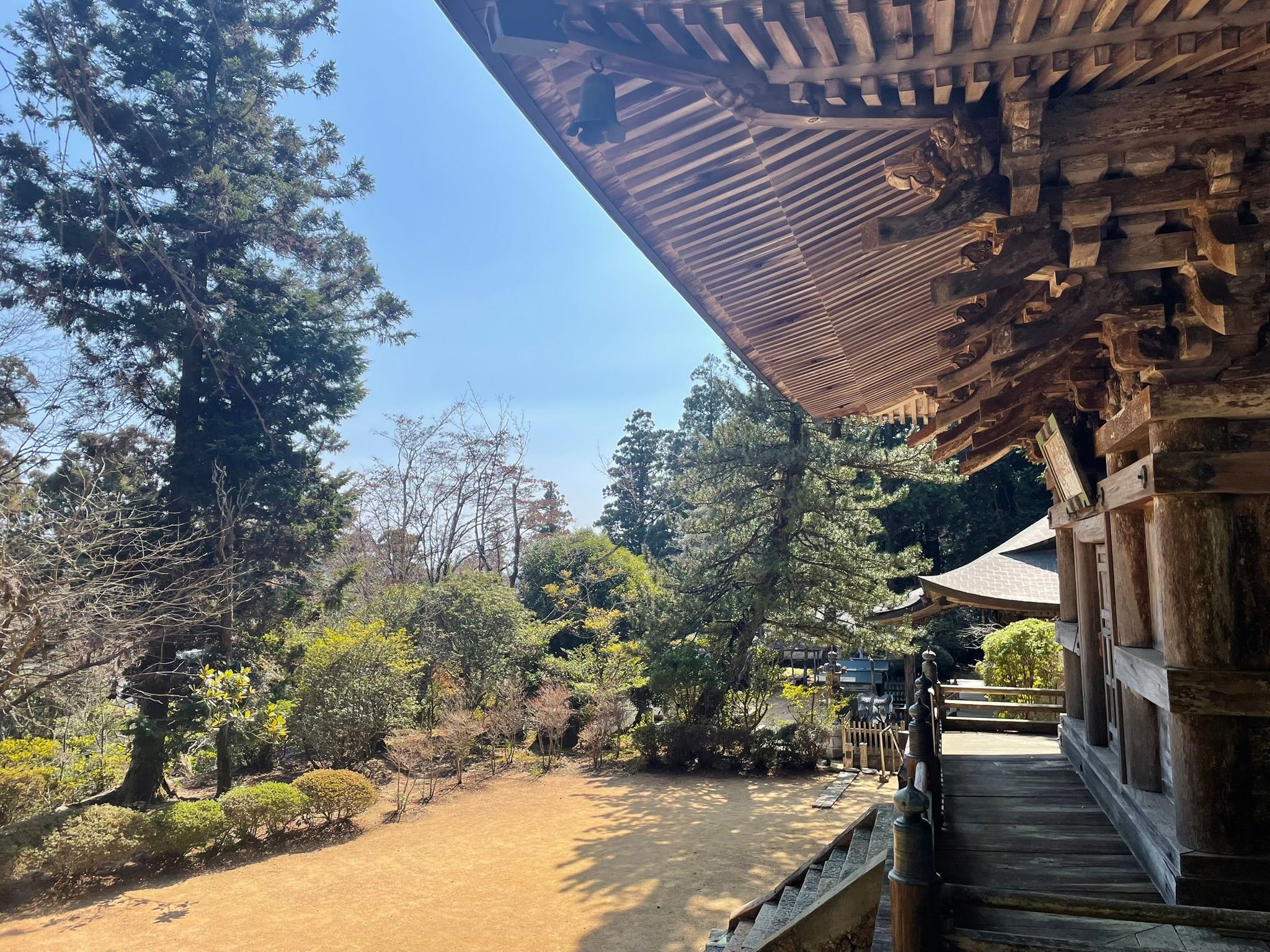
<p style="text-align: center;"><img src="/assets/images/mountain_temple_view.png" alt="Mountain temple view" width="500" /></p>

<p>Arriving at the temple, I took some time to take in the peace and tranquility of it and its surroundings. The gardens were well maintained, creating a contemplative atmosphere. I sat down opposite the main hall to listen to other Henro chanting the Sutras - something that always seemed to tingle some things deep inside me. Before making my way back down the mountain, I asked the Henro sat beside me what the ‘secret’ was for good health and happiness in Japan, to which he replied that he did not know. Perhaps I’d slowly find out during my trip.</p>

<p>Picking my bag up where I’d left it a few hours before, I looked at my map and decided that I’d press ahead to a place called Oyama to camp for the night. Tired, stomach empty, I plodded along, hugging the coast the whole way to Oyama Michi-no-eki. Arriving, I scouted out the area to look for a reasonably flat patch to camp, and found a place right next to the ‘Lover’s Sanctuary’ in Kono Park. Unfortunately, I did not have a lover, but that wasn’t the point of this trip. Not wanting to pitch my tent yet, I sat beside a man on the terrace to watch the sunset. Talking to him, he said that he lived nearby, and was undertaking the pilgrimage in sections. He was enjoying some food and a cold beer and looked like the kind of person who was peaceful and content within - enjoying the little things, carrying only the bare essentials on his back. We talked a little, my Japanese limiting the depth of conversation, before another person who was undoubtedly a Henro turned up. Decked out from head to toe in all the pilgrim attire, white trousers and shoes included, I asked whether he was also thinking of camping there that night. He said no, explaining that it was too early for him to sleep, and that he preferred to walk later into the evening until he felt like sleeping. In terms of where he was sleeping each night, he said that he only had a sleeping bag - no pad. He just lay on whatever surface he could find, so long as it was somewhat sheltered from the rain. I thought to myself that this guy was pretty hardcore, and that I should stop complaining about my thin camping mat.</p>

<p>After talking to and listening in on the two Japanese Henro’s conversations for a good part of an hour, the decked out stormtrooper was ready to leave and continue walking along the coast. I handed him a couple of sweet pans - strangely sweet Japanese bread - I’d been given as osettai just down the road. I wasn’t too hungry, having polished off the nuts that I had left, and, to my delight, the matcha flavoured pan that I gave him was his favourite. He gave me a protein bar in return before heading off. Asking the older Henro where he’d camp, he pointed to a sheltered section beside the building, explaining that his tent was a freestanding one, meaning that he didn’t need to peg it down. I’d contemplated getting such a tent before my trip, but decided to make do with what I already had. That night though, it would have been nice. Instead, I walked to the park and pitched my tent before doing some writing whilst watching the most serene, cloudless sunset of the trip so far. Once the sun had set below the horizon, I headed to bed for a long night’s sleep.</p>

<hr />
<p>Waking up, the inside of my tent was saturated with water, which confused me as it certainly hadn’t rained overnight. I must have pitched on a bit of dirt that was prone to generating lots of condensation. Packing up my wet tent, I was quick to get moving such that my hands didn’t get too cold in the cooler morning air. The older Japanese Henro had already packed down and left by the time I got moving towards Aki City. After an hour or so of walking, I arrived at Aki and decided that I’d take a detour off the Henro path to what was marked in my guidebook as ‘Samurai Residence Street’. It sounded cool, so I thought I’d go and take a look given that I was in no real rush to get anywhere. I passed through the suburbs of Aki, double-checking that I was going the right way a few times before arriving at the Samurai Residences. Confused, as there seemed to be nothing special about the area, I became a little agitated for taking a detour with no real reward. But, as always, I tried to view it as an important lesson - not to get your hopes up too much. Having not seen much, I headed back towards Aki via a different road before picking up some bits of food for breakfast. I looked at the map and realised that I’d get close to Kochi that night, this being the biggest city up to now by far. All I had to do was hug the coast for a few hours before heading inland towards Kochi’s suburbs.</p>

<p>Walking along the coast in heat that seemed to be increasing in intensity as the days went by, I stripped off the bottom part of my trousers for the first time on the pilgrimage. Passing through the villages of Akano, Ajiki, and Nishibun, I soon bumped into two Dutch pilgrims as I walked through a beachside pine forest. Anne Marie and Peter were a couple in their sixties or seventies who were walking the Henro together, having headed straight to Tokushima after finishing the Kumano Kodo - another, supposedly more taxing, although far shorter pilgrimage to the east of Shikoku. The Kumano Kodo, it transpires, is also the sister pilgrimage to the famous Camino de Santiago in Spain, with people who complete both being called dual-pilgrims. Cool, I thought, but I was content with only doing the Henro for now, not being one for ticking boxes and building up accolades unless I had a compelling reason to do so. But maybe I’d just not caught the bug yet.</p>

<p>The three of us walked together for the best part of the day, until arriving at the twenty-eighth temple, Dainichiji, not too far away from Kochi City. We mainly talked about life. Anne Marie was a Mathematics teacher, and their daughter had just completed a PhD in Mathematics at MIT. Peter was a psychologist, who had also spent a good part of his career teaching, but had recently retired to focus on other things. In 2021, seeing life slip away in front of him, he decided that, from then on, he wanted to spend at least half of each year walking. What started as a Camino, soon became a handful of Caminos, before spreading to a collection of different long-distance walks and pilgrimages across the world. When walking together with his wife, they’d rent out their place back home.</p>

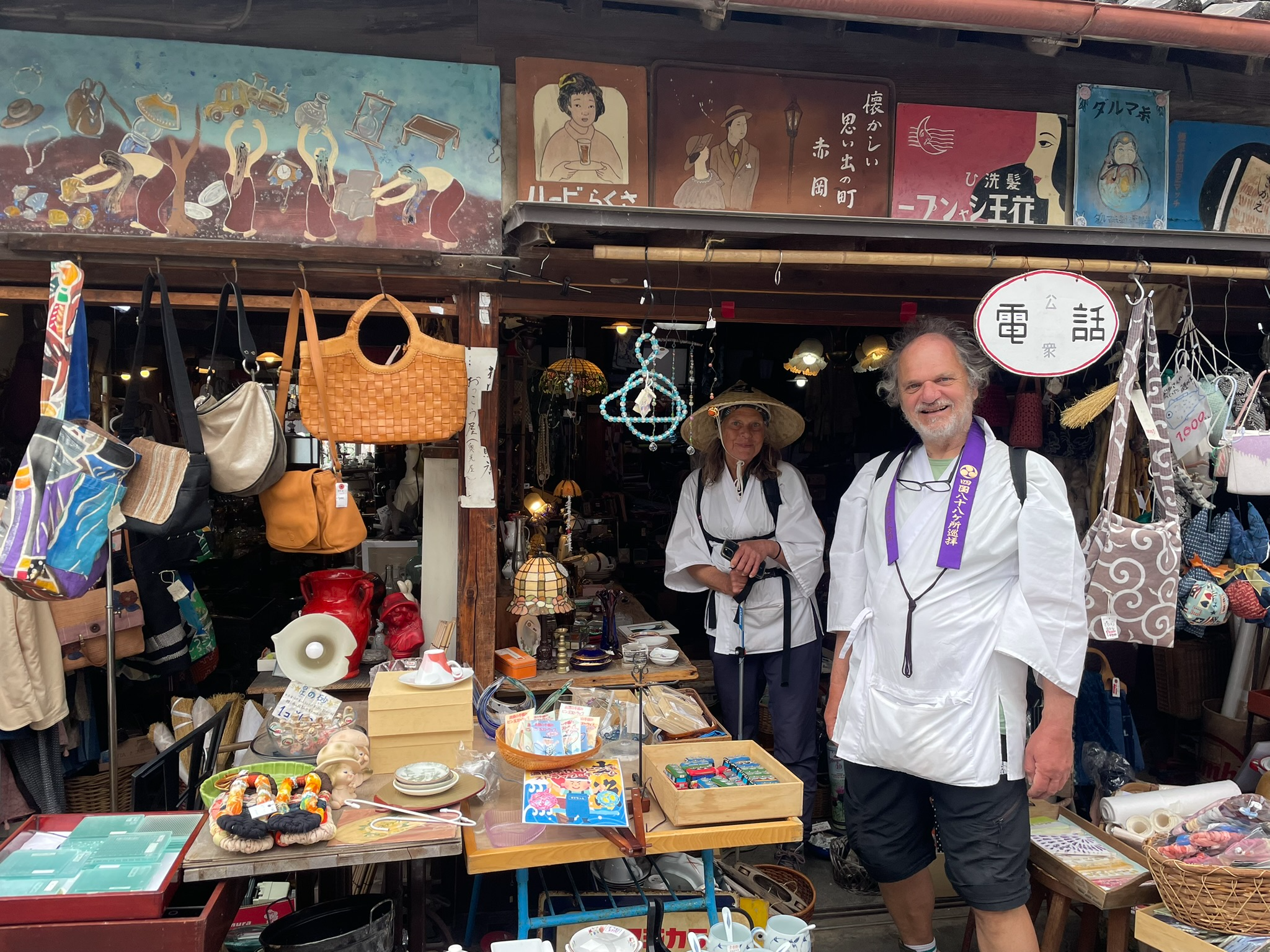
<p>Making our way to a fresh supermarket to buy some lunch - having told them about my super salad secret - we found ourselves walking down an eloquent street lined with small, independent Japanese shops. On the left-hand side, there was an antique shop with the most beautiful array of little things for sale. I’ve always had a soft spot for nice pottery and this shop certainly had very nice pottery, for very good prices. In the left-most room of the shop, the owner was sat talking and enjoying some tea with a young Japanese couple. Intrigued by three Europeans shopping around, they started talking to us. Soon, the shop owner had brought out a table and some chairs, as well as some gyozas, biscuits, and green tea as osettai. I asked the owner where the pottery was made, and she explained that they were a collection of works from various local crafts people. Looking around the shop at the same time was an American Henro called George. We agreed that today was tough due to the heat, and parted ways for now without saying much else. Leaving the shop, we thanked the lovely owner and young couple, before swinging by the nearby supermarket to grab some food. As custom by now, I sat on the floor outside the shop enjoying my big salad and let the experienced Dutch continue making their way to the next temple.</p>

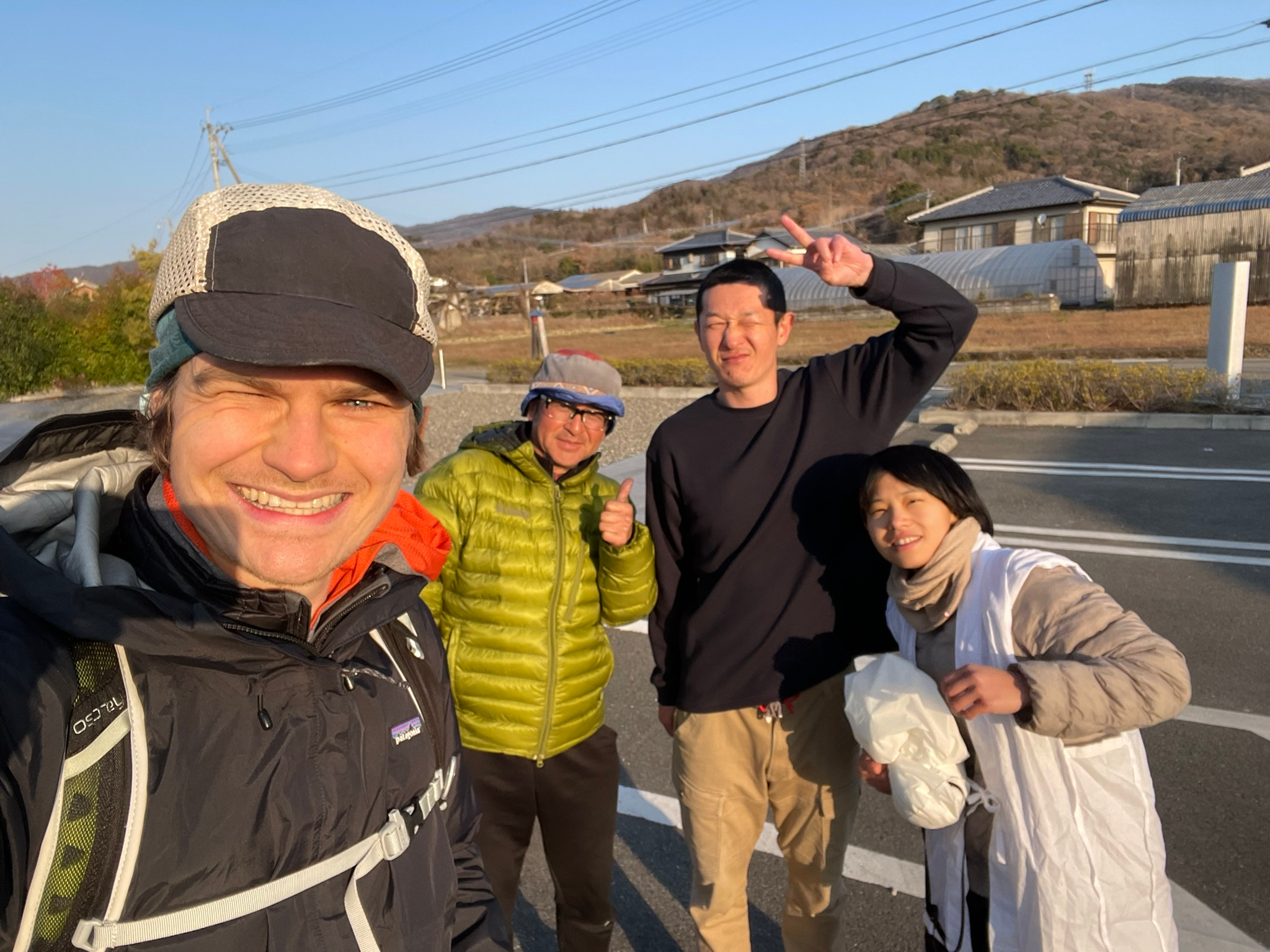
<p style="text-align: center;"><img src="/assets/images/dutch_henro.png" alt="Dutch Henro" width="500" /></p>

<p>For the next couple of hours, the walking was urban to say the least. Despite the Henro being 80% on roads, up to now, it hadn’t felt too urban, other than some of the stretches surrounding Tokushima. However, walking through the outskirts of Kochi, the roads became busier and the fumes from the car exhausts certainly made the air notably less fresh. Once again, however, I reminded myself not to complain and that this was a lesson in dealing with environments that weren’t necessarily ideal in my mind. Soon, I arrived at Dainichiji, feeling drained and low on energy. The Dutch Henro were getting ready to leave, having already performed their rituals, and were speaking to a German lady who said that she also hadn’t washed her trousers for over a week. This made me feel better for not having done a laundry yet…</p>

<p>Trying to decide what to do, I hung around the peaceful temple as the last pilgrims of the day came to collect their stamps. Deciding that I wanted to try to stay there, I asked whether the Tsuyado was available that night. Unfortunately, two French Henro had already beaten me to it, however, the nun offered for me to sleep in my tent on the temple grounds. Initially, I thought that this would be great, and put down my sleeping pad on a sheltered bench in a hut beside the temple office. However, I was soon overcome with restlessness and a desire to continue walking for the day - the evening sun luring me into some contemplative steps, the French Henro having passed on my offer to head to a local restaurant for dinner. Looking in my guidebook, I could see that there were a few Henro rest huts indicated on the map, all within a couple of hours of where I was. So I thought that I may as well walk until dusk and enjoy the nice sunset.</p>

<p>Crossing Toitajima bridge, I weaved my way through Kami City’s rice paddies. Feeling tremendously grateful to be alive and feeling deeply within me that life really is quite finite. There’s something about sunsets that invoke deep emotion - at least for me, anyway. I started the voice recorder on my phone and made a song up as I walked, its premise being how many of us take so many things for granted and that, the reality is, we could be gone any one of these days. One day, I’ll record this song properly and share it.</p>

<p>Having had my emotional release through singing, I passed not one, but three of the rest huts indicated on the map, with neither of them proving to be suitable to sleep in, unfortunately. Not too fussed about having to walk on further, I stopped at a Family Mart at a crossroads and bought some onigiri and egg omelette for dinner. Feeling energised, I left the convenience store and started walking down the straight road to my right. According to my map, it would take no longer than half an hour or so to make it to the next temple and another hour from there to the next Henro hut, Kamohara. Marching along the road with my head torch on, after around thirty minutes I started thinking where the left-hand turn to the temple was. Unsure, I checked my map and, to my disappointment, I’d managed to pop out of the Family Mart on the wrong road, so had been walking in a direction perpendicular to the route.</p>

<p>Picking myself up, I took a couple of small streets to rejoin the route shown in the map and soon made it to Kokubunji. Already dark, I was tired and really wanted to sleep. Looking around the temple, I couldn’t see a Tsuyado, but the disabled toilets on the grounds looked very cosy. However, in line with my vow not to sleep on any temple grounds or sacred sites without permission, I filled up my water bottles and continued making my way to the Henro hut around an hour away. A few kilometers before the rest hut, I could see a Lawson’s sign, and got excited that I’d be able to buy some food for breakfast the following morning. However, upon arriving at the entrance, it was clear that it was closed for the day. Instead, I continued walking towards the rest hut, picking up a warm can of coffee from a nearby vending machine to use as a hot water bottle in my sleeping bag. Finally, I arrived at the Henro hut. If you could call it that. I’d drawn the short straw, as it was essentially a glorified triangular shaped bus stop with a slanted bamboo bench wide enough for a small Japanese person to sit on. But I had no choice - it was late and dark, and I was done for the day, having been on my feet for well over 12 hours by now. At least I’d be sheltered from the rain. I put down my mat and slept with my hips digging into the outside wall of the hut, being awoken every so often by a car passing by on the road right beside me.</p>

<hr />

<p>Having had a less than ideal night’s sleep and given that I’d been walking for ten days without rest, my body was feeling a little worse for wear - my mind tired. I decided that it was time for a rest day. This would allow me to recuperate, do some laundry, and wash in my first onsen, as well as spend some time looking around Kochi. It was also a Saturday, meaning that tomorrow morning the famous weekly Sunday market close to Kochi’s city centre would be on. Being one of the most well-known markets in Japan, and myself being a lover of markets, I decided that this must be fate. I’d rest and chill today, head to the markets tomorrow morning, and then keep moving on.</p>

<p>After waking up in the bus-stop like shelter having had less than ideal sleep, I was keen to get moving and to find a vending machine where I could hydrate with some green tea. Making my way to the thirtieth temple, Zenrakuji, I picked up a green tea and enjoyed it before entering the temple. Leaving the temple, I asked a local whether they knew of any nearby laundromats and onsens. He suggested an onsen close to the centre a few kilometers away and a laundromat just down the road. I waddled my way along the main road to the laundromat and proceeded to strip off all of my clothes in the convenience store toilet next door, leaving me wearing only my waterproofs. I guess this is one of the logistical hurdles one faces when packing so light - at some point, you’ll need to wash all of your clothes at once. This seemed like a good workaround, though, given that I only had to walk for an hour or so to the onsen, where I could wash and change into clean clothes. I sat in the laundromat eating my breakfast, enjoying resting my legs. Once washed, I threw what I could in the extortionately priced and environmentally awful tumble dryer and hung all of my wool clothing outside on a railing in the sun. Once the clothes in the dryer were done, I packed them up nicely in my bag, hung the rest of my clothes off my rucksack like a walking clothes hanger, and slowly made my way to the onsen.</p>

<p>It turns out that I misunderstood what onsens were during my first few weeks in Japan. I assumed that all of these big places with hot baths and saunas were onsens, however, it turns out that onsens are unique in the fact that they are natural hot springs. This means that the hot water in some of the baths in onsens was heated purely by nature. Pretty cool. Anyway, at the time I didn’t know this nor do I think I cared. I was simply excited to finally have a proper wash after ten days.</p>

<p>Walking in to the ‘super public bath house’, everything was new to me. A sign told customers to take their shoes off, which I proceeded to do, and to place them in a locker near the entrance. I then asked the receptionist if I could use the baths, mentioning that this was my first time in a bath house. He pointed to the little vending machine to the left, telling me to first buy a ticket there. Not understanding the Kanji menu, he told me to choose the first option - 1000 yen for use of the place all day. Pretty good deal, I thought - it turns out this would be one of the more expensive washes of my trip, though. Ticket in hand, I gave it to the receptionist, who then gave me a locker key. I walked under the parted blue curtains hanging over the entrance to the men’s baths and was greeted with a changing room full of naked Japanese men. No, this wasn’t a surprise to me, as I knew before heading to Japan that nearly all bath houses required you to be clothesless. It was just different to any situation I’d been in before, so I think my brain was just confused. I found my locker, stripped off, and made sure to bring my water bottle into the bath house. I was hoping to sweat out all the toxins in my body by sitting in the sauna for as long as possible. Before entering, I filled up my water bottle and weighed myself. I’d lost nearly five kilos since the start of my trip, but I didn’t panic, as I still felt strong and trusted that my body had reached a new equilibrium suited towards long-distance hiking.</p>

<p>I entered the first room containing rows of mirrors and sinks with chairs in front of them. This is where one washed themselves sparkly clean before entering the baths. I sat down on a small plastic chair and looked at myself in the mirror. I was tired. Weathered. I could see. These next few hours would bring me back to life, I thought to myself. I washed a few days worth of sun cream and sweat off before heading straight to the cold bath to bathe for a few minutes before the sauna. I grabbed a small foam mat to sit on in the sauna before opening the door and walking in. It was huge! Not only that, but for some strange reason, there was a big television in the front, with multiple rows of wooden benches tiered as if in a small stadium. I took a seat in the corner, not particularly impressed by the television present in what was meant to be a space to relax… I sat for twelve minutes or so - the length of time the clock in front of me suggested - and then went back into the cold pool. I repeated this four times, feeling pretty wiped out by the end. Still intrigued by the various different indoor and outdoor baths, I did the rounds with them before heading back to the first room to wash off again. My first time in a bath house certainly didn’t disappoint. I felt like a new man, or should I say, pilgrim.</p>

<p>Leaving the changing rooms, I headed to the lounge area where people relaxed following bathing. Fascinated by the Manga libraries at the other end of the room, I headed into one to lie down. However, once I sat down, I realised that all the magazines were pink, so I left. Later, I was told that that was the women’s Manga library. Spotting a vending machine with milkshake-like drinks in it, I put in a couple hundred yen and chose one at random. At the time, it was the most delicious thing I’d ever drunk - smooth, refreshing, and full of fat. Dehydrated, I sat down near a table and continued drinking lots of water, chatting to an American who had lived in Japan for the past half a decade or so. He used to be a travel guide around Cape Muroto, so knew Shikoku very well. He suggested some places for me to head to in Kochi, as well as some highlights along the next section of the Henro. I thanked him and left to find somewhere for lunch.</p>

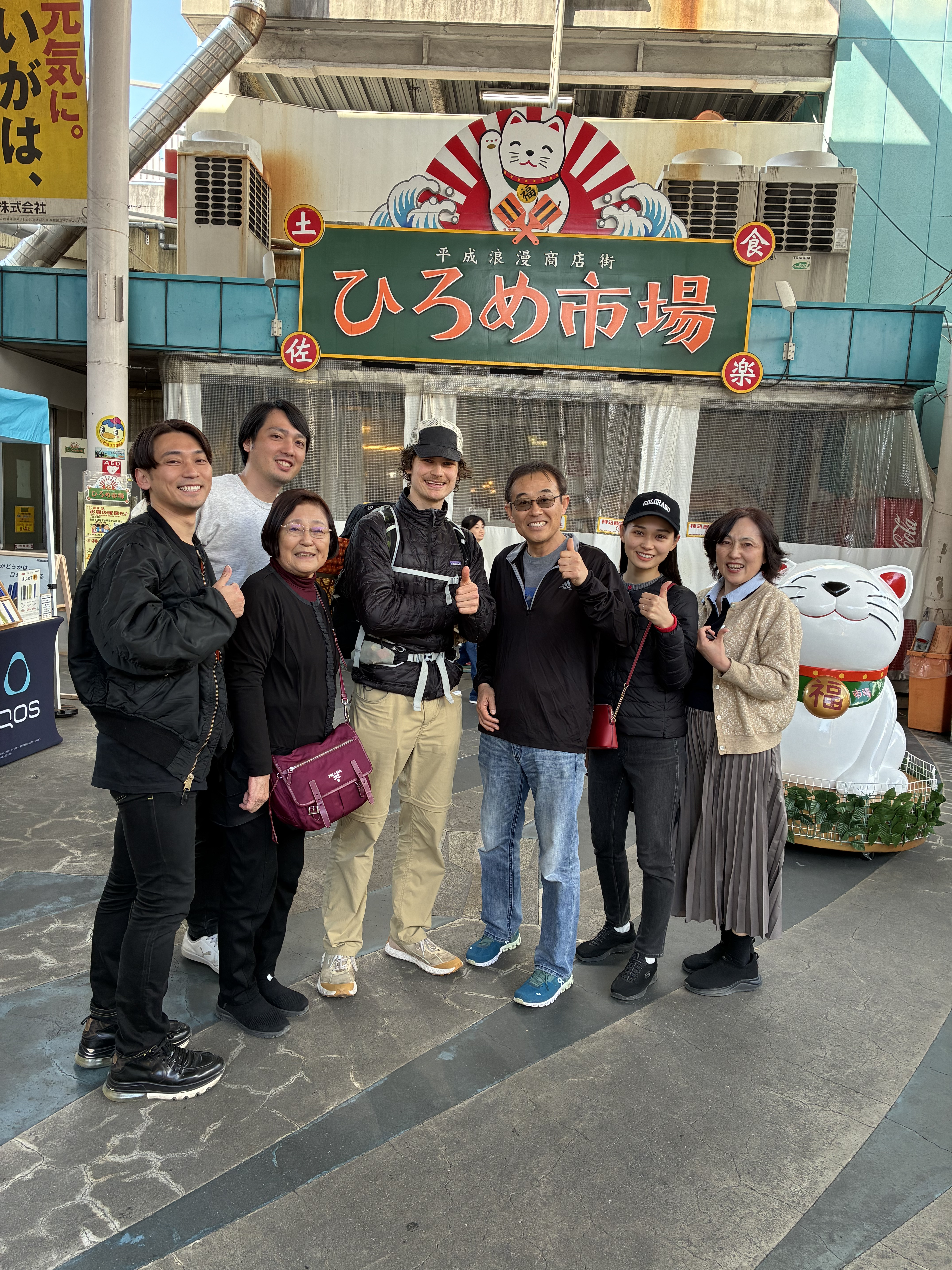
<p>Passing through a large roofed shopping street, I made my way towards a market that the American had recommended. Arriving at Hirome Market - one of the most famous indoor food markets in Japan -, I bumped into group of Japanese people who seemed to be struggling to take a picture of all of them together. I offered to take a picture of them but, to my surprise, they asked if they could have a picture <em>with</em> me. They were interested in what I was doing and why I was in Kochi. I told them I was a Henro, and asked them what they were doing. They were a family, and the father explained that his daughter had married the day before, so they were out celebrating as a family. Asking where the husband was, the young woman replied saying that he was out playing golf. I was concerned, but I guess things are just different in Japan.</p>

<p style="text-align: center;"><img src="/assets/images/IMG_6997.jpg" alt="Japanese Family" width="500" /></p>

<p>Entering the market was like entering the Tardis. From the outside, it doesn’t look too special - a small entrance with a cat painted above it and some curtains draped in front. But on the inside, woah, it was like something I’d never experienced before. Imagine the most popular London market, but everything is just cosier and cheaper. The atmosphere was incredible, with many locals and Japanese tourists enjoying the hundreds of different food stalls scattered around the market. I did a round of the whole market to see what was on offer, and decided on a Katsuo no Tataki stand that looked good. I ordered my food and then sat down to wait for someone to bring it over. Squeezing awkwardly between some people sat around a big table, wishing that I didn’t have my oversized sedge hat, I made conversation with some young Japanese university students who were in Kochi for the weekend. The bonito arrived and the tanginess of the ponzu sauce combined with the punchy green herb, shiso, was unbelievable. I was so happy and grateful to be eating such delicious food. As a side, I’d ordered some seaweed fritters. Their saltiness and crispiness was unlike anything I’d ever tasted. I was satisfied and satiated having eaten my tastiest meal of the trip so far. But the people sat to my right had other ideas. The couple, whose English was more limited than my Japanese, decided to start ordering some traditional Japanese foods from the various stalls for us to share together. I tried all kinds of different things and, by the end, was full to the brim. Some Germans who were excited to be in a place that served cheap beer then sat beside us and were happy to meet another English-speaking person.</p>

<p>Time passed quickly for the rest of the afternoon, as I talked to the young German, around my age -travelling with his Dad - about the motivation behind my pilgrimage. We discussed how we live in a hyper-stimulated world, where we’re often glued to our devices. I mentioned how I had no real interest in travelling much beyond Shikoku, as I’d come to Japan only with the intention of completing the Henro. We agreed that to keep chasing the next thing in life can end in burnout and depression, and that one should tread lightly when deciding to do something ambitious. Having eaten even more delicious food and tea that the Germans and Japanese couple kindly offered as osettai, I bid farewell to them for the time being, wanting to head to Kochi Castle to watch the sunset.</p>

<p>Sat watching the sunset, I reflected on my day of rest by writing in my journal. I thought to myself just how amazing the Japanese people were, and that there was no reason why I couldn’t learn from their generosity and practice it myself. The value and importance of social, human connection - in its rawest, purest sense - became apparent to me. I started experiencing what I’d heard about before visiting Japan - the Japanese people’s kindness and hospitality. I wanted to put myself out there, so I would talk to the locals whenever I bumped into them, and many of the best moments up to now had happened because I’d been confident without being arrogant. For me, the trip was as much a cultural experience as it was a spiritual journey.</p>

<p>Shortly after sitting down, I started talking to a lovely French woman stood nearby talking photos. I asked if she wanted to head back to the market with me to find some dinner. We walked there together and, after bumping into Kari wandering around the market with her two friends from home, we sat down next to three middle-aged Japanese people. At first, one particularly flirty lady thought that I was far older than I was, expressing amazement when I told her I was only twenty-three. Perhaps I really had aged over the past couple of weeks, or perhaps she’d had one too many cocktails? Despite this, she was incredibly kind and walked with me around the market, helping me decide what to eat for dinner. I ordered a Japanese omelette and some small bits to fill me up for the night. Polishing off my food, I said my farewells and walked across the river South of the city centre to find a place to camp. Looking for a spot in the dark, I gave up and settled for a small patch of grass in the woods beside what seemed to be a cemetery.</p>

<hr />

<p>I awoke to a local doing hill sprints on the path only a couple of meters away from my tent. Opening my tent door, I realised that I was far closer to the cemetery than I thought, but thankfully I was still far enough from any graves not to feel like I’d disrespected anyone. Packing up my stuff, I headed back across the bridge to the street where the Sunday Market was held. Not 7 am yet, I was worried that the market may not be open yet, however, to my surprise, whilst walking through the shopping street to the market’s entrance, there were already many people around. I walked down the street, looking for something tasty for breakfast. I tried some local honey, before buying some oranges to enjoy whilst sitting down watching people pass by. Seeing some rice balls that looked tasty, I bought some to have for breakfast with some purple sweet potato from a nearby stand. One stall was selling organic tea with plants that all grew on their farm and the girl running the stand spoke excellent English. She said that she’d been for an exchange in Canada during school, something uncommon in the UK, I told her. Her hope was to study abroad when older, and she explained how she always enjoyed the opportunity to practice her English. Feeling full of good food, I left the market and started making my way to the next temple.</p>

<p>Walking towards Chikurinji, I became a little lost as the detail on my map made it difficult to navigate the small side streets. I asked a local lady for directions to the temple, and she pointed up the hill. Reaching the temple atop the punchy climb, I bumped into George again. We talked about the heat making things more difficult, and George mentioned that he started making sure that he carved out time in the day at around 1 pm to sit down and write. I took inspiration, and viewed it as an important reminder not to rush around Shikoku. Yes, I wanted to walk all day, but if something caught my eye, or I felt like I wanted to rest, then I should do so. I reminded myself that I was out there to slow down and be present. To disconnect to reconnect with that that truly mattered. After pausing to think about things, George offered me to borrow his battery pack to charge my phone that had been dead for the past couple of days. I accepted his offer and made my way to the next temple, before leaving his battery pack with the nun at the temple office. She seemed a little confused as to what I was doing, but eventually gathered that my friend would pick it up when he passed by.</p>

<p>My next stop would be Katsurahama - a beach that the American I met at the onsen suggested that I visited. I walked across a cool looking bridge with a free public campsite called Tanazeki Park beneath it. People were enjoying spending the weekend cooking over barbecues and sleeping under the stars, which made me feel happy. After crossing the bridge, I dropped down some stairs to the beach and, after bumping into the French woman I’d shared dinner with the previous night, I parked myself on the warm black sand. Tired, I took a nap, feeling the warmth of the sand beneath me. After half an hour or so, I was awoken by rain starting to drizzle on my face. I picked up my bag and continued on my journey.</p>

<p>Soon after the thirty-third temple, the proper rain started. It was as if God had decided to release all of it’s stored water at once, the rain falling dense and hard. Not wanting to get cold, I continued walking intently towards the next temple, Tanemaji, passing Sakura blossoms that were starting to appear. Performing my rituals at the temple, my hands were becoming cold, and my rain jacket had long ago saturated, meaning that I was soaked through. Not knowing where I’d sleep that night, I asked the nun at the temple office whether there was a Tsuyado at the next temple. Given that it was only 4 pm, I, for some bizarre reason, decided that I’d continue walking, despite the torrential rain. She said that the Tsuyado was closed, but that they had space in their Tsuyado. In my haste, I decided that it was too early to stop walking. Clearly, I was too restless and scared of spending time doing <em>nothing</em>. Despite my earlier reflections, I put my foot down and marched my way towards Kiyotakiji, hoping to make it up and down the hill that it lay atop before losing light.</p>

<p>Losing light quicker than expected due to the dense clouds hanging in the sky above, I upped my pace as I arrived at the bottom of the hill to the temple. Under a road bridge, I bumped into a Japanese Henro sheltering from the rain, unable to find her accommodation for the night. I asked if there’s anything I could do to help, but she said she knew where it was, she just needed to check the map. Pushing on, I put on my head torch as the foliage above blocked any light that was left. Arriving at the top of the long staircase leading to the main gate, I looked around in the subtle hope that there’d be someone who felt bad for me being soaked through and perhaps offering me a place to stay for the night. Having no luck, I accepted that I’d have to push on for the evening to pitch my tent next to the river. Before leaving, I picked up a staff from a box of staffs next to the temple as I was concerned about the slippery downhill back towards Tosa City. Walking down the dark streets in the dim light of my head torch, I arrived at a Family Mart. Hungry and wet, I took off my jacket and hung it on the staff in the shop’s entrance. I bought some rice and pickled vegetables, heating the rice up in the microwave to help try to warm myself from the inside out. I called my parents whilst waiting for my clothes to dry off a little and soon headed back out into the rain with some peanuts and yogurt in my bag for breakfast.</p>

<p>Having also bought a big bottle shaped can of warm coffee to shove down the front of my jacket, I started warming up as I walked the last few kilometers to where I hoped to camp. Arriving at the river bank, I didn’t like the look of the lumpy grass but, luckily, there were a couple of rest huts with some thin benches that were sheltered from the rain. I chanced it and quietly stripped off my wet clothes, hanging them on the other benches, before snuggling into my sleeping bag on a make shift bed I’d made by pushing some worn out chairs towards the bench. With a local peering at me through his window, I turned around and fell fast asleep.</p>

<hr />

<p>This was my account of the first few days of my pilgrimage in Kochi prefecture, Shikoku. Being the prefecture of ascetic training, I had to dig deep many times. The next post continues down toward another cape, Cape Ashizuri, before finally hitting Ehime prefecture.</p>]]></content><author><name>elis parry</name><email>elis.parry@proton.me</email></author><category term="Shikoku Henro" /><category term="Spirituality" /><category term="Nature" /><category term="Simplicity" /><summary type="html"><![CDATA[Passing through the small fishing village of Kannoura, I felt full to the brim with the omurice that I had eaten for lunch. Not being able to resist the temptation of eating the snack bar I’d been given, I enjoyed it as I walked through Kannoura. I walked past a few inlets where fishing boats were tied up, the sun shining, and the reflections on the water’s still surface as clear as any I’d seen. Like most other fishing villages, this one was also quiet, with the occasional small Japanese car or truck passing by and a local tending to their garden. Turning the corner, I passed the Germans that I shared lunch with as they took a break overlooking the small docks. I wished them good luck for the rest of the journey and told them to make sure that they protect their skin. The Japanese sun was starting to become more intense and their pale complexion meant that they were starting to show signs of burning.]]></summary><media:thumbnail xmlns:media="http://search.yahoo.com/mrss/" url="https://elisparry.github.io/assets/images/dutch_henro.png" /><media:content medium="image" url="https://elisparry.github.io/assets/images/dutch_henro.png" xmlns:media="http://search.yahoo.com/mrss/" /></entry><entry><title type="html">A Solitary Swedish Runner</title><link href="https://elisparry.github.io/2026-06-11/a-solitary-swedish-runner" rel="alternate" type="text/html" title="A Solitary Swedish Runner" /><published>2026-06-11T00:00:00+00:00</published><updated>2026-06-11T00:00:00+00:00</updated><id>https://elisparry.github.io/2026-06-11/a-solitary-swedish-runner</id><content type="html" xml:base="https://elisparry.github.io/2026-06-11/a-solitary-swedish-runner"><![CDATA[<p>Have you ever wondered what the anti-thesis to commercialised, performance-centric running is? Have you ever felt like you are merely chasing numbers, the superficial quantifiable? Have you felt your joy being slowly sapped from your running? These were all things that a promising young Swedish runner contemplated towards the end of his teenage running years. He was a successful runner in the conventional sense - running fast times, clocking big distances, progressing along a promising trajectory as one of the best in the country. But a foot injury picked up during a training camp in Austria made him reconsider his running and life more generally. He no longer enjoyed running like he used to and developed a general feeling of anger towards modern society and the way that things were run (no pun intended).</p>

<p>Shortly after his injury, he decided that what he needed was to head to the forest to live alone for some time. To, in the words of Henry David Thoreau, “live deliberately, to front only the essential facts of life”; stripping things back to the fundamentals in order to begin to clearly see what was truly important. Following living in a forest in a canvas tent for four years, struggling through multiple cold winters, having to fend entirely for himself, he later reintegrated into society after meeting a woman who he would later marry. Ever since, he has continued running every day, but no longer runs as part of a procession nor trend, but to simply connect to his body and surroundings. Today, many Swedish runners, both young and old, find inspiration in his writing and speaking, and he often gives talks about his experiences and approach to running across the continent.</p>

<p>His name is Markus Torgeby and, having re-read his book after initially deeply resonating with his experiences, I’ve decided to touch on some of my immediate reflections, giving my own insight and perspective and relating them to my experiences as much as possible.</p>

<h1 id="becoming-your-own-coach">Becoming your own coach</h1>

<p>When talking to an older friend of his who worked at the school that he attended, Markus is told that the only way for him to go forward is by becoming his own coach. Not forward in the sense of improving performance, but instead in the sense of developing contentment and satisfaction in his life. Having been pursuing results and achievement for most of his running years, his friend could tell that it had taken its toll on him - sapping his Soul and energy. He suggested that he moved away from the one-dimensional, which would allow him to use his running as a way of becoming a better human being. This was the conversation that instigated Markus’ decision to head to the woods. He clearly knew, deep down, that his present approach to running no longer served him and that a change was needed.</p>

<p>Truthfully, no one knows your body better than you do. We’re often told that we need some new fancy gadgets to help us train and recover but we are our own real masters. Yes, it’s certainly not easy to become your own coach, requiring tremendous discipline and self-drive, but once you start properly tapping into your mind and body, then a different kind of potential can be achieved. Not ‘athletic potential’ in the conventional sense, but a deeper spiritual potential.</p>

<p>This is not to say that I believe no one should be coached. I see great value in having a coach during the early stages of one’s running journey; however, after a certain point or threshold, that only you can feel, having a coach may only act to interfere with your own rhythms. Personally, I needed to go through the phase of chasing times and metrics to <em>realise</em> that an alternative existed. By experiencing the emotions associated with the incessant pursuit of success and performance only in the narrow-minded sense, I was able to conclude that it did not in fact bring <em>me</em> happiness. Notice the emphasis on the me, as I can only share my own experience, which may or may not differ greatly from yours. Don’t also think that once you drop all preconceived notions that you have about what running is really about that you’ll start floating along the trails with no issues. I’ve in fact found that quite the opposite is true at first, since much inner work starts needing to be done to face and address the impurities of mind that may have been driving you to chase the quantifiable.</p>

<h1 id="the-plasticity-of-ordinary-existence">The plasticity of ordinary existence</h1>
<p>Not all reflections that Markus makes are related to running. As mentioned, his realisation that he needed to change something was simply sparked by a running injury, but the turmoil and anguish that he felt was more complex than this. They pertained to his general view that much of what society was doing was <em>plastic</em>, explaining that he did not want to have to spend his time choosing between different kinds of “shit”. Instead, he wishes for the choices that he makes to have concrete consequences in the world. If he does something wrong, he wants to have to pay the price for it. If he does something right, then he shall reap the rewards of his work. Now, reflecting on this, I think about the yogic law of Karma mentioned in the Bhagavad Gita - that every action - thoughts included - has a consequence.</p>

<p>Often, we act in ways that are merely concerned with ourselves due to a conditioned sense of egotism, but, more often than not, we do not consider the <em>consequences</em> of how we act. We might say something mean to someone when caught up in anger, or even think about certain things that are impure. This is why I believe that Markus’ want is actually already fulfilled, as all of our actions ultimately have consequences, they just may not be explicit or obvious - perhaps because they’re outsourced or deliberately ignored. In saying this, I do see his view point. Take, for example, having to decide which box set to start binge watching or having to decide whether to light a fire in the woods so that your fingers don’t develop frost bite. Clearly, there are some actions (or inactions) that have more literal consequences in the physical world. Markus does not want to have to make decisions between a thousand different petty things, and instead wants to strip things back to primitive basics.</p>

<p>His choice of the word plastic is also fitting, in my view. By now, we’re aware that the proliferation of plastic is leading to wide-scale ecological destruction, undermining our personal and planetary health. With literal plastic, it’s easy to imagine how it breaks down into microplastics which then enter water ways that lead to the oceans and, boom, all of a sudden you’ve got plastic everywhere. It’s also easy to see the amount of cheap junk that lines shop shelves all over the world simply because the market has facilitated the production of said junk. Visually, we <em>see</em> clutter and we are starting to <em>feel</em> the effect of the plastic problem. However, there’s also the metaphorical plastic nature of things, which is what Markus is referring to. The single-use, temperamental nature of plastic. The concerning ubiquity of products derived from plastic. These are analogues of aspects of present day society. Where we value short term gratification and reward over long term satisfaction and health. Where we have little independence and creativity of thought and, instead, sail away with the fickle winds of news and social media. Where we live in a delusion that we can continue performing actions that are deteriorating the fabric of society and the Earth and expect there to be no explicit consequences. Where information networks are now being formed upon and moulded by fragile foundations built by only a select few individuals in power. Where a monopoly of big corporations have their fingers in many more pies than imaginable, with fossil-fuel derived plastic products, ironically, being one such example.</p>

<p>What concerns me is that since the time of Markus writing his book in 2018, both he metaphorical and literal plasticity of the world have continued increasing. Despite some awareness of the impact of the proliferation of AI - which in Mike Berners-Lee’s words, is somewhat a mirror to the proliferation of plastic, which existed not until the Twentieth century -, we’re continuing to allow it to infiltrate nearly every little corner of our lives. While living in the woods, Markus has no TV or radio to feed on others’ opinions and, instead, experiences life and it’s beautiful mundanity <em>as it is</em>. I think that society would be better off if we at least protected some our time for doing nothing other than observing oneself and nature, because <em>protecting</em> our time is what is needed now that we can, if we choose, to be constantly stimulated and distracted.</p>

<h1 id="overcoming-restlessness">Overcoming restlessness</h1>
<p>Related to doing nothing is restlessness. When restless, doing nothing is incredibly difficult. We feel like we have ants in our pants and that our dopamine hungry brains are not being fed. Boredom strikes us, but only because we’re caught up in this ideology of productivity and efficiency, where simply doing <em>nothing</em> is seen as wasteful.</p>

<p>Having been in the woods for a couple of months, Markus realises that he is incredibly restless. He feels like he should always be doing <em>something</em> and struggles to sit still. Therefore, to try to combat this restlessness, he decides to sit on a tree stump all day. He continues doing this for a couple of months until his restlessness is dealt with. Reading this passage, I couldn’t help but see the mirror of myself. As I currently do not work, I have much free time on my hands. Consequently, I have started noticing how restless I am unless preoccupied, even feeling so after long days of hiking during my pilgrimage in Japan. I know that such restlessness’ root is deep in one’s mind, but also believe that it is related to this notion of always needing to be doing something. Ironically, a consequence of such feelings is often feeling like I am captivated in the box of my psyche, like and animal confined in a zoo. But an animal only feels confined in a zoo as there are walls surrounding it, no different to the walls of my psyche. The treatment to my restlessness is, I truly believe, to become better at doing nothing, such that the walls of the psyche developed from past conditioning start to develop peek-holes to another way of being. To realise that having lots of time to do <em>nothing</em> is perhaps the greatest gift that one can be given.</p>

<p>Instead of ignoring such feelings of restlessness and running away from them, I am determined to sit with them until I can arrive at a place of peace. This work will be difficult. I attempted to do this by attending a Vipassana 10 day silent meditation last November, but I am not naive, and know that much work is still needed for me to arrive at a place where the state of boredom is a thing of the past; where solitude is pure bliss. How I will do this, I do not know, but meditation - including future Vipassanas - will certainly be a central component.</p>

<p>Sometimes, having lots of time “to do not very much” like Markus says is precisely what is needed. Our time needn’t always be filled or viewed as something to be spent. This view of time is aligned with the way we view the economy that’s constructed in present society. Time as a currency to be spent, just like money. But this creates the notion that, like money, depending on how we spend our time, we can derive different value from it. This ideology isn’t intrinsically flawed, but in a playing field where productivity is given almost utmost priority, we can start being caught up in spending only regards to whether that thing is seen as productive or not in the capitalist sense.</p>

<h1 id="appreciating-more-without">Appreciating more, without</h1>
<p>For some time now, I’ve believed that lots of things that we ‘have’ in our lives simply distract us from the things that nourish the Soul and that truly matter. Of course, this is only my opinion, but it’s also not been clear cut. Sometimes, I’ve had to fight internal battles as I’ve often thought - about various things - that you don’t want to go too far to the other end of the spectrum such that tremendous energy is wasted in trying <em>not</em> to do or have something. But then I remind myself that I am incredibly privileged and lucky and that with that comes a choice as to how I exercise my privilege. I do not wish to misuse it, as this causes many problems, like we can see in the world today. Instead, I believe that doing without by choice is a better way of exercising such privilege. That way, I can explore what changes when I do so and, hopefully, lead by example and help inspire others to live in closer alignment with Nature and, in the words of Gandhi, “live simply so that others may simply live”.</p>

<p>What I mean by doing without to appreciate more might be unclear, so a simple analogy may help. Consider a cake. If I were to eat a whole cake every day, then I’d soon numb my sensitivity and appreciation for said cake. Alternatively, an individual slice of cake only eaten on certain special occasions will generate far different feelings and emotions, likely bringing feelings of joy and gratitude. Markus’ is inspiring in the way that he clearly appreciates the small things. He comes back from long days running in the forest or chopping wood for fire, and describes making some porridge over the fire in a way that clearly shows his deep sense of appreciation for having warm food to eat. I also like porridge, and deliberately choose to make my porridge in the slowest way possible whenever I eat it for breakfast. Using big oats and water, slowly simmering it away for a good fifteen minutes. Yes, I could have used instant porridge, but then I’d lose the enforced pause created by having to overlook my porridge cooking, denying myself of the clarity of though that accompanies this seemingly meaningless task.</p>

<p>Reducing your life to its basic needs and ridding anything that’s superfluous is, similarly, a way of regaining the sensitivity that is lost when everything is available in stark abundance. That’s not to say that it is easy. In fact, by freeing up space and time, one has to start facing and working through one’s mental defilements - a lengthy process that’s never truly finished. Personally, I am fascinated with the extent to which I can go without and to explore where the sweet spot lies between having too little, or too much. I suspect that it is far closer to the former than the latter.</p>

<h1 id="endless-extremes">Endless extremes</h1>
<p>One of my favourite lines from the book, and a line that Markus closes his documentary is the following:</p>
<blockquote>
  <p>If I have to keep exposing myself to ever greater challenges in order to achieve the same emotions, then I must be doing something wrong.</p>
</blockquote>

<p>Why is this the line that I resonate most with in the book? Because this is something that I have come to painfully and slowly realise for myself - that the pursuit of extremes, challenges, pain, and suffering is in fact a symptom of an unsettled and discontent mind. It’s also something that I believe I’ve made much progress with over the past couple of years. I spent much of my late teens and early adult life pursuing various goals - many of which could be quantified - and constantly setting myself ever greater challenges. In academia, success one year only ever catalysed the desire to do better and succeed the following year, to the point that I eventually became numb to said ‘successes’. In my running, it was never enough just to enjoy running comfortably within my limits and boundaries and, instead, I persistently sought out more in my running. It’s not that I don’t think we should set ourselves ambitious goals and shoot for the stars, but this need not mean pursuing numbers.</p>

<p>Initially, pushing the extremes in my running looked like going further, faster, and being stronger et. cetera, but my perspective has since shifted. I now view my running as an act of self-transcendence, but know that the emotions that it invokes can also be accessed by other means - through meditation, for example. I’ve also come to realise that we often mix up the emotions that we feel and their origins. The mind does not care about our pace or heart rate - it cares about the degree of non-separation that there is between mind, body, and nature. The emotions experienced as part of a so called runners high do not require one to become the best runner in the town, country, or the world. They arise from the sensory dance from within and the surrounding sensory landscape.</p>

<p>So, what do I think is the reason for us arriving at a place, like Markus, where we pursue endless extremes? We live in a capitalist society whose groundwork, from a merely economical standpoint, is dissipating and spreading like disease across the population. We’re being conditioned, knowingly or not, to value not what someone <em>feels</em> or <em>offers</em> from their heart but, instead, things that indicate growth, success, and performance in the economic sense. The superficial quantifiable. Consequently, many simple things have transformed into ego-battles between dissatisfied individuals who are <em>projecting</em> their insecurities instead of <em>addressing</em> them. We’ve started resorting to pursuing greater extremes to even feel <em>anything</em>, but this need not be the case. The present desensitisation can be reversed if we reduce things to the essential.</p>

<p>We’re led to believe that by pursuing greater and greater goal posts, then we’ll always be satisfied in life. So why, then, are so many people discontent and restless? Because we’ve sapped the sensitivity of mind that’s required to still be moved by even the smallest of things by persistently bombarding ourselves with unnecessary information. The capitalist model has engrained the idea of life as a pyramid, or mountain to be climbed, in our minds - just like that pyramid that’s shown to us during any induction to a corporate job. But would one rather climb an endless pyramid all their life or, instead, be content with exploring what the lowlands have to offer? Perhaps then one will stumble upon a mode of flying that takes them off to the skies in the spiritual sense.</p>

<p>Something is certainly wrong if the only way that one can derive life satisfaction is through the continuous pursuit of greater feats. Perhaps we should look at how we undertake the simplest of things in life, noticing if any hastiness or rush is present. This could become our next challenge. To be present. It’s certainly one that I am trying to explore.</p>

<h1 id="a-bursting-bubble">A bursting bubble?</h1>

<p>Back to running, towards the end of the book, Markus discusses the current increasing interest in running. He thinks about whether the currently interest in running can be sustained, but says that this would not matter to him, as he will “continue to use his legs to make new discoveries”. The first thing I wrote down in my journal after reading this line was the following - “this is why I run too, and I’ve been depriving myself of it”. When I started running, I loved moving my body through my environment, exploring my surroundings, and being in nature. Over the years, as my running became more mechanical and regimented, I lost most of this. It took an ankle sprain last year for me to realise this, and to see that I could still use my running as a way of making new discoveries - about myself, others, and nature.</p>

<p>I talk a lot about finding your <em>why</em> - the true intrinsic reasons for why you run. The reason for this is precisely the reason why Markus is wondering whether the present interest in running will last. Don’t get me wrong, it’s great that more and more people are running and realising it’s power in making them a better person, if done for the right reasons. However, I sometimes think whether the ship is being steered by the right motives and people. If we run for extrinsic reasons merely, then these motivations will soon fade away and leave us questioning why we run. Funnily, at this point, I believe that if one cannot find a compelling personal reason as to why they want to run, then they should simply not run. We don’t all need to be running and we shouldn’t feel like we need to hop onto what’s certainly a trend in current times. If you prefer painting or cycling, then do those instead. But the catch here is that I believe that once people realise how powerful running can be to make new discoveries, then they will want to continue running. Not in an unsustainable, ego-driven way, but in a way that makes them a better human being, just like Markus chose to do.</p>

<h1 id="ignoring-the-rubbish">Ignoring the rubbish</h1>
<p>The final thing I’d like to touch on is the rubbish. One day, Markus is asked to help coach a bunch of nordic skiers how to run. For the most part, the skiers run with good, natural, form. Observing the runners, it makes Markus think about how simple running is - that it’s a thing that we’re born to do. He then mentions how he’s confused about why there are so many rubbish running shoes with thick soles that make it difficult to run how we’re naturally meant to. It’s a simple thing that everyone can do - it doesn’t require, like Markus points out, NASA engineered shoes. The industry is simply releasing products to solve problems that were long ago solved. There’s “all this useless stuff being developed, which in many cases is just about consumption”. This couldn’t be further from the truth. New gadgets, kit, nutrition products popping up all of the time, promising to make us as a better runner. I learnt a new term from a friend the other week - maxing. All of this stuff just sounds like a daft way of run-maxing to me - trying to maximise our running, again, in a way aligned with the capitalist mindset.</p>

<p>Another rubbish fad is diets. Diets don’t work because every individual is different. There’s so much crap around these days talking about different diets. I’ve fallen prey to it myself, trying low carb, high carb, and all the rest. But, the truth is, only <em>I</em> can know what’s good for me and how <em>I</em> feel. The same is true for you. As Markus says, though, the reason why big companies don’t just tell us this is because we can’t package “your own responsibility” into a marketable product that can create profit. Personally, I now ignore diets and do what we’ve done for thousands of years before food became so complicated - eat whole, hearty, unprocessed food.</p>

<hr />

<p>In an era where running is booming, it’s important to remember what running really is. It’s a dance. A movement of a free human being. But, truthfully, as Markus ends with saying, only us can decide how we live our life and what the meaning of life is. There’s no blueprint to follow, and my life is only one example of a life.</p>

<p>Carve your own path.</p>]]></content><author><name>elis parry</name><email>elis.parry@proton.me</email></author><category term="Running" /><category term="simplicity" /><category term="lifestyle" /><category term="nature" /><summary type="html"><![CDATA[Have you ever wondered what the anti-thesis to commercialised, performance-centric running is? Have you ever felt like you are merely chasing numbers, the superficial quantifiable? Have you felt your joy being slowly sapped from your running? These were all things that a promising young Swedish runner contemplated towards the end of his teenage running years. He was a successful runner in the conventional sense - running fast times, clocking big distances, progressing along a promising trajectory as one of the best in the country. But a foot injury picked up during a training camp in Austria made him reconsider his running and life more generally. He no longer enjoyed running like he used to and developed a general feeling of anger towards modern society and the way that things were run (no pun intended).]]></summary><media:thumbnail xmlns:media="http://search.yahoo.com/mrss/" url="https://elisparry.github.io/assets/images/woods_sandals.JPG" /><media:content medium="image" url="https://elisparry.github.io/assets/images/woods_sandals.JPG" xmlns:media="http://search.yahoo.com/mrss/" /></entry><entry><title type="html">Tranquil Tokushima</title><link href="https://elisparry.github.io/2026-06-04/tranquil-tokushima" rel="alternate" type="text/html" title="Tranquil Tokushima" /><published>2026-06-04T00:00:00+00:00</published><updated>2026-06-04T00:00:00+00:00</updated><id>https://elisparry.github.io/2026-06-04/tranquil-tokushima</id><content type="html" xml:base="https://elisparry.github.io/2026-06-04/tranquil-tokushima"><![CDATA[<p>From sleeping beside ancient temples to rolling along jagged cliffsides, the Shikoku Henro was certainly an exciting journey. Having been back in Wales for a week, I wanted to sit down and start writing up about this trip of a lifetime. Initially, I’d planned on keeping a detailed diary along the way; however, I soon decided that the diary formed in my memory would suffice. That way, when recollecting the journey, the things that impacted me and stuck with me would surface organically to create a shortened narrative, but one not lacking in depth. The few things that I did write in my diary, along with the pictures that I took along the way, will help form the skeleton of my writing. However, before I discuss my pilgrimage, it may be useful to roll back the clock a few months.</p>

<p>At the start of the year, I decided that I’d like to slow things down a little. Instead of jumping into another running training block, I wanted to make the most of my time between jobs to do something different. This coincided with a time in my life where my interest in spirituality was increasing, particularly aspects of the Buddhist philosophy. I’d attended a 10-day Vipassana silent meditation a couple of months prior, and had spent much time meditating, given that I was sidelined from running with an ankle sprain. The Vipassana, in hindsight, was nothing short of life-changing, and I now felt like I understood the power of observing the mind. This realisation moved me away from the naïve mentality that the best way of developing the mind is to undergo difficult challenges - running ultramarathons, reading many books, walking very far. I realised that the physical is merely a manifestation of the mental and, therefore, the former can only get you so far without developing and nurturing the latter. I began to wonder why we often devote so much time and energy to exerting ourselves physically, often entirely neglecting our minds, especially in the world of running. I started viewing things as a continuum between the mental and physical, as a sliding scale between different states. On one side of the scale, there’s the purely mental, or at least from a naïve standpoint. Stereotypical meditation, where one sits cross-legged with their eyes shut, might fall here. On the other side of the scale lies the purely physical. Again, from the naïve standpoint, this may be deadlifting a heavy weight. Then there are things that fall in between these, like running ultramarathons, for example. What I realised, however, is that any physical exertion is simply a manifestation of the mind, so I started to wonder why I pay far less attention to the sensitive mind than the superficial physical. I decided that, despite being a continuum scale, true physical self-transcendence can only be accessed if one patiently works on developing the mind. So, leading up to my next race in September, I decided that I wanted to explore <em>my</em> mind’s untapped potential.</p>

<p>With this in mind (no pun intended), I decided that I wanted to go on a pilgrimage. Specifically, one on foot. The primary goal being to become a better person and to help further dissolve the ego, something I believe is at the root of much of the turmoil I’ve experienced during my life. This seemed like a good sweet spot on the continuum scale, as I’d be able to meditate while walking, which itself is a physical act. My hope was that this would allow me to notice the interplay and synergy between the mind and body experientially, not just by reading texts and books that simply act to accumulate surface-level knowledge instead of wisdom. Regardless, I’d been thinking of going on a long-distance hike for some time, so I started looking for pilgrimages that I could do on foot that would take around two months to complete. This helped constrain my options, and I soon stumbled upon a <a href="https://www.nationalgeographic.com/travel/article/hike-shikoku-henro-thousand-year-old-spiritual-island-pilgrimage-japan">National Geographic article</a> mentioning a pilgrimage in Japan called the Shikoku Henro. A “spiritual lift” sounded like exactly what I needed, and the route seemed cool - a journey on foot circumnavigating the smallest of the four main Japanese islands, visiting 88 Shingon Buddhism temples along the way. Having started digging into more information about the pilgrimage, I realised that it was quite an esoteric thing to do, with Shingon itself being a school of Japanese Esoteric Buddhism. I was still unsure, however, as I avoid flying wherever possible, and having checked the price of the trans-Siberian railway, which was nearly £15,000 one-way, I’d have no option but to fly. Perhaps I should settle on one of the Caminos instead? But after calling a close friend to discuss my options, I decided to press ahead. I knew that the culture would be nothing like I was used to, having never travelled outside of Europe. I knew that this would be a trip of a lifetime. Flights booked, I was excited to leave in a couple of months’ time.</p>

<p>Before heading out to Japan, I needed to make sure that I had everything I needed for a long distance hike. Aiming to consume as little as possible, I first checked what I already had. Then, anything else that I didn’t have, I bought second hand or from ethical outdoor brands. I planned on carrying the bare minimum, with a part of the pilgrimage being about surviving with less, relying less on the external to facilitate tapping into the internal. However, I expected it to still be cold at night when I arrived in Japan, so I wanted to make sure that I would be warm enough when sleeping. I’d also heard that when it rained in Japan, it rained, so I took a waterproof coat and trousers to stay dry. Having made sure that I had everything I needed, spending far too much time getting caught up in petty details about kit, I was ready to head to Japan. But there was one last important thing to buy before heading out - the guidebook for the pilgrimage. I planned to rely as little as possible on navigating using my phone, having been running and walking without a GPS watch since last August, as part of a project that I’ve started called joyrun. This meant that the maps in the guidebook would be my primary way of navigating the island. To aid with this, I also took the time to listen to a great <a href="https://open.spotify.com/show/76ypjsojlw0i7hTwhV27AH">foundational Japanese audiobook</a> so that I could at least converse a little with the locals when lost. Learning a new language was fun and turned out to be a very worthwhile investment.</p>

<p>For those interested in what I packed, everything I took is shown in the photo below. To sleep, I had a sleeping mat, bag and pillow, a tent, a pair of clean socks, and full merino thermals. To walk, I had convertible trousers, running shorts, two pairs of socks and pants, a cap, a buff, a puffer coat, and full waterproofs. Then I carried a packable bag, some rope, a headtorch, a bottle, a toothbrush, toothpaste and floss, a power bank, a passport, a repair kit for my tent, a guide book, and a bag to put everything into. The only other things not shown in the picture are my notebook to write stuff down in and my shoes, which were the Norda 002s. I never like mentioning bits of kit, but these deserve a mention as they lasted 2000+ km of walking with 8-10 kg of weight on my back.</p>

<p style="text-align: center;"><img src="/assets/images/kit.png" alt="Kit" width="300" /></p>

<hr />

<p>Early in the morning on the 9th of March, 2026, I headed to the train station to catch a train to the airport. It felt freeing to know that I had everything that I needed to live on my back, including a house! I’d wanted to do something like this for quite some time, and now it was actually happening. I arrived at the airport early and sat there people watching for a couple of hours. I don’t think I’ll ever enjoy being in airports again, as I find myself thinking about all of the flights arriving and departing, polluting and destroying the habitability of our planet. I felt like a huge hypocrite, but rationalised the action to myself in my mind, this being my one flight of the year, just like the three previous years.</p>

<p>Landing in Japan, I found the bus ticket office and, after initially buying the wrong ticket, I bought a ticket to Tokushima on the island of Shikoku, where the first temple on the pilgrimage, Ryōzen-ji, was. Waiting for the bus, I saw a young couple that looked like the only reason they were waiting for the same bus as me was to head to the start of the Henro. Perhaps there would be more Western people hiking than I thought?</p>

<p>Interestingly, the Shikoku Henro has no real ‘rules’, unlike other long-distance pilgrimages like the Caminos. People can undertake it in whatever way works best for them - driving between temples in a car, cycling, taking weekend trips to complete the pilgrimage over a few years, and anything in between. But a small number of people choose to walk the entire way continuously, visiting the 88 temples in numerical order. This is the more traditional way of completing the pilgrimage and, in the view of many, the best way, as it allows for deeper immersion in nature and the island’s culture. Since I had the time, I also planned to visit the 20 additional Bakkaku temples along the way, which would add a couple of hundred kilometers to my walk but, more importantly, allow me to explore more of Shikoku, with these temples often residing in more remote regions of the island.</p>

<p>On the bus, I asked the guy sitting opposite me whether he had any recommendations regarding places to eat in Tokushima. He mentioned a couple of Udon restaurants that I could try. However, arriving in Tokushima, I felt slightly culture shocked, so I decided to buy some food from the 7-11 in front of the station. I took the chance to take some yen out of the ATM before hopping on the local train to Bando station, the station nearest to the first temple. The carriage was quiet, with a few commuters and school children dressed in uniform scattered throughout. Arriving at Bando station, what I was about to do really started to sink in. I contemplated finding a place to camp in a nearby park, but instead, as I planned on sleeping outside for the next couple of months, I decided to treat myself to the luxury of a guesthouse for the first night. I’d also been told to spend the first couple of days familiarising myself with what was and wasn’t acceptable regarding sleeping outside in Japan, so I didn’t fancy disrespecting anyone on my first night.</p>

<p style="text-align: center;"><img src="/assets/images/smile_bando.png" alt="Selfie" width="500" /></p>

<p>I walked into the Henro house and asked whether they had any space that evening. They told me to take my shoes off and to follow them upstairs, giving me a pair of tiny, slippery slippers to wear around the place. They showed me my room - a futon with a blanket bang in the middle of the room with a low table and a cushion to sit on the floor in the corner. Simple, just how I like things. I ditched my bags and walked to the convenience store up the road. Overwhelmed, I grabbed a few reduced ready meals from the refrigerated section. I found a bench beside the main gate of the first temple and sat there eating some cold noodles. I hoped that this wouldn’t be what I’d be eating for the next two months, but accepted that it would be fine if that was the case. After all, I was trying to dissolve my ego. I walked back to the guesthouse, wrote a couple of pages in my diary, before meditating and going to bed.</p>

<hr />

<p>Waking up the next morning, I headed to the start of the pilgrimage with a couple of people staying at the guesthouse who were also setting off that day: Will from Australia, Eri from Japan, and Jay from Canada. We followed the green line along the side of the road to the temple’s entrance. It was a crisp morning, and I could certainly feel a different energy in the air of the first temple. I felt both nervous and excited for the weeks ahead, going in blind to what would be my first long-distance hike beyond a week. I guess time would tell how my mind and body would respond. Waiting for the other’s to partake in the temple’s trade affairs, I took time to pause and take everything in.</p>

<p>It’s usually customary to undertake the Henro with a few items to hand. Traditionally, people wear a white coat and a sedge hat, as well as carrying a wooden staff and a stamp book to collect a stamp at each temple. I decided not to purchase any of these items in alignment with my desire not to develop attachment to items nor be burdened by material possessions. Some may disagree with my viewpoint here, but as previously mentioned, there is no right or wrong way to undertake the Henro. Despite this, I did purchase name slips, which were little pieces of paper that I would offer at each temple and to anyone who gifted me something along the way. I also purchased a box of incense sticks, which I’d use during the rituals at each temple. I paid in cash, something that I’d have to get used to, as much of rural Japan still transacts using cash.</p>

<p>Leaving the first temple, we wound along the streets of suburban Tokushima between the first few temples, taking it steady to ease ourselves into things. Shikoku is broken into four prefectures - Tokushima, Kochi, Ehime, and Kagawa. Each prefecture is considered a different stage in the journey of a Henro, with the twenty-three temples of Tokushima representing the idea of awakening. Awakening to what, I did not know exactly; however, I was ready to experience some real inner battles over the coming days, and expected to start awakening in some capacity, even if incredibly subtle.</p>

<p>Soon, a couple of the other pilgrims were already thinking about what they could send home to lighten their loads - the Japanese heat and hard surfaces proving to be a challenging combination from the off. We’d planned to stop at a bakery indicated in the guidebook for lunch; however, upon arriving, we realised that it was closed on that particular day, so we had to make do with convenience store food once again. Shortly after the fifth temple, it was time for me to take a detour up a small mountain to the first of twenty Bakkaku temples. I said my goodbyes to Jay, who said that it was a little sad to have to say farewell to each other after such little time, but I assured him that the coming and going of pilgrims into one’s lives was an important lesson in understanding the transitory, ever-changing nature of life. Climbing the mountain, I started lengthening my stride a little as I passed alone along dry hillsides, certainly feeling the difference in heat and humidity compared to back home. I was weary of snakes in the long grasses underfoot and worked a heavy sweat on the uphills, wanting to make sure that I could drop down the mountain before dusk. I passed another Aussie who said that she thought the pilgrim attire looked silly during our brief exchange. Such judgement, I thought to myself, despite somewhat agreeing with her.</p>

<p>Alone at the temple, I began my rituals for the sixth time that day. Entering under the main gate, I stood to the left and bowed once, hands together to ward off evil spirits. Then, I washed my hands and my mouth under the tap to purify myself and rang the gong to mark my arrival, before writing my name on a name slip. The sound of the gong reverberating through the temple grounds never failed to move me, making me feel like I was being moved from the inside, too. I then walked to the main hall, lit three incense sticks, and made a small donation before putting my slip into the box and bowing once more. Then, I opened my guide book, where I’d read a series of passages, including the Heart Sutra. Following the chanting, I’d repeat the rituals at the Dashi hall and then return to the main gate, bowing once to the right of the gate on my way out.</p>

<p style="text-align: center;"><img src="/assets/images/Bakkaku.png" alt="Bakkaku" width="300" /></p>

<p>The walk down from the first Bakkaku temple was the highlight of the first day, with the sun beaming on my face as it set, the birds singing their birdsong. I was happy that I’d decided to detour to the additional temples, as my efforts already seemed to be paying off, rewarded with panoramic views overlooking Tokushima. Losing light, I left the forest trail and started meandering along the roads of Tokushima’s suburbs, arriving at the sixth temple in the dark. I hoped to potentially stay at this temple; however, upon arriving, a fellow pilgrim had already set up camp in the room available under the main gate. Feeling chillier than expected, I pressed ahead, following the beam of my headtorch, to a spot that I’d promised earlier that day to Eri that I’d be camping there that night.</p>

<p>Approaching the rest of the huts, I could see that there were three others who were already settled in. I set up camp behind the rest hut to shelter from the cold wind and enjoyed sharing stories with Eri-san, Wataru-san, and Amano-san. I laughed along with them as they spoke in Japanese, the limited Japanese lessons that I did before heading out coming in more handy than I thought they would. Wataru was cycling the Henro, riding a cool-looking Japanese bike decked out with pannier bags full of kit. Amano was walking, like Eri and me, having stopped working to do the pilgrimage. The first night was colder than expected, but I knew that it would only get warmer as the seasons changed from Winter to Spring.</p>

<p style="text-align: center;"><img src="/assets/images/group_selfie.png" alt="Group selfie" width="500" /></p>

<hr />

<p>Waking up the next morning, I was keen to get moving - a combination of the coldness and eagerness to arrive at the next temple in the early morning light. I asked the others what their plan was. Wataru and Amano were headed to the Onsen for the day, and Eri was going to set off slightly later on. Because I wasn’t collecting stamps at the temples, I didn’t need to arrive between the temple office opening hours, these usually being 8 am - 5 pm. This gave me more flexibility to start walking earlier and to continue later into the day, these being my favourite times of day to be moving in nature.</p>

<p>The eighth temple, Kumadani-ji, was the most peaceful yet, having arrived before it was busy. I then made my way to the tenth temple, via the ninth, in front of which I’d been told there was a shop where one could buy handmade sedge hats to protect themselves from the rain and sun. These hats were supposedly of better quality than the ones sold beside the first temple, so I was happy to wait a day until I bought one. Along the way, at <a href="https://en.wikipedia.org/wiki/H%C5%8Drin-ji_\(Awa\)" title="Hōrin-ji (Awa)">Hōrin-ji</a>, I met an older Henro called Shen-san. He was in his 70s and was cycling the pilgrimage in sections, taking the train with his folding bike to nearby stations and connecting the dots to the temples on his bike. Like many Japanese, he looked far younger than his age, and I was blown away when he started talking about all of his crazy bike trips that he was still doing today. A few years prior, he’d cycled from London to Edinburgh in under a day, and four years ago, he cycled 1000 km around Shikoku in only four days! We enjoyed talking and took a picture together whilst enjoying some dried sweet potato that I’d brought from the honesty box beside the temple.</p>

<p>Next, I headed to the shop to see if they had any sedge hats that I could buy. I’d not planned on buying one, but the intensity of the midday sun meant that I desperately needed something that would provide more cover than my small running cap. I was in and out in 10 minutes, leaving with a dome-shaped bamboo hat atop my head. For the next few hours, the walking was exposed, passing along the flatlands in the wide valley surrounding Tokushima. Taking a detour to use a porta-potty in the middle of some fields, I was gifted some water and a strange-looking energy drink in a small glass bottle by a couple of lovely Japanese farmers. Confused as to what the drink was, I stashed it in my pocket as something to be drunk only in an emergency. I soon crossed the big river before starting a gradual climb up to the eleventh temple. At the bottom of the climb, I picked up a bamboo staff from a box full of staffs for pilgrims to use. Perhaps this was an indicator of the difficulty of the climb ahead.</p>

<p>The eleventh temple lay at the bottom of what was notoriously known as the most difficult day of the Henro - the day with the biggest climb of the traditional route, from the eleventh up to the twelfth temple, Shōsan-ji. Aware of this, I decided that I would only push halfway up the mountain in the afternoon, as I did not want to be caught at nearly 1000 m in the cold and rain. This meant that I only had a short stint left to do for the day, so, before entering the eleventh temple, I visited one of the nearby <a href="https://maps.app.goo.gl/eWbTMCZhX4ipzNoY7">hostels</a> that also served as one of the Henro information points. I wanted to double check with them whether there was anywhere that I could sleep half-way up the mountain.</p>

<p>Opening the door, I took my shoes off before asking in very broken Japanese whether there was anywhere I could sleep on the mountain tonight. The lovely lady answered in perfect English, and the man, who sat at the table eating his lunch near the reception, decided to join in on the conversation. His name was Hideki-san, and he proceeded to tell me to sit down before returning with a plate of salad, tomatoes, and tofu for me to eat for lunch. I was incredibly grateful, for I’d incorrectly assumed that there would be somewhere for me to grab some food before ascending the mountain, so I was running on an empty stomach. We talked for a while. Initially, I thought that he worked at the hostel, but it turned out that he was a journalist from Atami, completing the pilgrimage at a slow pace, walking for half of the day and working remotely for the other half. We practiced some Hiragana and Katakana together on the whiteboard on the wall above the table before saying our goodbyes.</p>

<p>Leaving the hostel, I passed through the eleventh temple, making sure to top up my water supplies before walking for a couple of hours to where I hoped to stay for the night. The lady at the hostel said that there was a hut mid-way up the mountain that pilgrims could stay in. Given that there were boars roaming around the area, I liked the sound of a hut for the night, so I decided that I’d hedge my bets in being able to sleep there. Climbing, I quickly warmed up and was soon dripping in sweat as I lugged what now seemed to feel like a bag of bricks up the trail. I stripped off as many layers as possible to help stay cool and put my staff to good use, using it to help push me uphill. Not long after, I dropped a little downhill before seeing the hut perched beside the trail - Ryusuian rest hut. This was luxury - a wooden hut that even had some doors and windows! It was still only 4 pm, but I knew this was too good an opportunity to pass on and that pushing over the top was too ambitious. I unpacked my stuff in the hut before switching into my sandals and wandering up and down the pass to try to find a restaurant to eat dinner. I’m not sure what I was thinking, but it turns out there wasn’t anywhere to eat nearby, so I gave up and accepted that I’d go without food until lunch the next day. This was OK, as part of the pilgrimage was about learning to suck things up and get by with less. I knew that I wouldn’t go hungry.</p>

<p>That night, I spent my time lying on the floor of the cabin and doing some writing in my diary. It felt nice to be somewhat in the wilderness, disconnected from everything. Life felt simple.</p>

<hr />

<p>Waking up, having spent the night feeling like Henry Thoreau sleeping in a cabin halfway up the mountainside, I set off on the second half of what was known by pilgrims to be the most difficult ascent of the pilgrimage. Atop the mountain lay the twelfth temple, which I reached early in the morning. It was peaceful, and the unseasonal snow made it feel like a winter wonderland. However, with my hands starting to get cold from my lack of gloves, I soon headed down the mountain. In my haste, I rolled badly on my ankle, letting out a small screech when it happened. Potentially sprained, I felt like things couldn’t have gone any worse. I thought that my ankle had fully recovered since I sprained it last summer, but my lack of strength work was coming back to bite me. Carrying extra weight meant that my ankle had really been strained this time.</p>

<p>On my way down, I bumped into Shen-san walking up the road to the temple. I told him that I’d rolled badly on my ankle, and he brought us some pickled plums to share from an honesty box, explaining that they were great fuel for cycling. They were unlike anything I’d tasted before - extremely sour with a slight underlying sweetness. I’m not sure I could eat many of them in one sitting. We shared this precious moment together and he asked to take a selfie on his camera to show his cycling friends when he would next see them. As I continued hobbling down the mountain, my ankle became stiffer, so I wrapped my buff around the swelling and continued making my way down to the valley. At this point, I started accepting that I’d maybe have to call the pilgrimage off after only three days of walking.</p>

<p>Combined with the ankle, I was starting to feel a little low on energy, and my mood was not the best. I’d hardly eaten for a whole day by now - only a couple of pickled plums and the strange energy drink that I was given the day before - and was hoping to find some food in one of the villages in the valley. However, everywhere I passed that was marked on my map as a shop was either closed or did not sell food. I accepted that I might have to go another few hours without food. But, my low morale was soon lifted when I happened upon a small shop run by a lovely Japanese lady whose name I ashamedly do not remember. After struggling to understand what things were due to my limited Japanese reading ability, I bought some food, and the owner kindly heated some things up for me in her kitchen, even giving me some steamed broccoli as a gift to have with my rice. By now, I was starting to understand one key aspect of the Henro - the concept of Osettai.</p>

<p>As a Buddhist pilgrimage, the Henro has many associated traditions related to aspects of the Buddhist philosophy. One of these is the concept of Osettai, which means giving gifts with no expectation of receiving anything in return. An important life lesson, but one that can only really be understood if put into practice. During the first couple of days in Shikoku alone, I’d received many gifts. Often small, from tangerines to bottles of green tea, they are a way for the giver of the gift to develop good fortune for their good deeds - the law of Karma, if you like. There is no monetary exchange involved and, instead, a pilgrim offers a name slip in return for the gift in order to create a continuous loop of good faith. Over the coming weeks, I’d realise how powerful such a small act can be, proving as beneficial to the giver as to the receiver.</p>

<p>Leaving the wonderful shop behind, I pressed on for the final handful of hours of the day, where I’d stay at my first Tsuyado of the pilgrimage. Along the Henro, there are various types of accommodation. My plan was to sleep outside every night, occasionally making the most of the different donation-based lodgings available along the way. One type of lodging are Tsuyados, which are simple lodgings on the grounds of some of the temples. Having done some research before heading out, I’d marked the temples that had Tsuyados in my guidebook. That night, with the help of the lovely shop owner I met at lunch, I managed to book myself a spot in a temple’s Tsuyado. As promised earlier over the phone, I arrived around 6 pm, feeling like a broken man. My body was aching, and my ankle was in a lot of pain. Entering through the temple’s main gate, I looked out for something that might resemble a Tsuyado, but I struggled to find it at first, wandering around the grounds and out of the back, ringing a doorbell of what must have been a local’s house, before finally stumbling upon the small hut. I opened the door and was happy to see that there were no other Henros there, given its small size. I unpacked my bag and wrote in my diary: “ankle is very bad. I can’t even do child’s pose”. I was out of food, but luckily, like many places in Shikoku, there was a convenience store just around the corner for me to grab some supplies for dinner and breakfast. I set up my bed in the Tsuyado and fell asleep soon after sunset. This would become the norm during the pilgrimage, working with nature’s cycles and rhythms, falling asleep as the sun set, waking up as it rose.</p>

<hr />

<p>Having had the best night’s sleep so far, I felt pretty good within myself upon waking, deciding that the least I could do was to be positive and hopeful that things would improve. Before leaving the temple, I had one last thing to do. Conveniently, the temple at which I stayed, <a href="https://en.wikipedia.org/wiki/Ido-ji" title="Ido-ji">Ido-ji</a>, also had a very old well under the roof of one of the huts. According to my guide book, this well was dug by Kūkai - the monk that the pilgrimage is associated with - with a stick, and if one made a wish above the well under the Hikagiri Daishi, then this wish would come true. So that’s what I did - I wished for my ankle to heal so that I could continue walking the pilgrimage.</p>

<p>Leaving the temple early that morning, I could feel the sun warming my stiff, cold body as I walked towards the mountains surrounding Tokushima. Passing another 7-11, I overtook a veteran pilgrim, Kuse Naoki. Having returned home and flicked through the National Geographic piece that inspired me to undertake the Henro, I later learnt that he’d been diagnosed with cancer around ten years ago and given five years to live. It is inspiring to see that he is still alive and healthy, attributing his <a href="https://www.nationalgeographic.com/travel/article/hike-shikoku-henro-thousand-year-old-spiritual-island-pilgrimage-japan">“survival to his training as a yamabushi, an ascetic mountain monk who seeks enlightenment through physical exertion and immersion in nature”</a>. This, I am not surprised about, myself also realising the importance of nature immersion. When I first passed him, I noticed that he was a man of few words, but that his demeanour was calm and poised. This continued throughout the pilgrimage as we yo-yoed each other back and forth countless times. Now I understand why - he knew the power of using the Henro as a way of going inward, to self-transcend and that there’s no need to speak simply for the sake of speaking.</p>

<p>For the rest of the day, I continued working my way through Tokushima’s suburbs, being gifted a handmade sticker from the owner of a cafe called Koso Labo before walking through long indoor shopping malls to shelter from the sun and have a restbite from the busy roads. I walked for a little while with a pilgrim in his late 60s, who was hoping to complete the pilgrimage in 26 days, requiring that he walk a marathon every day. He was a great man, but seemed to be walking in a rush at all times, not taking the time to stop and look at the map for directions, and running to make the traffic lights before they changed. I wondered to myself whether he was truly immersed and present in his surroundings, or whether the Henro was, instead, a ticking the box exercise. It would be a shame if so.</p>

<p>Arriving at what would be my last temple for the day, Tatsue-ji, I felt both extremely grateful and some slight turmoil. Coming to Japan, I planned to use the pilgrimage as a way to get back on track with some things, as I’d caught myself letting my overall health slide a little. The conundrum arose, however, when it came to food. Undertaking a Buddhist pilgrimage, I wanted to live as close to a monk as possible. An element of the monk’s life is accepting whatever food is offered to them. As osettai was common practice around Shikoku, I was often gifted food that I perhaps wouldn’t choose to eat back at home. After a handful of days, my ego started to become frustrated, as I often ate highly processed foods that I’d been given as gifts. I was hungry, so it seemed non-sensical not to eat the snacks I was given, and I knew that this component of my ego was in fact a <a href="https://en.wikipedia.org/wiki/Sa%E1%B9%85kh%C4%81ra">Saṅkhāra</a> that needed to be irradicated during the Henro. This was one of many that would surface during my trip.</p>

<p>Picking myself up again after a morale dip, I enjoyed taking the small country roads to Maegawa Campsite - a free community-run campsite that I planned to stay at that night. With a couple of hours of walking left for the day, I bumped into another Henro. Given that I was walking the Henro alone, with no SIM card or entertainment, I always tried to jump upon any opportunity to talk to other pilgrims. Oftentimes, seeing someone ahead of me, I’d pick up my pace a little until I caught up with them. Nakamichi-san was an 80 year old, recently retired lecturer of Biology, undertaking the Henro for the first time. Having been walking all day, he was struggling and said that his feet were already in bits. I told him that he was moving well, not needing to worry about anything. I then asked him why he came to do the Henro, just as I did with everyone I met. He said that he’d wanted to try it for a while, as a challenge of physical and mental endurance, knowing that the most difficult part of the journey was having to carry everything on your back. That evening, he had booked a Henro house to stay in - these being lodgings specifically for pilgrims along the route.</p>

<p>We stopped to go to the toilet, and as I needed to grab some things from the shop, we nipped into the small shop to grab some food. For the last forty-five minutes, I carried his shopping to lighten his load. Arriving at the guesthouse, he asked the owner where the local campsite was. The owner proceeded to give me directions, telling me to follow the road for 200 m before hanging a left down to the bank of the river. I followed his orders, but was rather underwhelmed when I arrived at what I initially thought was the campsite. Hungry, I took off my bag and sat on the sand bank to eat my dinner. About to pitch my tent, I decided that I’d scout out further along the bank just to double-check whether there was a better place to camp. Turning the corner, I was delighted to stumble upon some huts with fire pits and a toilet block. This was the actual campsite!</p>

<p style="text-align: center;"><img src="/assets/images/hut_tent.png" alt="Hut tent" width="500" /></p>

<p>That evening, I pitched my tent before collecting some firewood from the river’s banks to start a fire in one of the pits. With a fire burning, I felt a deep sense of gratitude to simply have some warmth for the night. I sat there, daydreaming for a couple of hours, reflecting on the start of my pilgrimage, thinking about the enormity of the challenge ahead. Tired, I soon headed to my tent, falling asleep to the sound of the river meandering its way along the valley. I knew that the next day would be tough.</p>

<hr />

<p>Waking up with the sun once more, I wanted to get going pretty quickly  as I had another detour to do to the next Bakkaku temple. This time, it was atop a mountain, requiring a morning of walking to complete the out-and-back loop. I’d planned to stash my bag somewhere so that I could lighten my load and get the legs moving a little.</p>

<p>Rural Japan is both interesting and, at times, disheartening. Over recent years, the population has slowly been ageing and declining in rural areas like Shikoku, as young people are moving into the bigger cities - I suspect, as there are better job prospects and supposed ‘quality of life’. This made me feel sad at times, as I’d already seen how beautiful and peaceful the countryside was, and the sense of community in these small villages is something that a city simply cannot compete with. As a consequence of this depopulation, many houses are left empty to become abandoned, slowly degrading in nature. This also meant, however, that there were always old derelict buildings nearby, which were perfect spots to stash my rucksack behind when I wanted to walk an out and back.</p>

<p>Having found an old ivy-ridden building to hide my bag behind, I started walking up the mountain. Without the weight of my heavy rucksack, my legs felt light and springy, and I enjoyed climbing slowly and winding my way through the villages scattered along the hillside. Arriving at the temple, Jigenji, I sat down in the shade to cool down out of the heat before asking the lady at the temple office how I could get to Ana-zenjo, a cave used for training by Kūkai. Unfortunately, she said that the cave was closed that morning, and that I wouldn’t be able to get through the gate to walk the steps up to Ana-zenjo. I felt a slight disappointment as I’d looked forward to visiting the cave; however, in line with one of the pilgrims’ oaths, I tried not to complain when things didn’t go as planned.</p>

<p>Picking my head up, I took in the views before making my way down to a part of the mountain used for waterfall training - a type of physical training used by some monks, where they stand beneath a waterfall for some time to strengthen the mind. I climbed a long, steep staircase to the waterfall and, given the lack of monks present that morning, tried to imagine what the training would look like on a different day. I then wound my way down some switchbacks to a bridge crossing the river before turning back on myself to start walking back to my bag. On my way back, while passing through a small village, I said ‘ohaio gosaimasu’ to a local lady and, when she realised I was a Henro, she shouted for me to stop and handed me a few oranges as osettai. Hungry once more, I was very grateful for this gift, and they proved to be some of the best oranges that I’ve ever tasted.</p>

<p>Arriving back at the derelict house, I was glad to find my bag where I’d left it. As I’d planned a little when at the shop the day before, I’d brought enough food to have for lunch that day. I walked to find a bus stop to use for shelter, before eating a super salad to fuel me for the rest of the day. After surviving on convenience store ready meals and rice for the first few days of the pilgrimage, I decided that my body would not last much longer if I didn’t change what I was eating. I know how important the fuel I put into my body is in terms of recovery and I was starting to clock bigger and bigger days, so eating well would help a lot with my overall mood and recovery. After messing around with different meals, I landed on a good, filling lunch that seemed to keep me going all day. I’d buy a big bag of mixed salad leaves, throw in some tomatoes, boiled beans, avocado, nuts, and raisins before drizzling quite a lot of extra virgin olive oil on top and shaking the whole bag. It felt good to get lots of colourful stuff into me, and I certainly started noticing the difference in my energy immediately.</p>

<p>Having eaten my lunch, I pressed ahead with the rest of the day. I was nearly halfway relative to where I planned to stay that night, but the next few temples were on top of some big hills, so I knew that things would be slow going. The climb up to Kakurin-ji was incredible. Short but punchy, I felt tremendous energy flowing through my body as I pushed up the hill in the heat. The trees hugged the side of the hill, and I soon hit a ridge-like path with trees on both sides. On my way up, I could see a runner power-hiking, so I decided that I’d push a little to catch up and talk to them. They lived nearby and were on a training run. She gave me a couple of snacks as osettai, and we talked for a little while on our way up the hill. Her smile was infectious - like many Japanese people - and gave me some extra energy to make it to the temple. Arriving at the temple, the level of tranquillity was above any I’d experienced up to now on the pilgrimage.</p>

<p>In Japan, temples are often taken care of very well. What this also means is that many temples have a relatively new energy and feeling to them, as the buildings are regularly maintained, repaired, and painted. What I liked about Kakurin-ji was that it seemed to have preserved some of its original woodwork, with the facades and overhanging roofs showing signs of weathering, having stood strong and welcomed many pilgrims for hundreds of years - helping them awaken as they neared the end of Tokushima’s twenty-three temples.</p>

<p style="text-align: center;"><img src="/assets/images/temple_roof.png" alt="Temple roof" width="500" /></p>

<p>After soaking in the energy at the temple, I sat down to eat a banana or two before making my way down the other side of the hill towards the valley that stood between the twentieth and twenty-first temples. The downhills were starting to take their toll on my legs that day, but I knew that the tiredness wasn’t something to worry about - it was part of why I was here, to explore how my mind responded to fatigue and physical pain. Hitting the road on the valley floor, I saw Wataru-san - the cycling Henro that I met on the first day - working hard, pushing his bike up the steep roads hugging the hillside. I wished him good luck and thought to myself that it must be an incredible challenge to undertake the pilgrimage on a bike, as many of the climbs were too steep to cycle with a bike loaded with camping kit, meaning that pilgrims would often be pushing their heavy bikes alongside them. Crossing the valley, I was happy to only momentarily be in the mid-afternoon sun, soon hitting a narrow road shaded by the tree canopy that led me to the bottom of the next big climb.</p>

<p>By now, my body was starting to adapt to the long days of walking. The initial shock seemed like it was fading away, and my legs were becoming stronger. Despite being in good shape before coming to Japan, there’s little you can do to fully prepare for hiking with everything you need to live on your back for such a long time. However, I was now starting to really enjoy the challenge that the climbs had to offer, finding myself being able to get into a flow as I took long strides uphill - feeling my legs working and burning as they carried me up the mountains.</p>

<p>Passing an older Italian couple, I soon bumped into a local man who was out walking for the afternoon. He carried what looked like a shopping bag full of groceries, and must have been in his 70s or 80s. I was impressed by his speed uphill and started talking to him. He quickly asked where I was staying that night, and offered for me to come back to stay at his house. I asked if he lived along the Henro, and he responded saying that he lived around 30 km away, close to the coast. Wanting to complete the pilgrimage as traditionally as possible, I politely declined his offer, saying that I planned to find somewhere to stay along the route, a few hours’ walking away. We continued talking before he came out with some strange remarks about the size of British people’s penises, wanting to make it clear that the cold would certainly affect things. Not knowing to think whether the man was strange or not, I picked up the pace again and said goodbye.</p>

<p>The climb was longer than I expected and, upon reaching the temple’s main gate, like many temples, a long set of stairs to the main temple grounds lay before me. But I also came to like these staircases, using them as a way to find a little more untapped energy before resting and bathing in the peace of the temples. Exiting the temple, I made my way along a beautiful path through the forest. Arriving at another statue of Kūkai, I paused to take in the vast landscapes. There was an almost 360 view overlooking most of the Tokushima prefecture. The island’s inland peaks rose high, still covered in trees all the way up to their summits - a contrast to Wales, where mountains have been over-grazed, the treeline having receded, bearing little resemblance to their natural state. I could see the coast that I would soon arrive at sometime during the next couple of days, and was starting to feel more and more immersed in the surrounding nature and habitat.</p>

<p>Hanging a right, I hit a ridgeline that would take me down the hillside before what I hoped to be the final section of the day to Byodo-ji, Awa. I was quickly losing light, but this time of day was starting to become my favourite time to walk. As the sun began to set, the temperatures dropped a little, making walking less strenuous. Wildlife started to become more apparent, as the wild boars roamed around and the birds started singing their evening melodies. It’s difficult to describe, but as dusk approached, I started to feel as if things aligned in a way that allowed for deeper reflection and introspection. Perhaps the fading of light made me think more deeply, the symphonies of nature allowing me to bathe in its teachings.</p>

<p>Losing light, I picked up the pace slightly so that I would arrive at Awa before it was completely dark. Hitting the tarmac roads once more, I felt tired and was having to work through some challenging things in my head as I followed what felt like the longest stretch of road yet. With the sun setting behind me, I arrived at the twenty-second temple before sunset and sat down to soak in the events of the day. I’d been on the move for around twelve hours by now, and was looking forward to finding a nice place to sleep. Feeling worse for wear, I decided that I’d try to see if one of the local guesthouses happened to have any spare rooms for the night. Strangely, the temple had Wi-Fi, so I logged on and looked for guesthouses that were nearby. There was one just around the corner, so I decided to check it out.</p>

<p>I walked into a room of Japanese Henro sitting around a table eating their lunch. Both Kuse Naoki and Nakamichi-san were part of the group, and the feast that lay in front of them looked incredible. I explained to the owner of the guesthouse that I was mainly looking for somewhere to eat, so I thought I would see if any of the guesthouses had availability and could offer meals. Unfortunately, they said that they were full that night. Whether or not this was the case, I do not know, but I had also not washed for a handful of days by now and was starting to look like an aged pilgrim. In wanting to help me, they offered to call a nearby guesthouse. However, this other guesthouse did not offer meals, so I explained to them that I’d try to find a shop instead, as I needed some food. Asking in broken Japanese whether Awa had any shops - “supermarket wa doko deska” - the owner said that he’d walk me to a small shop just ten minutes down the road. Walking to the shop, I asked the gentleman whether there was still a Zenkonyado in Awa, these being free lodgings offered by the Japanese to walking pilgrims. I’d pencilled in a number and a marker on my map before heading to Japan, but the sources I was looking through must have been outdated, as the man told me that they barely existed anymore, with there being only one in Tokushima prefecture. I accepted that things had clearly changed in the last decade and bought some bits for dinner, eating them sitting on a step outside the shop. The shop owner then came out and handed me a warm can of coffee as osettai, the best gift I could have asked for at the time - not because I wanted to drink the coffee, but because I was getting cold again and I’d figured that these small cans of coffee worked very well as heaters if you placed them down the front of your jacket as you walked.</p>

<p>After a break, I pressed ahead with the last stretch for the day. It was already dark, and I’d hoped to camp near Awa, but there didn’t seem to be anywhere appropriate to do so in my guidebook. Preferring to be safe and know that I’d have a place to camp for the night, I decided to walk an hour or so further up the Henro route to a camp spot below the walls of Fukui dam. With my dim headtorch light guiding me, I walked carefully along the winding country roads to the dam, turning the light off a couple of times to soak in the darkness and look up at the stars above. I felt calm and at peace, and knew that I’d sleep well that night. Arriving at the park below the dam, I pitched my tent, brushed my teeth in the public toilets, and slept like a log until dawn.</p>

<hr />

<p>Waking up, I was excited for the day ahead of me. I didn’t have too long to go until hitting the coast and feeling the sea breeze. During the pilgrimage, I chose to take the scenic routes whenever possible, as I wanted to go more inward and have more time to disconnect from things. I meandered along the river before arriving at a rest hut near Fukuicho. But this was no ordinary rest hut. Inside, there were wall sockets for pilgrims to use, as well as a coffee machine to make some tea or coffee. The best part, however, was the showers that were in the changing rooms of an abandoned school beside the rest hut.</p>

<p>The local community had maintained a toilet block with showers for pilgrims to use on a donation-based basis. Having not washed for over a week, I knew that I needed to take this opportunity to clean my body and hand wash some dirty clothes. Leaving my bag in the hut, I headed to the shower, before washing myself clean as quickly as possible. I still wanted to respect the planet’s resources, so I kept the shower short - using it only to fully wash myself and nothing more. It would have been easy for me to take advantage of this resource, but I chose not to be greedy. Next, I handwashed some clothes in the sink using some of the soap available. I’d hang these clothes on my bag to dry in the morning sun. Leaving the village, I felt like a new man. I was clean and felt like my spirits were already higher. Today was going to be a good day.</p>

<p style="text-align: center;"><img src="/assets/images/rest_hut_selfie.png" alt="Rest hut selfie" width="500" /></p>

<p>The next stop would be on the coast, but I first had to climb over Kaitani Pass. The climb was punchy, but I was rewarded with incredible views towards Yuki. Even better, I was beginning to see the cherry blossoms appearing as the temperatures rose. I’d heard much about the Sakura in Japan during springtime, and imagined myself walking through the trees of cherry blossom during the Henro. This was now becoming a blissful reality.</p>

<p>Walking down the other side of the pass in intermittent rain, I couldn’t help but feel tremendously grateful and alive as I walked through the forest down to the sea. Arriving at Yuki, I passed straight through as there was no sign of any shops to stop for some food. Hitting Tainohama, I walked onto the long white beach and enjoyed listening to the sound of the waves and let out a “woooo” like I often do when I feel a deep sense of joy. On the far side of the beach, I bumped into two Dutch Henros that I’d briefly met a few days before and stopped to talk to them under the shade of a beachside rest hut. I gave them a kumquit each - a small Japanese fruit that look like tiny elongated oranges, but certainly pack a punch. They then gifted me a grapefruit that they’d carried from the guesthouse they were staying at. By now, many different fruits were approaching their peak season, with various citrus fruits growing in abundance along the Henro trail.  I’d picked up the kumquits earlier in the day at an honesty box beside the road for 100 yen a bag.</p>

<p>After a short pause and snack, I carried on walking towards the next coastal town, Kiki. Up to now, I’d been choosing the scenic routes wherever possible, so I decided to do the same here. It didn’t look much longer than the standard route on the map, and I wanted to walk as close to the coast as possible. How wrong was I - this detour happened to be one with many punchy ups and downs and had little to no shade from the sun. The dry grass alongside the path also seemed like prime snake territory, so I was careful to look out for any friends along the way. However, just like all difficult sections I’d walked, I was rewarded with incredible views along the coast and was starting to see some interesting rock formations as I entered Muroto-Anankaigan Quasi-National Park. Feeling a little tired, but in good spirits nonetheless, I pushed on to the twenty-third temple, Yakuō-ji.</p>

<p>Walking along the streets of Hiwasa was completely different to walking down the streets at home. The sound of the birds tweeting atop the gables and pylons echoed around the narrow streets. The buildings were all fairly old, but this made me feel like I was certainly in Japan as I passed many small, independent shops before crossing the main road in front of the temple. Hungry, after soaking in the atmosphere of the temple, I went hunting for a supermarket. Despite preferring to support smaller shops, I was also aware that my body was being pushed close to its limits and would break down if I didn’t put good stuff into it. Supermarkets made it easier to find fresh fruits and vegetables as well as vegetarian protein options like beans, yogurt, and eggs. I asked a local where the nearest supermarket was and followed her directions. Very hungry by this point, I brought stuff to make another super salad as well as yogurt, fruit, nuts, and dark chocolate to make as a late breakfast. Like most days, I then sat outside the supermarket and used my small pocket knife to cut up some fruit and veg. After finishing eating, I was full to the brim, feeling heavy, but ready and well-fuelled for the long stretch ahead.</p>

<p>Leaving Hiwasa, I turned left onto the biggest scenic detour of the pilgrimage so far. The guidebook had written that this way was “hilly” with “superb views” and suggested that it would take around 7 to 8 hours to walk to the next village with amenities. Well stocked with nuts and yogurt from the shop, I passed Hiwasa Castle and started following the undulating trail along the coast. This was the most difficult yet rewarding section of the pilgrimage so far. The trail climbed up and down through seaside forests, with many viewpoints along the way to soak in the scenery. At one viewpoint, I bumped into a pilgrim from Luxembourg who wasn’t too chatty, but made me question my decision to press ahead for the day, as he seemed to know more about the difficulty of what lay ahead. Traversing the Semba Kaigai Cliff, the path then swung slightly inland and followed a windy ridgeline for a couple of kilometers. I felt free, but then became sad as I saw the remnants of deforestation work scarring the hillsides.</p>

<p>Wherever I go, humans’ impact and destruction never takes too long to stumble upon. I felt both anger and hope stirring inside me, as I knew that the pilgrimage would help solidify the path that I am on towards creating a better world, even if it is in the tiniest of ways.</p>

<p>With a couple of hours of sunlight left, I decided to press ahead along the trail towards the Minami-awa-sunline - a scenic road connecting Minami and Mugi, with views overlooking the Pacific. I pushed hard over the last hill, now drenched in sweat and getting thirstier, having already run out of water earlier in the afternoon. I dropped down through another cedar forest that provided a sensory experience that I cannot describe with words. The sound of the birds, the beams of light from the low evening sun shining between trunks, the feeling of the leaves beneath my feet. I wanted to be nowhere else. This was life.</p>

<p>Hitting the road, I quickly bumped into two Japanese men who looked like they were out on their evening walk. Their English was very limited, perhaps even more so than my equivalent level of Japanese, so we had to make do with using a select few phrases and words along with gestures to converse. They were concerned that I’d be cold that night and that I wouldn’t find anywhere to camp, but I assured them that my sleeping bag was warm enough and that I would be able to find a spot down the road, where my map indicated that there were some toilets. With the sun setting in front of us, we laughed as we walked down the sunline. They then walked me to a spot where I could camp, beside a car park with toilets nearby. I thanked them for their kindness and said that I needed to fill up my bottles with tap water from the toilets. Using Google translate, they said that the water was nasty to drink, and that a motorcyclist had fallen ill doing so. I’d been fine all week drinking toilet tap water, so I was willing to risk it if I needed to.</p>

<p>I sat down to eat some yogurt and nuts for dinner, and we talked about our lives - what we did for work, where we lived. They didn’t seem in any rush to walk back to Mugi before sunset and soon, another man turned up in his car dressed in a suit. He worked for the police and was as friendly as the other two. We were watching the sunset when another man appeared, having walked from Mugi with a bag full of water and green tea as osettai. I was lost for words and felt incredibly indebted to the two men whom I’d met, now knowing that their earlier phone call was one to ask someone to bring some fluids to me. They then quickly left, and I watched the light fade away, Cape Muroto in sight. Seeing the extent of the long coastal section ahead, I headed to my tent for some much-needed rest.</p>

<hr />

<p>I slept poorly that night, being awoken by a few cars arriving at the car park late at night. One car sounded as if it was full of young adults who were having quite some fun. I’m not sure what they were up to, but they seemed to wander around the spot where I was camping for a little while before sitting in their car. I opened my tent door to peer and see what was going on, and decided that I was just overthinking things. I’d been safe up to now, so what could possibly go wrong?</p>

<p>The next day, I wanted to put in a big stint. Along Cape Muroto, there aren’t any shops for a good few kilometers, so I wanted to get as far along the Cape as possible so that I would leave less to do on the second day, allowing me to find some food sooner. I passed through Mugi, arriving before the shops opened, and continued along the coast. I must have been tired that day, as I remember very little from the morning other than walking through Awa-Kainan trying to find some food and Wi-Fi.</p>

<p>Before heading to Japan, I’d applied and been interviewed for a couple of PhD positions to start in Autumn and expected to hear back from them around a week into my pilgrimage. This was mainly why I had my phone, so that I could check my emails and respond to any offers if I was lucky to receive any. Logging into the Lawsons’ Wi-Fi, I was delighted to see that I’d been offered places on both programmes that I’d applied for. I felt very grateful and happy that I now knew what I’d be doing next, but also found it difficult to contemplate things seriously and knew that I needed to properly think about which PhD I’d like to take. I had a day to think long and hard about things, but I think my gut knew what to do anyway.</p>

<p>Just after midday, I caught up with two German pilgrims. They had just finished school and decided that they wanted to hike the Shikoku Henro. I admired them for choosing to do something like this to test their minds and bodies. Their bags were big and looked heavy, making it an even more impressive feat. They said that I should press ahead as I was quicker than them, but I explained that I always sped up to catch up with other Henro whenever I saw any. We walked together for a good hour before going into a small cafe to eat some lunch. This would be my first meal out during the trip.</p>

<p>We sat outside on the balcony overlooking the Pacific and talked about life. I then asked the waitress, Saukui-san, whether I could charge my phone somwhere as I wanted to make sure I had battery to join some video calls somewhere later that day. Not knowing where I’d camp that night, needing WiFi for the calls, I looked at the map in the guidebook and decided that I’d keep pushing further along the coast for a few more hours to a cheap campsite called Rider’s Paradise. The Germans had heard about it and said that it looked good, so I kindly asked Saukui in Japanese if I could use her phone. She was incredibly kind and hospitable, calling the campsite for me to make a reservation and even complimenting me by saying that I had “beautiful legs”, which I appreciated given that I looked pretty scruffy by this point. I paid my bill and said goodbye, being given a snack as osettai to keep me going for the rest of the day. I set off alone again, the Germans having left before me.</p>

<p>Soon after, approaching a town called Kannoura, I crossed the boundary into the next prefecture along the Henro - Kochi prefecture. My time awakening in Tokushima had come to an end. Now it was time for ascetic training, with the temples of Kochi representing austerity and discipline. Having still barely dented the pilgrimage, was I ready for what lay ahead?</p>

<hr />

<p>I hope you enjoyed reading this first post about my pilgrimage in Japan. If you reached here, then I’d love to hear what you thought as I might try to craft this, along with my writing about the rest of the trip, into some sort of book. My hope is to write authentically, describing things as they happened. The first week was reasonably gentle, but things started to get more interesting the further I went. I’m exctied to share the next piece of writing about Kochi!</p>

<p>Ultimately, this is a personal account for me to look back on and recollect my time in Japan.</p>]]></content><author><name>elis parry</name><email>elis.parry@proton.me</email></author><category term="Shikoku Henro" /><category term="Spirituality" /><category term="Nature" /><category term="Simplicity" /><summary type="html"><![CDATA[From sleeping beside ancient temples to rolling along jagged cliffsides, the Shikoku Henro was certainly an exciting journey. Having been back in Wales for a week, I wanted to sit down and start writing up about this trip of a lifetime. Initially, I’d planned on keeping a detailed diary along the way; however, I soon decided that the diary formed in my memory would suffice. That way, when recollecting the journey, the things that impacted me and stuck with me would surface organically to create a shortened narrative, but one not lacking in depth. The few things that I did write in my diary, along with the pictures that I took along the way, will help form the skeleton of my writing. However, before I discuss my pilgrimage, it may be useful to roll back the clock a few months.]]></summary><media:thumbnail xmlns:media="http://search.yahoo.com/mrss/" url="https://elisparry.github.io/assets/images/temple_roof.png" /><media:content medium="image" url="https://elisparry.github.io/assets/images/temple_roof.png" xmlns:media="http://search.yahoo.com/mrss/" /></entry><entry><title type="html">Filthy clean</title><link href="https://elisparry.github.io/2026-05-21/filthy-clean" rel="alternate" type="text/html" title="Filthy clean" /><published>2026-05-21T00:00:00+00:00</published><updated>2026-05-21T00:00:00+00:00</updated><id>https://elisparry.github.io/2026-05-21/filthy-clean</id><content type="html" xml:base="https://elisparry.github.io/2026-05-21/filthy-clean"><![CDATA[<p>Only a handful of years ago, I was just as blind as most. Blind to a problem intentionally hidden from us, yet with serious consequences. A problem that we unknowingly buy into, contributing to vast destruction on scales that are incomprehensible. It’s a problem that every supermarket in the country contributes to, be it knowingly or not. It’s yet another hand being played by big corporations to make us think that we need their products to live our lives. In fact, it’s a problem caused largely by a handful of key players in the industry.</p>

<p>What I’m referring to here is the toxic - both literally and metaphorically - industry of cosmetic and household cleaning products. Or, perhaps more generally, the vast proportion of anything that’s sold to us in a bottle with the promise of leaving something - either our bodies or our environment - cleaner. For who wouldn’t want to be cleaner?</p>

<p>Sitting on the sofa this evening, I caught a glimpse of the back of one of the magazines on the pouffe. Lined along the back were a collection of cleaning products that promised to keep your caravan clean. Again, who wouldn’t want a clean caravan, after all? Different shaped bottles in different colours, like a rainbow, catch the eye of the reader. Great marketing, some would say. I’d agree. Great marketing for yet another set of products whose externalised costs are ignorantly glossed over in the pursuit of profit. For products that supposedly make our lives better, but in fact cause great harm.</p>

<p>The use of cosmetic products and household cleaning items with every chemical under the sun in them has been something that has concerned me for a good number of years now. Having reached a tipping point regarding my patience and tolerance for the toxic aisles of bright coloured bottles in every modern day supermarket, I decided that I’d write about a topic that I believe many of us choose to ignore, or know little about, the dark, hidden truth.</p>

<h1 id="asking-the-question">Asking the question</h1>

<p>To start, I’d like to wind back the clock to the period when I realised that something wasn’t quite right. These products were certainly too good to be true. It must have been during my first couple of years of university. I’d started university caring a lot, in the traditional sense, about my appearance. So, like many, I spent time finding the best products to address various components of what many would refer to as a self care routine. Dry skin. No problem, here’s a moisturiser. Acne. No problem, here’s some benzol peroxide. Dry skin from the acne cream. No problem, here’s some niacinamide. Dry, unhealthy hair. No problem, here’s some ammonium lauryl sulfate mixed with sodium lauryl sulfate, polyethylene glycol and twenty other ingredients that would make a good tongue twister. Also known as shampoo. Oh, and don’t forget the conditioner, too. To rehydrate dry hair after shampooing. Oh, plus some hair gel and spray to keep the hair looking good. And maybe some cologne with some diethyl phthalate to keep me smelling good. The irony is that the chemicals that I just mentioned are all toxic.</p>

<p>This was the norm for me when I started university. In fact, I don’t think this even scratches the surface when it comes to the number of products that I was using, putting onto my body. This is before even considering any of the things that I used to keep my environment ‘clean’.</p>

<p>But at some point, I remember coming across a great source of information called ‘The Story of Stuff’. It’s a channel on YouTube containing videos discussing the real story behind our stuff - from the clothes that hang in our wardrobe, to the food that we put on the table, and, importantly, the products that we use to ‘take care’ of ourselves. This coincided with a point in my life when I began to think about the true costs of the things that I was doing. I was no longer illusioned in thinking that the things that I consumed and used had no externalised costs attached to them. Climate change was - and still is, more than ever - becoming of increasing concern, bringing to light the importance of not ignoring the supply chains that underly everything we produce and, subsequently, consume. I started to question the norm.</p>

<p>Potentially swayed to bearing the burden of the true cost of everything that I did in my day to day life, I started opening my eyes to the truth. I could no longer continue to use a fancy shampoo promising to offer shiny hair for three days, for I realised that once that soapy lather makes it way down the drain, that’s not the end of the chain. There’d be some aquatic life, at least, baring the burden of my ignorance, or perhaps some crops that were once organic ceasing to be so as they become laden with the chemicals that comprise the concoctions that are sold on the shelves as ‘shampoo’. Even if I turned my attention back to myself, I no longer saw any positives in using such products, for I realised the damage these chemicals must be causing to my body’s natural biome; my hair, my skin, and, more concerningly, my insides. I could see the flaws in the system, where, for example, on the one hand, I was being sold a product to give me glowing skin, but on the other, I was being sold some Frankenstein-like junk food only adjacent in the same aisle - aka, something that will likely achieve the opposite of glowing, healthy skin. Players playing the same game in disguise, focused only on deepening their pockets.</p>

<p>I realised then that we were being sold a lie - that we’re led to believe that it’s what we lather on our outside that determines how healthy our skin or hair is. But the truth is, there would be little market for the cacophony of ‘self-care’ products if we simply took care of what we put inside us. These products are used to mask how broken and destructive a very large fraction of the cosmetics and cleaning product industry has become. Yes, it’s true that sun cream is still important and that there exist some products that can aid healthy skin, but they’re certainly not the ones that stack the supermarket shelves. Now I choose the opposite approach, taking care of what I put inside me, my mind and body, before turning to any products, and whenever I do, I take care not to tread into the world of toxins and harmful chemicals, for I appreciate the true cost of things.</p>

<p>But I appreciate that some of you might be confused. If these things are so harmful and useless, then how and why am I still seeing them on shelves in every modern supermarket? And what’s so harmful about them after all?</p>

<h1 id="harmful-hygiene">Harmful hygiene</h1>

<p>To begin this discussion, I’d like to dive straight into the harms of the chemicals that are contained in many of the products that most of us regularly use. Then I’ll dive into how big corporations get away with such behaviour.</p>

<p>Off the bat, many chemicals included in cosmetic and personal hygiene products have been linked to cancer [1]. Just flicking through one paper discussing the dark side of beauty [1] made it apparent to me the stark number of chemicals that the manufacturers of these beauty products get away with including in their products that are linked to some form of cancer. From parabens and phthalates being linked to skin and breast cancer, to heavy metals having general carcinogenic potential. Like when I first read about this, I am just as struck now. In the aforementioned list of common harmful ingredients in beauty products, there are over a handful that have an associated carcinogenicity. But this might still sound all up in the air and unrelatable.</p>

<p>So let’s look at the preservatives that are often included in these products. Of the list of preservatives commonly seen in these products, only a couple are not linked to causing skin irritation. So, when we’re lathering on our skin creams that promise smooth, radiating, itch-free skin, it’s quite likely that they actually include ingredients that themselves irritate our skin. If this isn’t bad enough, which I can understand as skin irritation may be a minor issue if we can walk the streets looking all fresh and clean, then the plasticisers so often found in fragrances, these being phthalates, have been linked to hormone disruption. So when I used to spray some expensive cologne to smell nice before heading on a night out, I was also inadvertently messing around with my and others’ hormones.</p>

<h1 id="corrupt-companies">Corrupt companies</h1>

<p>OK, I get your point, these things contain lots of harmful chemicals, so how are these companies allowed to sell these items? This all comes back to the legislation - or more precisely, a lack of - surrounding these beauty and cosmetic products. We’ve arrived where we are now due to us being caught up in the mid-twentieth century mentality of ‘better living through chemistry’ [2], and despite getting better at identifying and thereby prohibiting the use of some of the harmful chemicals, there’s still a lot lacking regarding the management and oversight of products containing such chemicals.</p>

<p>My guess as to why these companies can still get away with selling us these products is that they themselves have a large say in what does and doesn’t constitute harmful and, just like the tobacco industry did when they successfully lobbied for cigarettes being harmless, or even good, for humans, the cosmetic industry are able to cleverly pry their way into important discussions regarding the harm of their products, swaying any legislators and people of power to allow them to continue to destroy both the planet and the people who inhabit it. Just take the long-term lobbying blitz of chemical companies to undermine EU safety, which has included “using eye-catchingly high potential industry costs; ignoring the health and environmental benefits of regulation; undermining science; and making misleading claims about how progressive proposals would work.” [3] Or the deceptive, destructive chemical giant that is DuPont’s continued efforts to lobby MPs not to ban PFAs [4].</p>

<p>You see, the common theme that recurs whenever I dig into how these big companies can get away with such destructive acts is money and power. They have so much money and power - far more than we might at first think - that they can undermine fundamental truths about their wrongdoings and the harms of their actions, prohibiting legislative action against the use of harmful, toxic chemicals in their products. Just a couple of days ago, I came across various news articles discussing the high levels of toxic forever chemicals found off the South coast of England, and overheard an MP discussing how the concentration of toxins and pollutants in its constituent waterways was hundreds of thousands of times higher than the safe amount. The PM’s response was that he’d certainly look at it, but we’ve not simply arrived at such high levels unknowingly. Ignorance has played its course and will continue to do so unless we acknowledge the real harm we’re causing.</p>

<h1 id="toxicity-in--toxicity-out">Toxicity in = toxicity out</h1>

<p>One thing that is certainly true is the following: toxic chemicals in = toxic chemicals out. This simple fact means that whatever these big companies put into their products at their chemical factories is what comes out the other end when we squeeze something out of a bottle in our homes. What’s even more concerning is that chemistry itself does not discriminate between the bottle from which a certain product came from. What this means is that, if, as so many of us do, we use a combination of beauty products that are initially sold separately, we may just be recreating our year 10 chemistry class experiments. In our homes. On our bodies. Given the amount of PPE and risk assessments we had to do during these classes at school, I’m concerned, to say the least, about what may have been going on when I used to combine a whole load of these different products.</p>

<p>To add to the above, what’s also true is that toxicity in means toxicity out. And, more importantly, once something toxic enters our domestic water waste, it’s highly likely that it also ends up in other water sources, too. This is an example of how our actions can begin catalysing ecological destruction, and is what I’ll touch on next, as, after all, the least we can do is try to protect the habitability of this Earth that we live on.</p>

<h1 id="coral-corroding-cosmetics">Coral corroding cosmetics</h1>

<p>I mentioned in my post discussing tipping points that we’ve now likely pushed coral reefs beyond large-scale tipping points by warming the planet. To add salt to the wound, many of the products that we use on a daily basis also contribute to coral reef corrosion. The product that immediately jumps to my mind, and is the biggest culprit of the all, is sun cream. It also happens to be the product that I seemingly continue to use despite my awareness of its harm to both myself and wider nature.</p>

<p>It’s true that protecting our skin is important, and it’s also true that many sun creams do a good job at this. But whilst doing so, they also contribute to destruction elsewhere. Another example of unnecessary human selfishness. Unnecessary because there are alternative products that exist that do not harm nature, plus, various different cultures have successfully covered up and protected their skin for countless years before sun cream was a thing. The main culprits in many sun creams that cause great harm to coral reefs are oxybenzone and octinoxate [5], which bleach and disrupt their growth.</p>

<p>Just recently, I bought some new sun cream from a drugstore in Japan. I opened the bottle and applied it to my skin, and all I can say is that there’s no way that it isn’t harmful in some way to the environment. Its colour seemed crazily artificial, and the white pigmented chemical in the ‘sun milk’ stained everything it contacted. I felt guilt after buying and using it, as I do not wish to support such products. But it’s difficult when you are part of a broken system.</p>

<h1 id="dirty-dealers">Dirty dealers</h1>

<p>Given all of this, what should we do? Firstly, we can’t expect individuals to be held accountable as it is ultimately up for companies and governments to decide what’s on the shelves. But that doesn’t mean that we can’t work to change the system. Just like with anything that we spend our money on, we can decide whether we want to support companies that care about the planet or not. This is what I choose to do. Yes, these products are often more expensive, but there’s a good reason for this. The ego doesn’t like to spend more money than necessary on something, but once you stop ignoring the true cost of the things that you buy and consume, then you can start to feel good about spending your money ethically.</p>

<p>For the most part, however, I have just stopped using the products that I was once convinced were needed for me to be healthy. The only products I use now are toothpaste and suncream. I make sure to brush my teeth properly twice a day, flossing most days, and I often swoosh around organic coconut oil in my mouth to give it a deep clean. Regarding my toothpaste, just like the suncream, I still want to do better at always making sure I have some natural mineral one lying around if I run out. As of four years ago, I no longer use any hair products and instead know that how my hair looks is simply a gauge of a small part of my health that I shouldn’t ignore. I find that if I eat healthily, focusing on getting in plenty of healthy fats, my hair stays healthy. Regardless, our hair actually cleans itself in cycles and has its own microbiome that is necessary for healthy hair. I no longer use moisturiser, choosing instead to eat healthily. From time to time, I’ll use some olive or coconut oil on any dry spots, also massaging it in occasionally. Cologne is something I last used a handful of years ago, and I now choose to just smell like myself, sometimes using lavender oil as a fragrance - it also is a great essential oil to help relax and destress. I’ve not used deodorant for four years and, before you ask, I don’t smell of BO because I put good stuff into my body and work up a sweat by exercising every day. I very rarely wash my body using soap, finding that hot water is enough, and I choose not to disrupt the natural bacteria on my skin that are so vital for good health. The exception to this is washing my hands and down below, where I use whatever is available wherever I am. In terms of sun cream, I hope to use it minimally in the future and, instead, make sure that my skin is covered using clothes. For shaving, I am currently messing around with creating my own natural shaving cream and have been using a metal double-edged razor for the past couple of years (this is a great way of saving money and reducing waste!).</p>

<p>Enough talking about what I do. The crux is that many of the cosmetic products that we are made to believe are necessary are in fact wholly unnecessary and cause great harm to us and the planet. Personally, I’ve decided to trust my body and to focus instead of preventative healthcare and medicine, viewing my food as a vital component to this. Next time you use a cosmetic product, perhaps take a moment to look at the list of chemicals in it. Do some research to see if they’re harmful or not. The chances are pretty high that they.</p>

<p>An important point to make is that what I’ve mentioned above is just a very small piece of this corrupt industry, and I’ve ignored other huge problems, such as the slave labour at the end of the chains of many big cosmetic companies. This is something that I may touch on in future writing.</p>

<p>I decided long ago to step away from corporate control and deception, choosing to live more in alignment with my body and the Earth. I’m happier for it.</p>

<p>[1] https://www.frontiersin.org/journals/public-health/articles/10.3389/fpubh.2024.1439027/full <br />
[2] https://www.storyofstuff.org/movies/story-of-cosmetics/
<br />
[3] https://euobserver.com/202912/behind-the-chemical-industry-lobby-blitz-to-undermine-eu-safety/
<br />
[4] https://www.theguardian.com/environment/2025/aug/28/chemical-companies-lobbying-mps-not-to-ban-pfas-forever-chemicals
<br />
[5] https://sustainable-earth.org/cosmetic-ingredients/</p>]]></content><author><name>elis parry</name><email>elis.parry@proton.me</email></author><category term="Lifestyle" /><summary type="html"><![CDATA[Only a handful of years ago, I was just as blind as most. Blind to a problem intentionally hidden from us, yet with serious consequences. A problem that we unknowingly buy into, contributing to vast destruction on scales that are incomprehensible. It’s a problem that every supermarket in the country contributes to, be it knowingly or not. It’s yet another hand being played by big corporations to make us think that we need their products to live our lives. In fact, it’s a problem caused largely by a handful of key players in the industry.]]></summary><media:thumbnail xmlns:media="http://search.yahoo.com/mrss/" url="https://elisparry.github.io/assets/images/boat.jpg" /><media:content medium="image" url="https://elisparry.github.io/assets/images/boat.jpg" xmlns:media="http://search.yahoo.com/mrss/" /></entry><entry><title type="html">A goal’s goal</title><link href="https://elisparry.github.io/2026-02-22/a-goals-role" rel="alternate" type="text/html" title="A goal’s goal" /><published>2026-02-22T00:00:00+00:00</published><updated>2026-02-22T00:00:00+00:00</updated><id>https://elisparry.github.io/2026-02-22/a-goals-role</id><content type="html" xml:base="https://elisparry.github.io/2026-02-22/a-goals-role"><![CDATA[<p>What is the goal of a goal? Can a goal even have a goal? It’s been over half a year now since I ditched my running watch in an attempt to strip back my running. I’d grown tired of how such a primitive act became entangled with technology and the digital world, and wanted to experience running for its simplicity again. Since I’d sprained my ankle at the beginning of August, I went a few months without running to allow it to heal, only lacing up my shoes again sometime in mid-November. At the time, I had in my head that I still wanted to ‘log’ my running in some way and to have goals that I could work towards in my running. I still wished to shift from a ‘training’ mentality to simply ‘living’ and ‘running’ one. That is, running is a part of my training for life, not merely something isolated from the rest of my life. So, when I returned from my ankle sprain, I started off with a digital log - a spreadsheet with some columns along the lines of route name, how I felt, what I sensed etc. I hoped that this would integrate nicely into project joyrun, in which I hope to help others (and myself) (re)find joy in their running. However, as someone who’s trying to move away from the screens when I can, this digital log only lasted a couple of weeks at most. So, I thought I would give a written log a shot.</p>

<p>Even when I was training with a GPS watch, I still defaulted to logging my running in a more old-school way. After my runs, I’d populate a table on a piece of paper with the distance that I’d run and any comments about niggles etc. But this was never a standalone training log. It provided little information that was useful other than mileage, which sometimes allowed me to see whether I had cranked up my volume too quickly. However, what it did do was allow me to visualise progression and consistency in my running. Slowly, over the course of a training ‘block’, the A4 sheet of paper would fill up, and it was nice to see a visual representation of my consistency. I preferred this simple method to Strava as I could annotate it with some comments - for example, use a red pen to mark out a weekend where I was backpacking instead of running. That way, when I looked back at my ‘training’, a clear narrative could be seen. So, surely I could have just kept logging my running like this? Well, the issue now was that the only metric that I threw into this log was the distance run, which I now don’t really know. I wanted to find an analog, pen and paper way of logging my running, but let it slip away from me. As a result, for at least the past three months, I have no real log of my training. I know that I’ve been doing roughly X amount of time, but that’s about it. It’s been very freeing and liberating, but I’ve noticed that a key piece of the puzzle is missing. The reason why I’ve been finding it difficult to keep a physical log is that I’ve had no real goals to work towards with my running. It’s not that I believe that we always need to be working towards a big goal, as that way, we can start feeling lost when this isn’t the case. But I do think that goals are great things that we can use as anchors in our training and lives more generally. Aimlessness can otherwise arise.</p>

<p>Going forward, I’m hoping to try to find a solid analog way of logging my running, and I think that revisiting and appreciating the importance of <em>goals</em> is a necessary first step. That’s why I wanted to write this post - to discuss a goal’s role, touching from time to time on how it ties into our running.</p>

<h1 id="direction-matters">Direction matters</h1>
<p>Before I delve into things, one important point I would like to make is the following: goals can become counterproductive if you haven’t decided on your direction. Now, notice how I’ve been careful not to state anything about going in the <em>wrong</em> direction. This is because the right direction looks different for everyone, and it’s up to us as individuals to decide on that direction. The wrong direction, however, is never clear-cut, as there are an infinite number of levers that we could pull that don’t send us in the idealised, ‘perfect’ direction. However, I think that it’s safe to say that we must practice some caution and awareness of our direction of travel if we’re about to set a lofty goal. The difficulty is that many of us don’t have a sense of our direction of travel and are blindly caught in an inertia, meaning that we’d never be able to conclude whether a goal was aligned with the right direction. This can lead to a less meaningful life as we’re caught up in passivity and conformity, having not truly reflected and considered what we’d like to ‘do’ with our life. But we’re not to blame. It’s difficult to know what we want to do these days. There’s an infinite abundance of choice, which can sometimes lead to cloudiness and decision paralysis. So, the first step is to choose your direction.</p>

<p>When choosing a direction, I believe that it’s important to do so from a place of clarity and calmness. Otherwise, we may question whether the direction is right when things start to get tough. Ask yourself: what life do you want, what will help you move towards that, and what no longer serves you? These questions may seem shallow at the surface, but with great contemplation, much depth can arise from them. Like anything that’s written, the purpose of them is to kickstart an exploration into the Self and to lead to other questions. Running might fall into your idea of the life that you want. If that’s the case, then great. But if it doesn’t, I suggest that you simply accept that. Accept that maybe running is not part of the life that you want. That’s fine. Everyone doesn’t need to run.</p>

<p>From a personal standpoint, this concept of the right direction is something that I’ve been toying with for the best part of a couple of years. Fortunately, following a Vipassana silent meditation, I was able to gain clarity regarding the right direction for me. Importantly, I did not dwell on or get caught up in the past, and the possibility that I’d perhaps been headed in the wrong direction, because such thinking gets us nowhere. Every event in the past leads us to the present and cannot be changed. So it’s a waste of energy trying to restructure your path on the map of the past. I digress. For me, at least at present, my hope is to work on helping address some issues related to climate change. Consequently, I am trying to take small steps towards this. But it’s important to note that, firstly, this is an intentionally vague goal (more on this later), and it is also only one component of the landscape of the future. I’m using the word landscape to avoid the one-pointedness and close-mindedness that often comes back to bite us if we set explicit, lofty goals.</p>

<p>So, once you’ve identified a direction, or, perhaps more appropriately, a landscape to navigate through, it becomes relatively simple. Not easy, but simple. You just need to make sure that at each step of this path, you are making the right choice in the present moment. Which it always has to be and <em>is</em> if you think about it philosophically. Then you can live life away from the hypothetical and ‘what ifs’. What happens then is that the goal(s) become a byproduct of the means. In essence, you’re on the right map now, and can address any stiles, river crossings, or mountains as and when they arise.</p>

<h1 id="why-big-isnt-better">Why big isn’t better</h1>
<p>If I am no longer working towards a big goal, then how do I know what to do to head in the right direction? An example that may help to explain why this is something not to worry about is wanting to become a ‘better’ runner. This is quite a broad brush statement, but I would say that it is an element of a life that one wants to <em>live</em> instead of being one particular goal. I know that vagueness and lack of measurability are often said to be unhelpful when trying to make progress, but bear with me. If you’ve decided that you want to become a ‘better’ runner, then your definition of better can evolve over time. This can be both good and bad, as we risk getting caught up in the incessant pursuit of hammering down our PBs, but the flip side to the coin is that it can make it easier to accept that maybe what I once thought of as being a better runner is no longer what I believe. Maybe now being a better runner means not letting it take over your life, or enjoying connecting with nature more during your runs instead of running a sub-20 5 km. But that’s not to discredit such goals - they can be very helpful, but only when they are the means and not the overarching goal themselves. Otherwise, we can develop an unhealthy attachment and reliance on the extrinsic. The key thing to do is to allow these goals to naturally arise and disappear. In this light, a goal may look something like: this week, I want to focus on recovery, which will instigate a series of other goals, such as doing a few easy runs and getting some good sleep in. I know this may not make too much sense, but the important think to take away is that letting goals be a means of heading in the right direction is very important.</p>

<p>Why am I drilling this point in? It’s because big goals often have big fall-offs. I know this from personal experience. If you set one huge goal of winning a race, then there is bound to be a big crash and burnout following it - even if you win. That’s my viewpoint anyway. The reason I believe this is that big lofty goals allow us to live them out in our minds time and time again before even ‘achieving’ them, which I think generates a tremendous wastage of energy. To compound this, when we finally achieve our goals, they seem anticlimactic and superficial as we’ve lived them out a thousand times in the false reality of our psyche. These are consequences of fixating over an outcome, instead of full immersion in the process.</p>

<p>The truth is, however, that it’s difficult to both <em>define</em> and <em>navigate</em> our landscape these days as we’re exposed to so many others who are ‘succeeding’ in the traditional sense - the one that aligns with the status quo. Just take running as one example: whereas twenty years ago marathons were something only a rare breed did, we now all want to do an ultramarathon. I’m not saying that this is a bad thing, but why do you want to do it? Do you want to do it because others are or because you genuinely love running? This is a question that we should ask ourselves about and a goal that we decide to pursue. It’s what I try to drill into people when they ask for advice on enjoying something: make sure you have intrinsic motivators, as the extrinsic will <em>always</em> fade away.</p>

<p>Suppose you do really love running, though, because of how it makes you feel and being able to explore new places. One must still be careful with setting lofty goals. Every once in a while, maybe they’re harmless in the long run, but the regular pursuit of lofty running goals <em>can</em> also negatively affect other parts of our lives. It may lead to us sacrificing family, friends, health, and well-being as a result of a one-pointed drive towards the big goal. I won’t go into detail here, but I would like to emphasise that the view that we see on social media platforms is distorted to say the least. Aspiring towards similar goals to others is sometimes OK, but we now live in an age where we’re flooded with a constant stream of ‘successes’ from ‘successful people’ in all facets that we’d like to improve in our <em>own</em> lives. I myself have certainly fallen prey to being caught up in wanting to maximally progress in various different aspects of life, which only inevitably leads to discontentment and lack of peace. This is why it’s important to carve your own path and not compare yourself to others. Things take time - often longer than we think.</p>

<h1 id="process-trumps-outcome">Process trumps outcome</h1>
<p>One reason why setting big lofty goals can also by itself be detrimental is that we may neglect the process - the steps that take us to that goal. The difficulty is, as mentioned above, we cannot know <em>a priori</em> what <em>all</em> of the steps towards a huge goal are. Moreover, the enormity of the goal can overshadow smaller goals and make them feel petty and meaningless. Whenever I myself set a big goal, I’m a big fan of working backwards from the goal to think about <em>some</em> of the steps to help achieve that goal. As a result, micro-goals arise as means from the larger goal. The trick is to then almost intentionally forget about the big goal for the most part, as it frees up a lot of mental energy and space to focus on the process. In my running, for example, it’s far easier to focus on one week at a time and within that one day at a time instead of thinking about the big race a few months down the line all the time. In the past, I’d be inclined to say that the bigger goal can be drawn upon as inspiration and motivation when times are tough, but I now question how useful such an extrinsic motivator can be.</p>

<p>Now that we know the importance of immersing ourselves in the process, which itself composes of sub- or micro-goals, there’s an important thing to mention: discipline. Without discipline, we become engulfed in the pursuit of a goal and in wanting to achieve it, which can paralyse us and make us freeze in the present. Discipline means being attentive to the small steps along the path <em>as</em> and <em>when</em> they arise. It also means doing the mundane, boring, and seemingly pointless little things that eventually build up to something extraordinary, deep, and meaningful. Many people talk about the importance of breaking things down into more achievable goals. This is not new. However, I think many of us get caught up in a strange space between the projected fantasies of our minds and action, which results in an inability to take even the smallest steps.</p>

<p>When taking small steps along this landscape that is life, it is also not about going all in with great intensity. Yes, in the short term, perhaps this can be done without too many consequences. But if we try to apply this logic to things that take more time, which are many things in life, then we will burn out. I used to view going all in as something the best of the best do to become successful, but the disillusionment of what it means to be successful and an increased appreciation for so called <em>slow living</em> has made me lose interest in this fallacy. Sustainably becoming a better person is all about the <em>navigation</em>. If we focus on the navigation - that is, the process - then we will always arrive where we were meant to while simultaneously avoiding the incessant pursuit of idealistic, illusory goals.</p>

<h1 id="timescales-matter">Timescales matter</h1>
<p>OK. That’s enough spiel about goals and why the magnitude of the goal that we set matters, and can impact our life. Something else that’s important is the concept of time. With any goal, as mentioned above, it does help if we can tie something conclusive to it. Achieving a particular goal in a certain time is a way of doing this. By time, I don’t mean running a sub-30 5 km. Instead, I mean running a 5 km in four weeks’ time, for example. Or maybe you want to have written the first section of your thesis by two weeks’ time. The key with any goal is for it not to be too far into the future. Yes, some goals can have longer timescales, such as training over a year for a race, but we must have shorter timescale goals along the way too. This helps us avoid disappointment when big setbacks arise too as we’ve hot hedged our bets on something that <em>could</em> happen a long way down the road.</p>

<p>I certainly saw the importance of time-centered goals come into play during my time at university. Yes, we had exams to sit and a thesis to write, but we always had goals that were operating over short timescales too. This allowed full immersion and involvement in the process and made it easier not to be overwhelmed by the big picture. Even then, though, the longest goals - at least in my head - were no longer than a year. Looking further into the future seemed like a waste of energy to me. But I appreciate now that sometimes it is useful to have perspective and realise that most things of worth take a good handful of years at the least to manifest properly. So it is still important to bare this in mind as otherwise we might fall for the trap of thinking that change and progress can happen overnight.</p>

<p>By setting goals that have relatively short timescales, we can stay grounded in the reality of the present. This avoids us falling down the slippery slope of setting goals that are too big and having no life satisfaction consequently.</p>

<h1 id="stripping-back">Stripping back</h1>
<p>By now, it should be obvious that for goals to be effective and useful, we need ones that are <em>sustainable</em> and that won’t cause a big crash after achieving them. This is where I think things become interesting. When working towards a goal, the <em>type</em> of goal matters. What I mean by this is that it may not be a great idea for your goal to be to binge-watch 6 hours of Netflix every day of the week. You might easily achieve your goal, but I’m not sure we can call the attainment of such a goal ‘success’ in any sense. Instead, I think that it’s incredibly valuable and powerful to only pursue activities and goals that add intrinsic value to your life. Of course, what these things are is up for each individual to decide for themselves, but I hold the view that we may actually be better off <em>not</em> chasing some goals, especially ones that are a byproduct of societal conditioning. Such goals only contribute to the increasing problem of pseudo-productivity in the modern world. Many of us would likely be better off setting goals of <em>not</em> doing something - that is, embracing boredom and solitude. This is the first step in stripping back our goals - only set ones that align with the direction that you are headed and rid any that are simply <em>noise</em>.</p>

<p>This ties into the next step in stripping back our goals: the importance of not taking too much on or putting too much on our plates at once. I’ve fallen prey to this many times during my life. It’s difficult not to when the collective psychology is one that pursues and encourages productivity and busyness. However, this, once more, is often busyness for the sake of busyness; for distraction’s sake. I’m inclined to say that much of this is what I’d call pseudo-living. This state of living contains many tasks that simply act as void fillers, distractions, taking away from the things that we truly want to pursue and achieve. A concrete example of this for me was Strava. It did not help me in any way to step closer towards the person that I want to be, while enjoying my running being an element of this. All it did was occupy some of my time, making me <em>believe</em> that I was getting closer to my goals and aspirations. But this is perhaps more an example of things that fill up our time without us noticing.</p>

<p>I guess taking too much on at once is a little different. It may be that you get carried away in trying to maximise progression in a number of different avenues in your life, leading to having to juggle all these things at once. I’m not saying we shouldn’t have <em>range</em> in our activities and pastimes, but there’s a fine line between chipping away and burning out. Again, I’ve been there. The crux here is to make sure that you set <em>realistic</em> goals given the <em>context</em> and your <em>circumstances</em> - those last two things are key. If you’re already training for your first marathon and raising a child, maybe it’s not the best idea to be trying to set up your own company too. Intuition and awareness of Self are our best friends here, but it’s very easy to allow the clouded view we see online to start sending us around in circles.</p>

<p>OK, so how do I know which goals <em>to</em> and <em>not to</em> pursue? Despite all that I’ve said above, I also think that there’s a lot of power in just doing something when you decide that you want to do it (within reason, of course). We often feel like the stakes are high and the whole world’s eyes are peering over us, but many things that we procrastinate and fail to do are insignificant in the grand scheme of things. Best case, you achieve your goal. Worst case, you land back where you were before, so long as you obey the things I’ve mentioned above when setting your goals. With enough discipline and realism, we can still achieve many things that we thought were beyond us.</p>

<p>Now, suppose you have some goals you’d like to follow through with. The next key step in stripping back is, in my opinion, to go analog. Or at least as close to analog as possible. I’ve used a pocket notebook for years, and it’s one of the most useful tools that I have. I can throw in any important deadlines or dates into the calendar, timeblock my days to keep on top of things, and write any lingering thoughts down instead of habitually reaching for my phone or laptop to look something up. I find that having a year calendar on my wall also helps a lot when working towards some goals. It gives a visual representation of time, which often makes it easier to be realistic with my goal setting and to sketch out the sub-goals and -steps on the way to a particular goal. Despite my seeming push for people to plan out their time to the minute, there’s also a lot of power in allowing things to arise when and where they are meant to. This tends to naturally happen as goals become a means, as touched on earlier. Just maintain enough awareness and discipline, and things will often fall into place, especially if you’ve stripped things back.</p>

<h1 id="the-gift-of-gratitude">The gift of gratitude</h1>
<p>Having set goals, at some point - not always - we’ll end up achieving the goal. Especially if we’ve been realistic with them, whilst still making them difficult enough for growth to occur. One’s disposition might push them to immediately turn their attention to the next goal. I’ve just run a PB in the 5 km, what is the next thing I can do? Oh, maybe try to beat that PB, or run a new 10 km PB. It’s natural, and such responses are certainly ingrained in the collective psychology due to the aforementioned conditioning. However, please listen to me and take some time to step back and appreciate what you’ve achieved. Allow yourself to bathe in the joy of achieving the goal. Too many times during my life - in fact, most of the time during my studies - I was chasing a goal, only to achieve it and immediately move onto the next thing. No celebration, reflection, or self-praise. OK, education is perhaps not the best example as I now think that such numbing to success is a consequence of the competition-breeding education system, but it’s happened in my running too. In fact, I think it might be impossible for most of us <em>not</em> to start thinking what’s next when we achieve a goal. But these days, I try to allow myself, sometimes forcefully, to take a break and reap the rewards. Otherwise, surprise, surprise, we hit burnout and, at worst, gain no life satisfaction. If we’re going to pursue what could be argued as merely <em>superficial</em>, then let’s at least spend time celebrating them.</p>

<p>Celebration is one thing, but I believe that there’s a more important aspect to being content and satisfied when we set and reach our goals: gratitude. There are countless studies out there showing the power and benefit of expressing and feeling gratitude towards things, be it others, yourself, or nature. I’m no neuroscientist, nor will I bore you with why it’s good for us. But, from experience, it certainly gets some good juices flowing. You see, if we operate on autopilot in a mode where the ego - the <em>I</em> - is central in our lives, we may not think at all about being <em>grateful</em> for things. For e’re living in a vacuum where feeding the ego is the priority. Gratitude is the opposite of this. Whenever we experience success, it is <em>never</em> only from our own efforts. There is always something else that has helped you achieve success. Maybe it’s something obvious, like a tutor or mentor. But often it’s - and I’d argue, should be - subtler. Even when writing this blog post, I’m grateful to have a roof over my head, to have power to charge up my laptop and to have the energy to write because Mother Earth has given me nutritious food. You get my point. We can always find something to be grateful for if we step outside of the bubble of the <em>I</em>. Sometimes it’s harder to do so, but it’s these times where digging out the things to be grateful for has the biggest positive impact on our lives.</p>

<p>The gift of gratitude is one of the biggest there is. Gratitude itself will breed more gifts.</p>

<h1 id="the-next-rung-of-the-ladder">The next rung of the ladder</h1>
<p>Having - hopefully - practised gratitude and allowed ourselves some time to kick back, it’s natural to eventually turn our eyes to the next goal; the next rung of the ladder. This is, in fact, important, as we may otherwise become stagnant and feel as if there’s no meaning to our lives. Related to my point about not putting too much on your plate is the following: when setting a goal on the next rung of the ladder, it’s wise to stay in the same domain. What I mean by this is if, for example, you’ve achieved your goal of writing ten blog posts, maybe the next, ‘<em>difficult enough</em>’ goal will be to write a short story. This will help avoid getting carried away and being unrealistic with our goals, as we have some understanding of the distances between the rungs of the ladder in the present domain. That’s not to say that we can’t work across domains or put a finger or two in another domain, but the bulk of the goal should reside in a domain you are at least somewhat familiar with. For example, you may have run your first 10-mile road race and think that trail running could be fun, so you set a goal of completing your first 10 km trail race. There’s enough similarity that the goal does not become a big lofty one with the risk of a big fall off.</p>

<p>Something I personally like to do is to group some of my goals into larger domains. For example, I may have a goal of running a certain race in a few months’ time, so I naturally create and happen upon sub-goals that fall under the umbrella of preparing for that race. Maybe it’s to practice fueling, do some strength work etc. The goal of doing the race itself lies in a larger domain, that is, to make sure that I move and respect my body. I feel like this reduces the cognitive burden and baggage of possibly getting overwhelmed by things.</p>

<p>One caveat, or maybe warning, that I’d like to add is that the ladder is essentially infinite. This can become a problem psychologically, as we only have a finite amount of time on this beautiful Earth. This is where it is important to remember that, above all, presence is the most important thing. For if we aren’t present, we may end up haphazardly and passively blasting up the ladder without taking time to appreciate each rung, only then to realise that what we were pursing (which is often pleasure) will never <em>actually</em> arrive. Anyway, I’ll need to read some more Freud before I can square this a little better.</p>

<h1 id="subjective-success">Subjective success</h1>
<p>I’ve said all of these things about setting goals and about being successful and achieving these goals, but it’s very important to remember the subjectiveness present here. My definition of success will be different to yours. And your definition of success will be different to The Pope’s. In fact, they <em>should</em> be different. Once you understand the true Self a little better, you can start taking steps across the landscape of the right map, as mentioned earlier. When we do this, we need to remember our own <em>intrinsic</em> motivators, the <em>whys</em>. Then, when we achieve our goals, this consistent success acts to compound confidence in a healthy and sustainable way. The alternative narrative is that we continue pursuing the status quo definition of success - maybe the American dream - only to realise that we were living in an illusion. One sees this time and time again in society. There’s one bit of advice that I like to give myself regularly: not to associate my self-worth and -confidence with external things, such as status, my job, my grades, or how fast I run. Once more, it’s difficult to do this all the time, as I, like many, have been conditioned to think that these are the things that constitute a fun and meaningful life. But if you sit down and define your own <em>true</em> success, then the risk of this lessens. Goals then become things that meaningfully improves our baseline, not our status. This is a double positive, as status breeds discontentment.</p>

<p>Thinking more broadly, I believe that one thing that would bring a lot of good and peace to the world is if we all went <em>inwards</em> a little more. Imagine if we started measuring success in terms of intrinsically meaningful things, which cannot be measured, such as inner peace, joy, contentment, compassion, and non-judgment. To me, this seems like a no brainer, for if we become overly reliant on others’ perception of our *external ‘success’ then we will feel as if we’re lost in a raging storm when this validation mechanism ceases to exist.</p>

<p>One interesting thing to ponder on is the following: what if the definition of success were to have the <em>minimum</em> number of things to do on our to do lists? No, I don’t expect people to be recluses and to remove themselves from society, but there’s a lot to say for less being more. I remember telling a supply teacher, “quality over quantity” during a class in school as a teenager. The teacher was unhappy with my attitude, to say the least. But I think that it is true, both in the context of writing an essay and in life more generally. We shouldn’t brush ourselves too thinly, only undertaking and interacting with the superficial. But, most importantly, we should take all of these things with a pinch of salt, as nothing external can bring true satisfaction and contentment in the long run.</p>

<h1 id="a-balance-of-being">A balance of being</h1>
<p>Ultimately, in my very few years living on this Earth, I’ve realised that things require balance. Goals are no different. We must strike a balance between pursuing and striving and simply <em>being</em>. I used to think that simply <em>being</em> was a waste of time, for surely I’d be better off spending time <em>doing</em>, right? But the truth is that <em>being</em> is a form of <em>doing</em>. Some may argue that it’s the highest form of doing. I’d likely agree with them at this point in my life. Why? Because if we cannot realise the beauty and importance of <em>being</em> without <em>wanting</em> an alternative, then I think we are missing the point of life.</p>

<p>Perhaps one goal that we can all set ourselves is to simply <em>be</em> more often. It’s up to you how you do that, but you can start off by just sitting still and doing nothing for a few minutes after finishing reading this line.</p>]]></content><author><name>elis parry</name><email>elis.parry@proton.me</email></author><category term="Running" /><category term="Lifestyle" /><summary type="html"><![CDATA[What is the goal of a goal? Can a goal even have a goal? It’s been over half a year now since I ditched my running watch in an attempt to strip back my running. I’d grown tired of how such a primitive act became entangled with technology and the digital world, and wanted to experience running for its simplicity again. Since I’d sprained my ankle at the beginning of August, I went a few months without running to allow it to heal, only lacing up my shoes again sometime in mid-November. At the time, I had in my head that I still wanted to ‘log’ my running in some way and to have goals that I could work towards in my running. I still wished to shift from a ‘training’ mentality to simply ‘living’ and ‘running’ one. That is, running is a part of my training for life, not merely something isolated from the rest of my life. So, when I returned from my ankle sprain, I started off with a digital log - a spreadsheet with some columns along the lines of route name, how I felt, what I sensed etc. I hoped that this would integrate nicely into project joyrun, in which I hope to help others (and myself) (re)find joy in their running. However, as someone who’s trying to move away from the screens when I can, this digital log only lasted a couple of weeks at most. So, I thought I would give a written log a shot.]]></summary><media:thumbnail xmlns:media="http://search.yahoo.com/mrss/" url="https://elisparry.github.io/assets/images/sheep.jpg" /><media:content medium="image" url="https://elisparry.github.io/assets/images/sheep.jpg" xmlns:media="http://search.yahoo.com/mrss/" /></entry><entry><title type="html">To paint with no pint</title><link href="https://elisparry.github.io/2026-01-31/to-paint-with-no-pint" rel="alternate" type="text/html" title="To paint with no pint" /><published>2026-01-31T00:00:00+00:00</published><updated>2026-01-31T00:00:00+00:00</updated><id>https://elisparry.github.io/2026-01-31/to-paint-with-no-pint</id><content type="html" xml:base="https://elisparry.github.io/2026-01-31/to-paint-with-no-pint"><![CDATA[<p>Eight hundred and fifty. That’s the number of days since I stopped drinking alcohol. Fittingly, today is also the end of January - a month where many people decide to hop on the trend of ‘dry January’. Initially, I thought about writing a blog post before this month, to possibly inspire people to take a potentially uncomfortable, brave step to stop drinking alcohol in January. However, I chose against doing so. Why? I believe that any big decision in life is made when and only when the stars align and the time is right. Yes, perhaps some inspiration from someone who’s taken the step will help push someone over the threshold to take their own step; however, from experience, it still happens only when the universe wants it to. Maybe you’ve hit rock bottom, or you’re finding yourself hungover one too many times a week. Maybe it’s more subtle, and you’ve realised the inessentiality of alcohol to live a meaningful life. Or perhaps you’ve noticed that it does not serve you, does not allow you to be who you really are - to express yourself without judgment or pressure to fit in. Or maybe you just want to save some money. These are all valid and legitimate reasons to finally turn your back on booze.</p>

<p>Given that it’s the last day of January, I felt inclined to write another post about sobriety. I do not wish to impose my beliefs about alcohol on anyone, but simply to narrate my experience and my learnings, for I know that reading about others’ experiences was a big inspiration for me. Maybe you stopped drinking for the month, but plan to start again as soon as the clock hits midnight tonight. That’s OK. But I wanted to share some things that might allow you to take a moment to step back and reflect. To take a look into your core, your true Self, and to see whether alcohol serves you. It did not serve me, and I vividly remember my realisation that I did not <em>need</em> alcohol in my life during a formal dinner on the 4th of October, 2023. It wasn’t a eureka moment. Things had mulched over time in the back of my mind. However, it’s telling that I remember this date just as well as I remember my birthday. It was the only decision, the only path to take. One that has, without a doubt, transformed my life and shaped who I am today. For I cannot be grateful enough for how many opportunities have presented themselves in the midst of my sobriety. But maybe it’s just a coincidence? Perhaps they would have arisen anyway. But I’m no gambling man, so I’d rather stay on this side of the pond. Because it’s entirely possible to paint, to be an artist, without a pint. In fact, I only really started painting once I dropped the pints.</p>

<p>You might be thinking what all this stuff about paint and painting is. Well, I’m a person who likes analogies, because I think they allow for some separation between the concept and understanding, letting one synthesise and interpret something in one context, before applying it to another. It also helps to get people, myself included, to think. This concept of painting came to me only this morning, but I’m going to go with it anyway and see what comes out of it. I’ll use a short story to do so, starting off with a storm.</p>

<h1 id="painting-in-a-storm">Painting <em>in</em> a storm</h1>

<p>There was this young person who grew up participating in lots of creative pursuits, spending a lot of time playing and running around with friends. One of these was painting, being a fan of watercolour painting.  He continued into his high-school years; however, nearing the end of his time at school, his friends began turning to a supposed elixir that takes life to the next level. The young person liked the sound of this. He’d slowly seen some of his hobbies and creative passions slip away as the collective momentum moved towards this elixir. In the evenings on weekends, his friends would meet to share this elixir, and the following morning was sorted for them. A morning of fogginess and cloudiness - highly appropriate for a Sunday. After all, the Bible states that it’s a day for rest, right? The young man felt the pull to be part of this procession. He’d started feeling left out, so he felt like it was his only choice. He was now an adult, meaning that he had the freedom to buy and use this elixir whenever he wanted.</p>

<p>Roll on a couple of years, and the person’s life had become unrecognisable to the one he had during his school years. Hobbies had dwindled. Mornings out playing football had been replaced by these sacred rest periods following the consumption of too much elixir the night before. Evenings playing board games and listening to music with friends still happened, but the person’s recollection of them was misty, with only faint details left in their mind, often overwhelmed by more explicit details of the elixir’s consequences. Simultaneously, his watercolour paintings were becoming worse; changing. However, in the midst of the busyness of life, he denied that this dwindling creativity could be associated with the elixir, preferring instead to allow this new style of painting to become the norm. For years, things continued like this, knowing deep down that something didn’t feel right, but still caught up in the collective inertia of the status quo. He’d been in the storm long enough to forget what life was like before entering the storm.</p>

<p>But the transition from painting on a clear day to painting in a storm is a subtle one. That’s what gives the storm great strength to keep pulling you in. This man’s paintings had become dull, superficial, lacking in depth - mirroring the rest of his life. Mundanity and routine had taken over, and he was ready to kick back and accept that this is the artist that he would be for the rest of his life.</p>

<p>However, at the beginning of the year, his friends decided that they would travel for a month. The problem was that there would be no elixir where they were travelling. They’d have to cope without it for a whole month. The young man showed slightly more enthusiasm towards this than his friends, as he was aware that his life had changed since starting to drink the elixir; he just didn’t know exactly how. Before heading on the trip, he went to his art supplies cupboard to get some paint and canvases to take on his travels. When looking in the cupboard, he caught a glimpse of a painting dated a few years prior, from his time at school. Initially, he was perplexed and confused. He did not recognise the painting as his own and thought that perhaps someone had planted it there. But, upon further inspection, he realised that it was, in fact, his past work. Next to it lay a more recent painting, showing little resemblance to the older one. It was duller, less detailed, less vibrant, lacking in creativity - portraying a sense of abruptness, impatience, and chaos. There was a clear contrast with the older painting, which was full of life, detail, creativity, passion, and expression. He longed to be able to paint like this again. He missed it. Anyway, there was no time for reflection and introspection as they were about to head off on their travels.</p>

<p>The young man headed on his travels with his friends. They were excited, but also disappointed and deflated that they would not be able to drink the magic elixir that had been such an <em>integral</em> part of their lives. What would they do without it, they thought. The first few days went by, a little bit of a struggle. They did not know what to do with themselves in the evenings at first, and did not know what to do with the extra time that they now had on their hands in the mornings. To add to this, after the first few days, their sleep was better, so they felt restless and over-energised. Conversations were more difficult as they required a deeper level of listening and understanding than what they were used to when drinking the elixir. The problem now was that they had little to talk about that contained any real depth. They just wanted to go back home. To be able to hit the elixir again. To return to normality and routine.</p>

<p>At the same time, the young man decided that he’d put some of his time to good use, picking up his canvas and paint to do some painting. But something felt strange. He felt unsettled and uneasy, and was sure that if he only had the elixir available to him, he’d relax and ease into painting like Picasso. However, a couple of days passed, and towards the end of the week, he started to gain some clarity of thought and, importantly, the energy and creativity to start painting again. Since he had more time on his hands, he felt no hurry to paint. He took his time, allowing for pauses now and then to reflect, to think, to <em>be</em>. Strangely, he felt a sense of not knowing where to start - what colours, brush, and paint to use. This was an unfamiliar sense of abundance and choice that he had not experienced since his time in school. Since he painted the painting that shook him before his travels. With this newfound clarity and time, he sat patiently, thinking carefully about what to paint.</p>

<p>Towards the end of the week, he and his friends began feeling a little lost, but, interestingly, also full of choice. They noticed the surfboards and the bikes in the garage, the board games under the coffee table, the trails weaving through the woods, and the food sat in the fridge. Things that were waiting for them. Things that they used to do when they were young. They felt a little overwhelmed by choice, but they also felt like they had more clarity of thought, so they were able to sit and have constructive conversations to figure out what they’d like to spend their time doing. During the second week, in the mornings they hopped on the bikes and headed to the beach to read, and in the evenings they often cooked a meal together and played some board games. Their conversations were more fruitful, for they had more to talk about, despite the absence of the elixir that they previously thought necessary.</p>

<p>Alongside this, the young man continued to paint every day. Slowly, the creative juices were beginning to flow again. Flowing smoother that he ever remembered them. The painting was taking shape. It contained small details and colours that he didn’t know he was able to paint. He’d shaken off the first week or so of feeling lost and overwhelmed with thought and choice, and was able to calmly paint with newfound creativity. This continued for the last couple of weeks of the holiday. He, along with the rest of his friends, felt lighter, healthier, less tired, more creative, and full of conversation. There were still times of tension and dispute; however, they felt as if the nature of the storm that they were previously living in had changed. It had changed from one of persistent haziness and large extremes to one that only entered from time to time, being more subtle when doing so.</p>

<p>On the last evening of their travels, the group of friends sat around the fire to reflect on their time together. They all knew that they felt remarkably different now compared to the first day of their trip, but they also found it difficult at times to understand why. However, the young man who had been painting for the past month had an insight to share. He’d noticed his painting improve, his creativity re-emerge. After the initial increase in the strength of the storm, he’d noticed that things improved. His paintings were more full of life. He found joy in this old hobby of his again. He added a useful analogy to help explain, saying that it was as if he had been painting in a storm that he was unaware of. His canvases had been morphed and masked, and distorted by the rains and the winds that the incessant storms brought with them. He had to use most of his energy to simply put paint and a brush to canvas. Now, however, he explained how it felt like he had started to come out of the storm. The canvas was becoming clearer, just like his mind. The others nodded and agreed, for they could relate to his analogy. They realised that they had long been living in a way that numbed their senses and experience of life. That created a seemingly comfortable monotony and ignorance that they did not need to do any hard work to confront. However, their trip had made them realise that they too had been painting in a storm, just in a different way. Their newfound time and energy had allowed them to do things that they’d long missed, but brushed away in pursuit of the ubiquitous elixir. They still stayed up late on the weekends, but their blurred experiences were now substituted for one’s of depth and quality. They had started moving away from the eye of the storm. Exploring the expansiveness of painting outside of this storm.</p>

<p>One thing was certain, though. This glimpse that they’d had of a different way, a different path, was something that they wished to delve deeper into. However, they knew that upon returning home, to the place where elixir is the answer to everything, they may have to start painting on a different canvas. One that aligned with their true selves and beliefs. One that served them.</p>

<h1 id="painting-on-the-wrong-canvas">Painting <em>on</em> the wrong canvas</h1>
<p>After arriving home, the young man who enjoyed painting decided that he wanted to continue exploring what living without the elixir would be like. However, with the clarity that he now had, he realised that the canvas that he had been painting on was subpar. There were other canvases that he’d seen in the art shop that would certainly help facilitate better paintings, so he decided to head down to the shop to buy a few of them. This also helped him continue with his painting hobby, as he’d been painting on old canvases that reminded him of his old painting style, his old ways. But it wasn’t just these physical canvases that needed to change. He also realised that, having stopped drinking the elixir, the canvas of his life had started to naturally change in places, but would also require some deliberate changes too. For he had been painting on the canvas that society allowed him to so easily do, the one which allowed conformity.</p>

<p>Some of his relationships, he noticed, were not as fruitful and meaningful as he’d once thought. In the absence of the elixir, he’d changed how he spent his time, as new parts of the canvas of life began revealing themselves. He had started painting on different canvases altogether in both his life and his painting. Hobbies that he’d been putting off trying for a while became accessible as he had more time and energy, so he joined the local hill walking club and started to invest time in this. Slowly, his group of friends started to shift. Some of those who had been on the holiday at the start of the year had kept off the elixir, but most of them had settled back into their default lives. He felt no need to change anyone else, for he knew that one cannot do that. Instead, some of his friends started to drift away, but he felt OK about this, as he was now more able to invest time into developing deeper relationships with the people that mattered most to him. The people who liked him simply for who he was.</p>

<p>The structure of his days had started shifting too, as if the new canvas of life was bigger and more interesting than the old one. He had time to devote to practices to better himself in the mornings and to help others in the evenings. Time that he previously spent trying to fit in whilst drinking the elixir. He was often still around others, drinking the elixir, and started to grow in self-confidence by doing so. In a good way, as he was now having to face and tackle the insecurities that he’d previously been tucking away and using the elixir to mask. But, these nights were now only a <em>feature</em> of his life. A speck of paint on a canvas so abundant in other features.</p>

<p>Despite a change in his metaphorical canvas of life and the literal canvas that he painted on, the young man was often still trying to use the same tools to perform his art. He was still constraining himself to the status quo, much of which was built around and operated around the abundant elixir. This brought with it some difficulties, as he often found himself in the midst of situations where the elixir was the focal point. Likewise, as he’d not explored other ways of applying himself and of meeting others, he often felt a little captive and isolated, questioning whether his decision was the right one. In his painting, he realised that he’d continued using his old watercolour paints, his old brushes, restricting his expression and art. Just like the rest of his life, he now realised that he was painting with the wrong tools. A new canvas has little use with old tools; old habits and traits.</p>

<h1 id="painting-with-the-wrong-tools">Painting <em>with</em> the wrong tools</h1>
<p>Some time had passed since the young man’s holiday when he first stopped drinking the elixir. Things hadn’t been easy the whole way. There had been some ups and downs, just like there always are in a life well lived, but he had managed to view them from a place of deeper clarity and calmness. He was beginning to act from his heart. From where his values lie. He started becoming a better person. Now he wanted to see how he could change his toolbox. He decided that he’d put himself out there a little more and open his eyes to all of the amazing opportunities and experiences that the world has to offer. But he also realised that much inner work had to be done too, for this was a necessary component in facing some of the troubles that he was avoiding by drinking the elixir.</p>

<p>Over the next few months to years, he tried new things out. Not all of them hit the spot. Dancing was fun, but he felt like it wasn’t for him. He kept up the painting and decided to join a local group of painters. It was a good way to learn from others and to socialise in an inclusive space. This allowed him to meet new people and step outside of his comfort zone. He’d stopped trying to please people and fit in when it didn’t align with who he was; his ability to do so was helped by some new tools. He became more in touch with his mind and his body, and also with nature. He became more connected to others, to the people closest to him. In his painting, his new brushes and paint allowed him to express himself through his art in a way that he had never done. Bringing new colours and textures together to create a beautiful dance on the canvas. He also realised that his canvas of life was one that he could now explore with a new sense of excitement, for his new tools opened up many new doors.</p>

<p>His friends were beginning to notice changes too: a shift in his hobbies, how he spent his time, and who he spent his time with. But these came naturally to the young man, for he now knew that he was acting from a place of far greater purity than before. He stopped worrying as much about petty things, allowing life to unfold by itself, but being intentional at the same time.</p>

<p>Over the next few years, his <em>style</em> changed. Both in his painting and life. He moved further away from the artist that he once thought he would be for the rest of his life. Reflecting back, he noticed just how much had changed since that first trip without elixir with his friends. Just like when he first entered the storm that captivated him for years, exiting it possessed its own equal subtlety. However, he, without a doubt, knew that the life that he now led was a better, more honest, and pure one. His paintings started getting some attention, for his creativity was free to be expressed. In the rest of his life, he developed a quite sense of internal contentment in knowing that he did not need the elixir to live a meaningful life. But, instead of preaching to a choir, he chose to be reserved. Living a life aligned with his values. Leading by example by showing, not telling.</p>

<p>Slowly, just like the Picassos of the art world, his work and philosophy began to dissipate and spread. Like a ripple spreads in a pool from only the smallest drop of rain. He simply hoped, deep inside, that others would allow that tiny drop to drop into the pond that is life and to radiate, ripple after ripple, across society. He hoped that people would be given the opportunity to realise what painting can really be like if they step out of the storm. He knew that, for many, this action and that of discovering new canvases and tools to express oneself as an artist would be incredibly transformative.</p>

<p>For now, he resided back in his chair, appreciating and showing gratitude towards the beauty and love that radiated in his new painting; for he now knew the power of painting with no pint.</p>

<hr />

<p>I hope you enjoyed this short story. I had fun writing it. It’s fictional, however, I’ve tried to tie in some things that I’ve learned since becoming sober. It’s also not a narrative of my own journey, but there are elements of it that I’ve drawn upon when writing this. My hope is that, just like the young man in the story, I can share the joy that leading a sober life brings. I hope you enjoyed reading.</p>]]></content><author><name>elis parry</name><email>elis.parry@proton.me</email></author><category term="Lifestyle" /><category term="sober living" /><summary type="html"><![CDATA[Eight hundred and fifty. That’s the number of days since I stopped drinking alcohol. Fittingly, today is also the end of January - a month where many people decide to hop on the trend of ‘dry January’. Initially, I thought about writing a blog post before this month, to possibly inspire people to take a potentially uncomfortable, brave step to stop drinking alcohol in January. However, I chose against doing so. Why? I believe that any big decision in life is made when and only when the stars align and the time is right. Yes, perhaps some inspiration from someone who’s taken the step will help push someone over the threshold to take their own step; however, from experience, it still happens only when the universe wants it to. Maybe you’ve hit rock bottom, or you’re finding yourself hungover one too many times a week. Maybe it’s more subtle, and you’ve realised the inessentiality of alcohol to live a meaningful life. Or perhaps you’ve noticed that it does not serve you, does not allow you to be who you really are - to express yourself without judgment or pressure to fit in. Or maybe you just want to save some money. These are all valid and legitimate reasons to finally turn your back on booze.]]></summary><media:thumbnail xmlns:media="http://search.yahoo.com/mrss/" url="https://elisparry.github.io/assets/images/sea_italy.jpg" /><media:content medium="image" url="https://elisparry.github.io/assets/images/sea_italy.jpg" xmlns:media="http://search.yahoo.com/mrss/" /></entry><entry><title type="html">Untethering oneself: consciousness</title><link href="https://elisparry.github.io/2026-01-25/untethering-oneself" rel="alternate" type="text/html" title="Untethering oneself: consciousness" /><published>2026-01-25T00:00:00+00:00</published><updated>2026-01-25T00:00:00+00:00</updated><id>https://elisparry.github.io/2026-01-25/untethering-oneself</id><content type="html" xml:base="https://elisparry.github.io/2026-01-25/untethering-oneself"><![CDATA[<p>Writing is something that I enjoy doing, but, like many things that bring joy, I often need to dig deep to find the motivation to write when I don’t feel like it. This morning was one of those mornings when I couldn’t quite think of what to write about. So I turned to look at my bookshelf for some inspiration - like I often do when this is the case. I’m still planning on writing the final post in the series of posts reflecting on the book <em>Can the Mind be Quiet?</em> by Krishnamurti, but in flicking through the pages that I’d turned the corners of - something I do with all books if there’s something valuable on the page - I realised that I’d need to re-read the last section on Meditation before writing about it. This is just how it is sometimes. Ideas take time to sink in and to be synthesised and translated into writing. However, sat next to Krishnamurti’s book, I noticed the <em>The Untethered Soul</em> by Michael A. Singer, and decided that I’d dig back into it to share some of the things I learned from it.</p>

<p>When I read this book a couple of months ago, I remember it having a strong impact on me. There is a lot of depth and truth contained in its pages that I believe is incredibly valuable. My inclination to pick this book up again and write about it is perhaps also guided by my current state. I’ve started to feel as if my soul is becoming tethered and captive to my melodrama and mind-projections - losing my ability to focus, the joy in the little things, and the appreciation of the preciousness of every moment. I hope that re-reading some passages from this book will help kick some of these impurities out of me, and at the same time, perhaps my writing, inspired by Singer’s, will also benefit whoever is reading this post.</p>

<p>In the interest of keeping things as digestible as possible, I’ll be writing a few posts about this book. The first coincides with the first chapter of the book, titled <em>Awakening Consciousness</em>. This is an important matter, so this post reflects on this chapter. Once we understand how to awaken our consciousness, we can start making progress along the path to untethering ourselves.</p>

<h1 id="our-inner-voice">Our inner voice</h1>
<p>Backtracking a little bit, the first time I heard about this book was while watching a YouTube video on a great channel called Strength Side. It was a morning mobility and meditation routine - one that I really enjoyed for its simplicity and effectiveness. At the beginning of the video, the guy reads a passage from a book - it happened to be this one. He finishes with the following: <em>“True personal growth is about transcending the part of you that is not okay and needs protection. This is done by constantly remembering that you are the one inside that notices the voice talking. That is the way out. The one inside who is aware that you are always talking to yourself about yourself is always silent. It is a doorway to the depths of your being. To be aware that you are watching the voice talk is to stand on the threshold of a fantastic inner journey. If used properly, the same mental voice that has been a source of worry, distraction, and general neurosis can become the launching ground for true spiritual awakening. Come to know the one who watches the voice, and you will come to know one of the great mysteries of creation.”</em></p>

<p>I remember when I first heard this passage. It resonated with me. Over time, I’ve realised more and more that much of the difficulties and turmoil that we experience are a result of internal conflict. Of the mind getting caught up in it’s own little world, losing perspective of things, and not being aware that it is the <em>how</em> and not the <em>what</em> that determines one’s level of peace.</p>

<p>Transcendence is an interesting thing. It can be viewed as taking what is good in you and making it better or, more broadly, as an experience that goes <em>beyond</em> normal limits. In this case, the limit is our own psyche, which creates a constant battle with the inner voice, constraining and constructing one’s beliefs to protect oneself from facing the <em>truth</em>. To go beyond our limits, therefore, requires that we dissociate our inner voice from reality. They are two separate things. This seems to undermine the philosophical statement, <em>“I think, therefore I am”</em>, by René Descartes. However, I think that this statement is, in fact, false. For we <em>aren’t</em> our thoughts. It may seem like this if we are always caught in our unconscious thought patterns and their superficiality. However, in reality, we can choose to be an observer, residing in the depths of our consciousness. Notice how neither Singer nor I are saying that we should silence this inner voice. This is an almost impossible task in the Western world, at least without devotion and discipline towards a meditation practice, after which one may experience true inner silence. Instead, it’s about realising that you are not your voice - choosing to watch it without judgement, from a place of equanimity.</p>

<p>If you’re quite confused now, don’t worry. I was when I first listened to this passage, and I still very much only understand this matter at an intellectual level, not experiential. But, if you’re anything like me, the possibility of removing some of the baggage of my incessant internal chatter seems rather appealing. And if you also have an interest in spirituality, like I do, then the possibility of this being a tool to <em>“true spiritual awakening”</em> is exciting. So, there I was, just before doing some mobility exercises, gaining a slight hint of the fact that maybe <em>I</em> am the problem all along, for I realise, not for the first time, that it is far less about the external than the internal. And, if this is in fact the case, who wouldn’t want to start taking steps on a <em>“fantastic inner journey”</em> that will allow them to understand one of the <em>“great mysteries of creation”</em>? I certainly would.</p>

<p>So, roll on a few months, maybe even a couple of years, I decided to pick up this book. It had also been listed as a suggestion on a website including good books about spirituality, so I thought I’d give it a read. Before the passage quoted above, Singer points us towards the voice inside our head - that is, the inner voice. The one that may begin commenting on someone who’s being loud on the train as follows: “Why do they need to be so loud? How dare they think that they have the right to talk so loudly on the train? And what they’re talking about is not even important either. How selfish can some people be?” I’m sure that you’re all familiar with this voice. It’s the voice that acts from our unconscious mind. One that, unless tamed, can overwhelm us and lead us to lose control - in this case, it may be that you tell the people to “shut up”, or, perhaps even worse, prolonged conflict may occur inside your mind. Such situations are cases where our internal voice acts to try to conform the outside world to the conditioning of our psyche. Trying to create a semblance of control, which is in fact simply an illusion. This allows us to distort reality to fit our views, beliefs, and opinions. It’s this same inner voice that Singer encourages us to become <em>observers</em> of. However, he notes that this will make us <em>“feel more open and exposed”</em>, as I guess, in essence, we’ve now removed the previous filtering and distortion that our unconscious mind was performing. However, I believe that, as we’ll see later on, this is a necessary step in freeing oneself from the shackles of one’s mind. For it opens up an infinite expansiveness that is otherwise unaccessible, and frees up a tremendous amount of energy to <em>actually</em> experience life, as it is.</p>

<p>Most of what our internal voice says is completely meaningless. This is the truth. What’s also true is that most of our lives will unfold according to forces far outside of our control. Therefore, if one realises that our inner voice merely creates an illusion, a <em>semblance</em> of control and comfort, then we are able to live more <em>fully</em>, with the knowledge that life is simply a collection of experiences, there for us to experience. This is not to say to live life with complete passivity, however, it builds a strong case for going with the flow, at least at a high level, as our <em>thoughts</em> have far less of an impact on the outside world than we think. Therefore, why not choose to view things in a good light? It would certainly free us from much pain and despair. I can’t even begin to think about how often  I get caught up in my own internal dialogue about small, insignificant matters. I imagine that I’m not the only one, either. Realising the existence of the inner voice is the first piece of the puzzle.</p>

<h1 id="the-unwelcome-flatmate">The unwelcome flatmate</h1>
<p>Now that I’ve touched on the concept of this inner voice, what exactly is it, and how has it arrived where it has, incessantly commenting on all that is happening externally? To understand this, we must become familiar with the concept of the psyche. The psyche is often called the Soul or the mind. However, I believe that there’s a clear distinction and possible separation between them, so long as one isn’t simply caught up in one’s mind. Why do I say this? Because I believe that the soul lies and stems from the spiritual heart. Not the heart in the physical sense, but the heart that guides us through life - the one which experiences and knows the truth. It’s the centre of our spiritual selves, if you like. But its infinite potential is often highly untapped, for we are caught up in our minds. More precisely, we’re captivated in the prison of our <em>psyche</em>, in which we are unaware that we’re imprisoned.</p>

<p>The psyche is the root of the “neurotic burst of conflicting dialogue” that we constantly experience. A simple example is me this morning. Instead of sitting to eat my breakfast and <em>only</em> eat my breakfast - with full presence of the food that is on my spoon, the flavours and the textures when chewing - my internal voice was thinking about other things. About whether I have the right tent for a camping trip that I’m going on, or what I’ll write a blog post about. But this chatter is completely pointless and a huge waste of energy. More seriously, it meant that I did not appreciate my food, dulling an experience that has the potential to bring so much internal joy.</p>

<p>So, where do these thoughts originate from? Past experiences and thoughts that reside in our psyche. What’s the psyche? It’s this ‘box’ if you like, that we’ve constructed over the years to fit our views and beliefs. Consequently, it itself is simply a collection of thoughts and experiences that create the floor, roof, and walls of this prison that is our psyche. The uncomfortable truth is that by allowing the internal voice residing in our psyche to predominate our lives, we will always project our fears and insecurities onto others, or something else - ignoring the fact that the source of <em>trouble</em> is in fact this unwelcome flatmate that is our psyche. This is what causes much of the suffering in our lives, but it needn’t be there.</p>

<p>So, how does one tell this unwelcome flatmate that we’d like them to kindly leave? Well, Singer states that if we want to kick it out, we really have to want to do so. No half-hearted attempts here. And for us to arrive at the point where it is even slightly possible to kick it out, we need to have spent quite some time with it. Observing its workings, its operation, and the evolution of our own mental melodrama. Only then will we have a basis for using practices to help us free ourselves from the captivity of our minds. Then we can begin freeing ourselves from ourselves, noticing that distance is required between ourselves and our psyche. Just like Sri Chimnoy says, once we’ve reached the point where we wish to fully commit to the inner work of freedom, we must do so without turning back. The choice to do so must come from a place of purity and clarity. So we must be careful not to make this choice if we’re still caught up in a battle with our psyche. But once we make the choice, it will certainly be worth it. For it will allow us to reclaim our lives. The only life that we have.</p>

<h1 id="who-am-i">Who am I?</h1>
<p>Singer touches on one fascinating yet important point that must be understood before we can begin to progress along the spiritual path. It’s the concept of the Self. Now, like me, you may think that the question of who you are is an easy one to answer. You may say something along the lines of: “I’m John, and I’m 37 years old.” And if I reply and say that this is not who you are, you may start giving more detail: “OK, I’m John, I’m 37 years old, and I’m from Bath. I have 3 children, a wife, and I work as an electrician. I am a surfer too, and I’m 5ft 5 and weigh 70 kg. When I was younger, I played the violin and was a footballer…” You get the gist. Surely if I explain all of my experiences, that’s a pretty perfect representation of who I am, right? False. I’ve explained why we are not our thoughts, as they are merely constructions in your mind, and they can even be absent during deep meditation, during which we still exist. We are also not our experiences, actions, or profession. In fact, we’re not anything in the outside world. We cannot be.</p>

<p>So, who am I then? If I am not my thoughts, my experiences, or emotions, who am I? You are the one who resides in the seat of consciousness - a place of pure awareness. Without consciousness, we cannot see clearly, regardless of whether there’s a big elephant standing in front of us in the room or whether we simply see an expansive, empty field. We can be immersed in a situation full of stimuli, objects, and experiences, and still be absent, unaware. This is the case if we do not sit in the depths of our consciousness. Conversely, we can be immersed in a situation absent of any external stimuli and objects with complete awareness of this, being able to <em>see</em> events, emotions, and thoughts pass before us. That is who we really are. The centre of our consciousness. The Self is the one who takes that seat. Once we realise this and take this seat, we become aware and observant of the outside world, which we experience through our senses, but realise that <em>we</em> are <em>not</em> anything external.</p>

<p>Singer explains that we’ve always been the <em>“conscious receiver of what was”</em>. Our whole life - the experiences, emotions, thoughts, events etc. - are simply things that the consciousness is aware of. Something that helped me make sense of this was to think about the initial answer that John gave to the question above. If John is an electrician, living in Bath, with three kids and so on, then who was he before he had this job and lived in this place with his three children? He was still here. He still existed. OK, but as a teenager, he may have been in school, with a girlfriend called Clara, and a dog called Jim. So that’s who he was then, right? The more one thinks about this, the more one begins to realise that these are simply things in the outside world. They are not us. The true <em>us</em> has always been the same - we’re the Self, which sits in the centre of our consciousness. This is not to say that our outward Self has not changed, just that we’ve always been and always will be the inner Self.</p>

<p>The important thing to take away here is that we are <em>not</em> the outside world or our outside projection to the world. We are the Self, which sits in our deep consciousness.</p>

<h1 id="focused-awareness">Focused awareness</h1>
<p>Having introduced the concept of awareness, one might notice some similarity between being aware and observing things and a certain type of dream. The type of dream I’m referring to is a lucid dream. This is the example that Singer gives to help explain what it means to be seated in the awareness of Self. During a lucid dream, you might think, “Whoa, I’m dreaming that I am running. I’m going to run over there.” Contrast this to a regular dream, where we are so immersed that we are unaware that you are aware. It’s no different in our daily lives. There exists a continuum scale of awareness - ranging from entirely unaware, where all of our actions, thoughts, emotions etc. are controlled and originate from a place of unconsciousness, to entirely aware, where we remain inwardly aware that we are the one experiencing the <em>“events and the corresponding thoughts and emotions.”</em> Then, if you like, when a thought arises, we simply observe it, instead of getting lost and caught up in it. If you’re anything like most people, though, this is easier said than done. But there are things that we can do to help develop a deeper awareness. It all starts with focus. More specifically, focused awareness.</p>

<p>We’ve all heard the word focus, and have all experienced moments when we are in deep focus. Think about a time when you were in an exam, having to focus on the question at hand. However, even in situations like this, focus can come and go, and we might catch ourselves thinking about the person mowing the lawn outside the exam hall if we hear the sound of a lawnmower. This is a prime example of the ability of consciousness to concentrate on different things. In this case, our awareness is selective, deciding one moment to focus on the question on the exam paper and the next moment to focus on the lawnmower and everything else we associate with this - like a person in hi viz, the smell and sight of grass. Singer states, however, that if our consciousness is not centered, it *“invariably gets attracted toward one or more of those objects and focuses on them.” In the extreme, if it concentrates enough, we lose our sense of awareness and become object-conscious.</p>

<p>A real-world analogy that he gives to help explain this loss of awareness is a TV. Now, I’m not anti-TV, but I don’t really like them. One of the reasons for this is that watching TV is a way in which we can lose all focused awareness effortlessly. When we’re watching a show on TV, we almost lose our sense of other things going on around us, and the awareness of Self is lost in what’s on the TV. Similarly, if our consciousness is not centred, we easily become lost in our inner show - the one that consists of emotions and thoughts that reside in our psyche. We lose awareness of the Self, failing to create the necessary separation between <em>it</em> and the outside world. Interestingly, I believe that this may be the reason why passively watching TV gives a false semblance of control. For the psyche, if one is uncentered, watching TV is comfortable as it creates a familiar state of unfocused awareness. It’s often far easier to remain in one place on the continuum scale of awareness than to perform the hard work to start sliding towards a state of focused awareness. This is the place where we reside when we get lost and caught up in emotions, senses, and experiences. It’s familiar and comfortable for the unillumined mind, just like the living room where the TV sits. But, in actuality, we’re always quietly sitting deep in the seat of Self. It’s just that the our preoccupation with our melodrama makes us forget that <em>we</em> are still in there.</p>

<p>So, since we often get caught up in our own emotions, thoughts, and feelings, how do we re-centre when this happens? Singer suggests just starting by saying “hello” inside. Repeatedly. Over and over. Then, to notice, without thinking about being aware of it, that thought. This awareness of thought is your <em>“seat of centered consciousness.”</em> However, our consciousness is not merely occupied by thoughts and emotions. We’re also exposed to a continuous synchronisation of objects through our five senses. The combination of these sensory perceptions and our feelings about them can, unsurprisingly, very quickly dominate our consciousness, making us unaware of the Self. We lose knowledge of the separateness of us and the object, moving from <em>witness</em> consciousness to <em>un</em>consciousness. In Singer’s words, this <em>“is what it means to be lost.”</em> Now, instead of seeing oneself as oneself, we view ourselves as the <em>“sum of our learned experiences”</em> as our consciousness has become extremely one-pointed.</p>

<p>Now, notice how this state is one where our awareness is no longer independent of objects, both inner and outer. As touched on earlier, consciousness can be thought of as a state of awareness. Importantly, all consciousness is the same, absent from qualities. However, when our consciousness is not centred, we become focused on the objects of the consciousness, thereby losing awareness that we are aware. Importantly, consciousness can become aware of awareness. This is deep, <em>true</em> meditation, during which our focus has turned back to the Self. During such meditation, we contemplate the source of consciousness, creating separation between the object and Self. This is the first step to becoming awakened. Going back to the analogy of watching TV, shifting from immersion in the object to contemplation of the nature of the Self is no different to shifting from immersion in the TV to awareness that you are the one sitting watching the TV. Everything has remained the same, just that we’re no longer projecting our <em>“sense of self onto that particular object of consciousness.</em>”</p>

<p>By meditating, we cease to allow problems in the world trouble us. We realise that the external, and the internal for that matter, are constantly changing, and that we are the one who observes from the Self. From the Soul. During my Vipassana, this became clear to me. The ever-fleeting, impermanent nature of the universe, referred to in Sanskrit as <em>anicca</em>. We move from the finite, where we’re entirely preoccupied in our <em>own</em> TV show, to the infinite, where we are able to pull back and see everything.</p>

<p>Put simply, when pondering the question, “Who am I?”, we notice that we are the answer. You are the answer to this question. This is a question that we should ask persistently and consistently if we wish to start the journey to awakening oneself.</p>

<hr />
<p>I hope you enjoyed reading this first post reflecting on the book, *The Untethered Soul” by Michael Singer. It’s certainly not light stuff, but I hope that in sharing my reflections, I can start to make others think about some of these matters too. There will be at least one more post - likely more - discussing the rest of the book, where I’ll touch on the energy, freedom, self-transcendence, and living.</p>]]></content><author><name>elis parry</name><email>elis.parry@proton.me</email></author><category term="Spirituality" /><category term="lifestyle" /><category term="meditation" /><summary type="html"><![CDATA[Writing is something that I enjoy doing, but, like many things that bring joy, I often need to dig deep to find the motivation to write when I don’t feel like it. This morning was one of those mornings when I couldn’t quite think of what to write about. So I turned to look at my bookshelf for some inspiration - like I often do when this is the case. I’m still planning on writing the final post in the series of posts reflecting on the book Can the Mind be Quiet? by Krishnamurti, but in flicking through the pages that I’d turned the corners of - something I do with all books if there’s something valuable on the page - I realised that I’d need to re-read the last section on Meditation before writing about it. This is just how it is sometimes. Ideas take time to sink in and to be synthesised and translated into writing. However, sat next to Krishnamurti’s book, I noticed the The Untethered Soul by Michael A. Singer, and decided that I’d dig back into it to share some of the things I learned from it.]]></summary><media:thumbnail xmlns:media="http://search.yahoo.com/mrss/" url="https://elisparry.github.io/assets/images/trees.jpg" /><media:content medium="image" url="https://elisparry.github.io/assets/images/trees.jpg" xmlns:media="http://search.yahoo.com/mrss/" /></entry><entry><title type="html">Feet first</title><link href="https://elisparry.github.io/2026-01-20/feet-first" rel="alternate" type="text/html" title="Feet first" /><published>2026-01-20T00:00:00+00:00</published><updated>2026-01-20T00:00:00+00:00</updated><id>https://elisparry.github.io/2026-01-20/feet-first</id><content type="html" xml:base="https://elisparry.github.io/2026-01-20/feet-first"><![CDATA[<p>When we’re born, we’re given a pair of feet that are remarkably complex and that have evolved to allow us to do things that distinguish us from our fellow apes. Their primary function is to facilitate bipedal walking, with their rigidity being a key distinguishing feature from other apes. I can’t remember what my feet looked like when I was a few months old, but I have seen others’ feet at a young age, and noticed that mine look different now. In fact, most of my friends’ and my family’s look different too! My toes are more jammed together, I’ve got some red lumps from where my shoes have been rubbing, and my arches look more collapsed. These are just some of the <em>visual</em> changes that have happened to my feet since I was born, most of them being a consequence of wearing ill-fitting shoes. But there are more changes than meet the eye that we should be aware of. I’d read <em>Born to Run</em> a few years ago and liked it a lot. However, just like anything, I wouldn’t say that I agreed with everything the book said. But it was clear to me that prom <em>personal</em> experience, my shoes were causing unnecessary pain and issues.</p>

<p>Sitting down to write this post, my plan was to write about why modern running shoes are so bad for us and our feet and why we should transition to running with as little ‘shoe’ as possible. But, in doing some digging, I’ve realised that things aren’t as black and white as this. While there are clear detriments to wearing ill-fitting footwear, many of the downstream issues they cause - to our bodies but also to workers’ and the planet - are a little more nuanced. What’s clear to me, however, is that there is consensus surrounding various important aspects related to shoes, so I’d like to touch on some of them here and then give my (unprofessional) opinion. If one thing’s true, it’s that most of us should start taking better care of our feet, taking more of a <em>feet first</em> approach to life. This is certainly the approach that I am going to take.</p>

<h1 id="the-modern-shoe">The modern shoe</h1>

<p>I started my online search by trying to figure out the key features in modern shoes that are perhaps causing some issues. I’ve known for a while that the raised heels of most modern shoes, including running shoes, cause some changes to occur in our bodies, and it also seemed to make sense to me that a wider toe box is needed if we’re to allow our feet to function as they’re meant to. Notice my wording here - not to function for maximum performance in the modern sense, measured by metrics, but to function as they’re <em>meant to</em>. I’ve recently been struggling a little with the forefoot of my running shoes being too narrow, meaning that the outside of my feet, just before my toes start, are very sore after my runs. It’s started getting worse since I switched out my shoes after they stopped making the pair that I wore for a couple of years. For a while, I’ve shaken it off and accepted that it’s just part of running, but I’ve now decided that it doesn’t need to be like this. My toes don’t <em>need</em> to be crammed into a tapered toe box. They can, instead, be free to move as they’re designed to. Free of pain.</p>

<h2 id="tapered-toe-box">Tapered toe box</h2>
<p>So this is the first design feature of modern shoes that I’d like to touch on - the tapered toe box. Just like a raised heel, the tapered toe box supposedly appeared sometime during the 17th century, although I suspect that a few people were wearing them earlier than this. At the time, like many strange expressions of status and wealth - grass lawns being one of them - pointed, tapered shoes were worn by the upper classes, with a high heel also falling into the same boat. Slowly, like many things, these shoes became more and more mainstream and, eventually, the vast majority of shoes followed the same blueprint. But there were still some ‘wider’ toe box shoes around, as they remained cheaper and easier to make than their counterparts. But, like most ‘trends’, the tapered toe box soon caught on, and more and more people were wearing this type of shoe.</p>

<p>Roll on a couple of centuries to the 1970s, and a similarly important step in the evolution of shoes happened. Running shoe companies started to mess around with different shoe shapes. Over the next couple of decades, these companies used the power of marketing to introduce new features, such as motion control, stability rods, and carbon plates to the market. Then, like anything that has multi-million pound backing, these shoes proliferated onto mass markets, and they’re now the norm. But, interestingly, running related injuries have remained the same, if not <a href="https://www.trailrunnermag.com/gear/shoes/what-you-need-to-know-about-running-shoes-and-injuries/">increased</a>. Now, a few months ago, I would have thrown all my energy at convincing someone that we don’t <em>need</em> these shoes. Now I say that people can do what they want; wear whatever is comfortable for them. Instead, I’m now interested more generally in how we can take care of our feet. Not viewing things through the lens of performance, but instead through the lens of what is best for my body.</p>

<p>When it comes to the tapered toe box, there are a couple of key things that I’ve noticed happen to my feet over the years. Firstly, my big toes are no longer aligned with the metatarsals, as they should be. This, alongside my other toes being squished in, is a result of my shoes not allowing enough room for my toes to properly splay. This is also why I’ve got a few hot spots that have turned into lumps over the years from wearing tight fitting shoes. To me, this can’t be a good thing. I view it the same as bad posture. Nobody would choose to have bad posture, but our sedentary lives are causing our posture to become poorer. Therefore, to help with this, it would be wise to sit down less, perhaps standing to work instead (and wear minimal or no shoes as often as possible!). It’s the same with our feet. If my feet are starting to deform because of my shoes, then it makes sense to address this problem by wearing shoes that have a wider forefoot whenever I need to wear shoes. To me, this is an obvious thing that will improve my foot health.</p>

<p>Related to misalignment of the big toe, if we look at Liberman et. al’s <a href="https://en.wikipedia.org/wiki/Endurance_running_hypothesis">Endurance Running Hypothesis</a>, which is a series of conjectures which presume humans evolved anatomical and physiological adaptations to run long distances, we see that <em>“shorter toes and an aligned big toe provide better push off”</em>. It’s the first part of the kinetic chain that hits the ground, providing the foundation for any power to be generated in the posterior kinetic chain. Personally, I’d start questioning any ‘technology’ that alters this alignment of the big toe, considering that evolution is usually pretty good at dialling things in to be efficient.</p>

<p>Another, more subtle consequence of the tapered toe box is its effect on our stride - our running stride to be specific. When we run, our foot goes through a couple of phases once it makes contact with the ground. Or at least it should. It first undergoes supination, which is the reason why most people naturally land slightly on the outside of their foot when it first hits the ground. Then there’s pronation, where the foot and the arch turn in, and the inside of our foot (the ball) makes contact with the ground. This is an important step in the running stride that shoe companies risk undermining as they confuse us, deliberately or not, into thinking that pronation is a bad thing that should be counteracted. Finally, when we start the motion to lift our foot off the ground, the foot supinates again, rolling slightly from the ball of the foot to the outside edge again. However, modern shoes risk interfering with these important phases. In my view, the supination phases are the ones of most concern as, if our toes are crammed into the front of the shoe, they can’t function properly and the ‘surface area’, if you like, available to supinate (and splay) onto is reduced. From experience, when I’ve run in overly cushioned, narrow toe box shoes, I’ve noticed how my running stride changes. It’s a strange feeling, but a lot of cushion makes me feel like the feedback between my foot and the ground is not as good, and a tapered toe box makes me feel as if there’s less ‘foot’ making contact with the ground, which can only mean increased pressure through a smaller part of the foot, which then transmits up my leg, right?</p>

<p>You may be thinking, where did this idea of restricting pronation come from? This trend was started by Brooks in the late 1970s, when they introduced a <em>Vagus wedge</em> to control the inward rotation of the foot, making many believe that overpronation was the <a href="https://www.trailrunnermag.com/gear/shoes/what-you-need-to-know-about-running-shoes-and-injuries/">devil</a>. But there was no - and still isn’t - scientific evidence nor backing to show that this <em>technology</em> was necessary nor helped at all. Even worse, just like the big corporations that steered the rise of refined carbohydrates did, in attempting to ‘validate’ and justify their outlandish products, running shoe companies began hiring and paying research institutions to produce results that aligned with their marketing campaigns. Picking and choosing the small grains of ‘evidence’ (there is none) to support their products. That way, they’d make more money, generating more unnecessary piles of shoes in the landfill.</p>

<p>I digress. This post is about our feet, not our pockets or the environment. Not that they’re more important! Despite mostly being observations from personal experience, there are two broad points that are universal to anyone wearing a shoe with a tapered toe box: misalignment of our big toes and restriction of pronation and/or supination.</p>

<h2 id="raising-the-heel">Raising the heel</h2>
<p>The next, most obvious feature of a lot of modern running shoes is what’s called a heel-toe drop. What this means is that the heel of the shoe is raised relative to the forefoot, meaning that the amount of cushion under the heel is greater than the forefoot, if you like. If you’ve ever put on a modern pair of running shoes after walking around the house without shoes for a bit, you will have likely noticed how the shoes make you feel as if you are almost leaning forward on your toes. That’s because of the raised heel. You may also have felt like I do when I wear these shoes - not so much that I am on my toes, but more so that my heel feels incredibly elevated and cushioned. I don’t like how these shoes make my body feel, especially when I’m running on trails. This is because, over time, if all that one wears are shoes with a heel-toe drop, then their Achilles will begin to shorten. There’s no doubt about that in my mind. This also means that the leg muscles that have evolved to help us run efficiently do not fully lengthen, which I suspect leads to much of the calf and knee pain that a lot of runners experience.</p>

<p>Now, if we look at the Endurance Running Hypothesis again, we read that the <em>“achilles tendon springs conserve energy”</em>, which is clearly advantageous for us when running as the less energy we expend, the more efficient and further we can run. Again, I am concerned that shortening of this vital tendon from excessive use of high-drop shoes undermines our biology. Yes, one could say that if we just remember to stretch properly after our runs to make sure that our achilles doesn’t shorten, then we’ll be fine. But why have a problem and a solution when the problem need not exist in the first place?</p>

<p>Another consequence of a heel-toe drop is that we may be more likely to run with more of a heel strike than we’d naturally do without any shoes. This essentially means that the function of our feet is underutilised, as we’re not demanding that the complex bones, muscles, and tendons of our feet help us to conserve energy and dissipate any stresses from making contact with the ground. Many believe that this is one of the reasons why so many runners suffer from shin splints or similar issues, as the impact forces are more likely to propagate straight up our lower leg. But, to play devil’s advocate, the Endurance Running Hypothesis mentions that a <em>“broader heel bone will absorb more impact”</em> when discussing our evolutionary advantages that make us good endurance runners. However, this doesn’t mean that we should be landing on our heel when running. Instead, I think this relates to a latter stage in the running gait, - where, following landing on our mid- to forefoot, our heel drops to make contact with the ground before lifting off again, or during walking, where most people strike heel first. During this phase, it makes sense to have a broader heel bone to absorb more impact, but I still think the foot is the key player when it comes to running; otherwise, why would we still have them?</p>

<h2 id="plush-problems">Plush problems</h2>
<p>The next thing I’d like to touch on is the excessive cushion found in a lot of modern running shoes. Some of the issues touched on above are related to simply having too much cushion under our feet, but there are other important things to mention, too. Firstly, in my view, too much cushion affects the usually stable base that my feet create and, instead, make me feel quite unstable when running off-road. The reason for this is obvious to me; it’s just a slightly dubbed-down version of constantly running on one of those balance pads. But, you might say that it’s fine as the shoe companies usually add some features to counteract any lost stability, like some support structures, or a higher ankle collar, or something of that sort. Again, why create a solution to a problem that needn’t exist?</p>

<p>If you’ve ever tried running on some gnarly trails with some mega cushioned shoes, then you’ll know exactly what I mean by feeling unstable. You have to be hyper aware of any protruding rocks or cambers, as a misplaced foot could cause some serious damage to your ankles. You certainly wouldn’t take some super shoes on any technical trails. I’ve found that the lower the stack, the more stable and comfortable I feel on the trails. The extreme of this is when I had a pair of Vibram Fivefingers for a little bit. I went on a few runs in the woods with them, and I was no longer concerned that I would roll my ankle, as there was no extra cushion making me feel unstable. I’m not saying that we should sack off all cushion - as the Fivefingers also required me to be cautious of other things like pointy rocks - but I do not think at all that we need as much cushion as these big companies are telling us. I reckon the less one can be comfortable running with, the better. For me, my sweet spot is around 10 mm of pretty firm cushion.</p>

<p>Talking about cushion, another, more sad consequence of running in high cushion shoes, is the decreased sensory feedback and experience we get when we are running. Firstly, sensory feedback is not simply there to give us pleasure or signal pain. It also helps to stabilise us and to strengthen our feet. Anyone who’s done some single leg yoga postures will understand this. By really grounding our feet and tuning into the feedback that they’re giving us, over time, we become far more stable than we’d otherwise be if this sensory feedback were absent. I also think that this helps signal to the brain any imbalances that are present in our posterior chain, allowing the body to begin ironing these out. But, by wearing very cushioned shoes, we essentially numb our senses to what’s beneath our feet. Not only is this a tremendous shame, as feeling things under our feet is incredibly enjoyable, but it also contributes to the weakening of the tiny muscles in our feet. This doesn’t simply stop there. The body is highly interconnected, so weak feet causes issues with balance and stability that transmit up our bodies, which can lead to poor overall posture.</p>

<p>A simple way I like to think about this is using the phrase ‘Use it or lose it’. It’s especially true when it comes to our feet. If we don’t use or ‘work’ our feet, then we’ll slowly begin losing the strength and mobility that’s so crucial for longevity in our running and life. We then risk falling into a cycle of buying more and more high stack shoes as our feet become weaker and weaker, and we think that this is the solution. However, this is simply not true. We’ve just messed up our feet so much since a young age that we <em>think</em> that this is our only option. But this is something that everyone seems to agree on, regardless of whether they’re proponents of high stack shoes: we need to give our feet regular attention if we want to keep them functioning as they are designed to. This means being barefoot as often as possible, massaging our feet, doing strength and stability exercises, walking barefoot on rough surfaces, etc. The list is long, but if we want healthy feet throughout our lives, we can’t simply pop them in some big cushions all day long and expect them to be strong and healthy!</p>

<h1 id="the-future-shoe">The future shoe</h1>
<p>I’ve now touched on the key aspects of modern running shoes, and how they <em>could</em> be affecting our running. To reiterate, these are: a tapered toe box, a heel-toe drop, excessive cushioning, and overly stiff and/or supported soles. In the words of renowned movement specialist, Jay Dicharry, what these features all have in common is they exist to try to <a href="https://www.trailrunnermag.com/gear/shoes/what-you-need-to-know-about-running-shoes-and-injuries/"><em>“stop(ing) parts of your body from moving and force something to move in a different way”</em></a>. What we also know is that there exists not a single shoe that has been proven to reduce the risk of injury. Yes, there are many N=1 studies, but anyone sensible knows that such studies aren’t conclusive. The companies behind these shoes are not going to tell us to go and get stronger, train smarter, and work on improving our running mechanics. Commodity markets simply don’t work like this. And running shoes, which are themselves a commodity, are no exception. Where things become interesting - and my reason for not jumping to tell everyone to sack off all of their shoes - is that there is also a lack of evidence to suggest that running shoes are the <em>cause</em> of our injuries (although not many studies have been performed - you can guess why). Instead, according to Reed Ferber, the founder of the Running Injury Clinic, injuries arise having done <em>“too much, too fast, too soon”</em>. So, we’re left in a conundrum. If shoes neither cause nor prevent injuries, then why not carry on with business as usual?</p>

<p>Here’s where it becomes interesting. Firstly, despite not directly causing injuries, I do believe that shoes often result in runners doing too much, too fast, too soon. Let me try to give an example. I’m a relatively new runner, who has run on and off for a few years, but never really committed to running consistently. I’ve tried, but I kept picking up injuries and little niggles, even after trying various different types of running shoes to try to avoid doing so. But I’m back. I’ve seen a new pair of super cushioned, ultralight, colour coordinated shoes online that promise to take my running to the next level. And they were on sale, so even better. I get the shoes and immediately feel (extrinsically) motivated to get out and run. I sign up for a race, find a generic plan, join the gym… The first week in and I’m running further than I ever have, going to the gym every day and doing two speed sessions a week. It’s all because of these shoes! They feel like clouds under my feet - so plush, making me feel like I am right on my toes. But, roll on week four and I am nestled up inside again as I’ve done too much, too fast, too soon. Not this cycle again!</p>

<p>This isn’t a true story, but I think a lot may resonate with it. I’ve certainly had a similar experience in the past. By having a new pair of shoes, we may temporarily be given a false sense of security about our running. However, if we do not address the root causes of our injuries - such as muscle imbalances, lack of mobility or flexibility, etc. - then we’ll always come back to square one. In an age where running often feels like a procession, we have to practice self-discipline in not getting carried away. Otherwise, we’ll simply get injured (unless we’re really lucky!).</p>

<p>So, what does this mean looking into the future? How can we shift the running shoe industry from one that’s sneaky and manipulative into one that <em>serves</em> the true needs of runners. Don’t get me wrong, I’m not naive to think that this is not some David vs Goliath problem, but I’d call myself an optimist most of the time. Dicharry believes that instead of trying to limit and control movement, the way forward is to completely scrap the current running shoe blueprint and start from the ground up again. A future shoe would be something that conforms to ones foot and adapts alongside it while it functions as it is designed too. This is a big ask, and one where I think individual personalisation would be best, but it’s not impossible. I can already think of the shoe company On Running, who are spraying uppers out of recycled plastic. Perhaps in a decade’s time, running shoes will be moulded to our feet, providing nothing but a little protection from objects underfoot.</p>

<p>However, the truth is that many runners use shoes as a salvation for running injuries. But the notion that running shoes help prevent injuries is simply false. Instead, many of the reasons why we pick up overuse injures as runners are because we simply don’t put the required work in to ensure that our bodies are functioning well. We think that we can bash out lots of miles in high-tech shoes and then sit on the couch all day binge-eating junk food without picking up any injuries, which is not true. Ferber points to the fact that most recreational runners’ aerobic development is so far away from those at the elite level, which I believe can lead to this false perception that <em>normal</em> runners can train like the elites with no repercussions. He also mentions the other elements that many gloss over, such as plyometrics, strength work, mobility, massage, etc., which most elites dedicate at least as much time to as their running. It’s these hidden aspects and hours of work that help the best of the best run well and sustainably, not the shoes that they are wearing.</p>

<p>Personally, I’ve told many people who are trying to get into running that the best thing they can do for the first couple of years of their training is to just run easy miles. There is so much gain to be made simply by building up volume slowly to create a strong aerobic base - not forgetting the other important aspects mentioned above too - to make sure that we keep the body healthy everyday. More often than not these days, we like to take shortcuts to our fantasised final destinations, but the truth is, being a tortoise is better than being a hare much of the time.</p>

<p><span style="font-size:1.5em;"><strong><em>…the truth is, being a tortoise is better than being a hare much of the time.</em></strong></span></p>

<h2 id="less-is-more-but-take-your-time">Less is more, but take your time</h2>
<p>Although the reality is that there’s more to running sustainably and well than the ‘running’ component, I still think that there’s a strong case that can be made for running in <em>less</em> of a shoe. Dicharry agrees, saying that <em>“most runners can benefit from running in “less” shoe, especially models that don’t inhibit the natural motion of a foot.”</em> By most, I take that he’s referring to anyone who doesn’t have serious foot or joint problems, which I think it’s safe to say is most of us. However, one should take time in transitioning from their current shoes to more minimal shoes. Trust me, I experienced pretty horrendous calf soreness after my first short run in my Fivefingers. But the time and effort required to do so is certainly worth it. By slowly reducing the heel-toe drop of our shoes and then reducing the stack height, I believe that we can start undoing the damage that we’ve caused from years of wearing silly shoes. The main bit of advice I can give is for you to go to a nice grass field, take off your shoes and socks, and do a couple of ‘sprints’. Notice how your body feels when doing this. How are your feet interacting with the ground? What are your arms doing? What is your cadence like? This is how you’re meant to naturally run. Don’t forget this while you go on this journey to reverse the (very expensive) damage that modern shoes and a more sedentary lifestyle have caused.</p>

<p>I’d like to finish with some great words from Jay Dicharry:</p>

<blockquote>
  <p>Don’t spend time opening your wallet; spend time opening your mind to making yourself a better athlete… There are multiple ways of improving as a runner and getting faster, and none of them require spending money on a piece of footwear. Make your body better and you’ll run better.</p>
</blockquote>

<p>Let’s accept this truth and stop telling ourselves lies. Or, if you’re like me, take a look at your feet and be honest with yourself: do they look healthy and as they should? If not, then think about starting to put your feet first.</p>]]></content><author><name>elis parry</name><email>elis.parry@proton.me</email></author><category term="Running" /><summary type="html"><![CDATA[When we’re born, we’re given a pair of feet that are remarkably complex and that have evolved to allow us to do things that distinguish us from our fellow apes. Their primary function is to facilitate bipedal walking, with their rigidity being a key distinguishing feature from other apes. I can’t remember what my feet looked like when I was a few months old, but I have seen others’ feet at a young age, and noticed that mine look different now. In fact, most of my friends’ and my family’s look different too! My toes are more jammed together, I’ve got some red lumps from where my shoes have been rubbing, and my arches look more collapsed. These are just some of the visual changes that have happened to my feet since I was born, most of them being a consequence of wearing ill-fitting shoes. But there are more changes than meet the eye that we should be aware of. I’d read Born to Run a few years ago and liked it a lot. However, just like anything, I wouldn’t say that I agreed with everything the book said. But it was clear to me that prom personal experience, my shoes were causing unnecessary pain and issues.]]></summary><media:thumbnail xmlns:media="http://search.yahoo.com/mrss/" url="https://elisparry.github.io/assets/images/jumping.jpg" /><media:content medium="image" url="https://elisparry.github.io/assets/images/jumping.jpg" xmlns:media="http://search.yahoo.com/mrss/" /></entry><entry><title type="html">Irreversible inertia?</title><link href="https://elisparry.github.io/2026-01-05/irreversible-inertia" rel="alternate" type="text/html" title="Irreversible inertia?" /><published>2026-01-05T00:00:00+00:00</published><updated>2026-01-05T00:00:00+00:00</updated><id>https://elisparry.github.io/2026-01-05/irreversible-inertia</id><content type="html" xml:base="https://elisparry.github.io/2026-01-05/irreversible-inertia"><![CDATA[<p>I’m currently reading a book called <em>Waypoints</em> by Robert Martineau. It’s about his pilgrimage on the West African coast, one he decided to take as he was afraid of falling into a life he didn’t want to. So far, I’m enjoying reading it. One thing in particular made me think. He talks about the idea of <em>inertia</em>, which he tries describing by referring to the city administrator D. J. Waldie’s book <em>Holy Land</em> about a city in California. Waldie writes about growing up in a city called Lakewood and how his parents brought their house in 1946, <em>“less than a year after the war ended, and…felt extraordinarily lucky.”</em> He goes on to describe the house as a place of pilgrimage following the war and Depression in New York. Living there allowed them to feel like their life was <em>whole</em>, having <em>“habits that did not make them feel ashamed”.</em></p>

<p>At the time, such settlements were a new thing. These almost isolated, self contained cities are now ubiquitous, many of them being modelled on Waldie’s neighbourhood. Like Waldie, I’m sure that many residents of similar suburbs would agree that <em>“daily life (here) has an inertia that people believe in.”</em> Where there’s a certain monotony and familiarity that brings comfort and safety. This is one type of inertia, one that could perhaps best be described as the typical American dream. The Western dream, if you like, is not too dissimilar. Such inertia contains material items, things, creature comforts that facilitate habituality in an almost vacuum-like atmosphere. To look outside of this vacuum would be to undermine the power of the present inertia, taking tremendous energy to do so. Often, these materialistic things are interwoven with experiences containing depth; however, I suspect that such moments are fading away with great rapidity.</p>

<p>But inertia needn’t always take this form. It can take many forms. Perhaps the seemingly opposite form of inertia is one that neither Martineau or I have experienced: <em>“A place where there’s no work, seeing no way out of poverty, no chance to build a future.”</em> One would certainly say that they’re privileged and lucky to avoid being caught up in such inertia. But the symptoms resulting from these opposing inertias are often equivalent, these being despair, helplessness, and hopelessness. It’s just that in the first instance, these are clouded by the superficial, whereas in the latter case, they’re explicitly brought to the fore. The former is dangerous, as no <em>immediate</em> harm can be seen from this inertia that so much of Western society are part of. Deterioration inevitably awaits, though, with increased rates of depression being one simple example of this. It’s a result of the blindness developed from holding the naive viewpoint of seeming diametric opposition in these two types of inertia, for the implications are not too dissimilar.</p>

<p>A key motivator for Martineau’s pilgrimage was to shake himself out of the shackles of his inertia. A kind of inertia similar to that which Waldie discussed. He refers to the kind that involves spending too much time sat down, watching TV, and habitually doing the same thing over and over, which in itself is not inherently bad, but often we do so without knowing <em>why</em>. He says that such inertia is <em>“partly…(from) having so much choice you freeze”</em>, but I’d go further and say that, metaphorically, it’s not that we’re frozen, but instead that we’re swimming in waters without awareness of the presence of water. Allowing ourselves to become prisoners of a prison we didn’t even know we were in. Denying ourselves the Truth. It’s why such inertia often culminates in addiction, depression, and loneliness. Not addiction necessarily to class A drugs, nor depression so severe that it requires antidepressants, and not even loneliness in the way we view it - as being alone. Addiction can be subtle and strongly denied by the individual. Likewise with depression. If the collective equilibrium is set by the sum of individual inertias, then it’s often difficult to notice the presence of these defilements. So we may prefer to constantly surround ourselves with others, to occupy ourselves such that we’re distracted and <em>feel</em> like we’re not lonely in the intellectual sense. But loneliness is <em>not</em> the same as being alone, for we can be alone without feeling lonely. This itself is freedom.</p>

<p>During the same short passage in the book, I started thinking about the different levels of inertia present in current society, and how some of these are causing a collapse that most of us are blind to. I believe that, despite being psychological - almost a state, if you like - like many things, the roots of such inertia are present in the physical world. Yes, ultimately our whole life happens inside our minds, but inertia resides in a place predominated by unconscious thoughts and emotions that reside in our psyche, which itself is constructed from our experiences. In this way, the physical is inextricably linked to the superficial unconscious behaviour patterns that are the building blocks of any inertia. My concern is that much of the present inertia, both at an individual and societal level, is nearing becoming irreversible, if not already so. This is why I wanted to write about what I believe to be a key component of this potentially irreversible inertia, as well as one of the key consequences. Who knows, maybe I’ll look back in a couple of decades’ time, if I’m lucky to still be here, and feel like the present inertia has only become stronger. Or maybe I’ll be proven wrong.</p>

<h1 id="the-pursuit-of-pleasure">The pursuit of pleasure</h1>
<p>When thinking about the root cause of the present inertia, at least in Western society, the pursuit of pleasure is at the forefront. Pleasure is an interesting thing. For we often think that the way to attain happiness is to pursue pleasure. Then we <em>will</em> feel fulfilled in our lives. But, like I’ve touched on in my post reflecting on my learnings from Krishnamurti’s book, <em>Can the mind be quiet?</em>, pleasure itself is very destructive, as it’s pursuit is done so from a place of fear. It is joy that brings happiness in life, and joy is something that cannot be pursued. This is something that does not originate from the <em>I</em>, the <em>ego</em>, unlike pleasure, which does. The interesting thing is, in the Western world we’re conditioned to pursue pleasure, believing that this is the origin of <em>joy</em> or en<em>joy</em>ment. From the moment we enter the school system, the whole structure is designed around climbing the so called social ladder. One where hierarchy dictates the position which someone takes in this ladder, and in which we either inspire towards, or reflect upon, in the pursuit of pleasure and happiness. The way towards satisfaction is to climb up to the next rung on the ladder.</p>

<p>While climbing this ladder, we may start accumulating some wealth. Not in its purest sense, instead, monetary wealth. With this <em>wealth</em> we can afford greater and better comforts and entertainment, thereby fulfilling our craving for pleasure. I’ve nothing against comforts nor entertainment; however, it’s a very slippery slope if we use such things to mask the Truth. For these are the easy options, requiring little effort to obtain. But it’s against human nature to derive pleasure from things that don’t require hard work to achieve. Hang on, though, if I work hard in my profession then by this principle, I <em>have</em> worked hard to obtain and deserve these pleasures. It’s completely fair if I want to just enjoy life. But this logic has one key flaw - pleasure is a consequence of not taking the easy route. Therefore, if one works a profession that’s difficult, they <em>will</em> likely derive great pleasure from it, however, this is different to pleasure that is <em>pursued</em> during one’s pastime to ‘escape’ their work. The latter may, at the very least, counteract the former and, at worst, develop a dependency on it. When talking of such pleasures, there is almost and infinite choice in the modern world, meaning that we can always <em>try</em> to maximally derive pleasure. This is the root of the never-ending rat race, on a ladder that has no end, whose rungs become further separated the higher we climb. These greater distances require more and more of one’s soul to be sold. It then becomes incredibly easy to become passive and fall into this cycle - confusing what we <em>want</em> and <em>need</em>, which the late David Foster Wallace believed is the root of most human suffering.</p>

<p>However, this is not to say that one should simply do nothing and deny themselves life experiences. For, ultimately, all that life is is a collection of experiences, with doing nothing, importantly, being one of these. It’s simply that there cannot be purity in one’s actions if they are performed from a place of fear, as when pursuing pleasure. Contrarily, if performed from the conscious mind, then actions become pure and clarity arises, allowing <em>true</em> joy and happiness to surface. Moreover, if we shift away from the pursuit of pleasure towards that of presence, then <em>all</em> experiences will provide deep joy. Coming back to the ladder, at least in my view, there’s little mention about the highly unstable foundations of the current ladder and the expansiveness and power of an alternative foundation constructed from going <em>inwards</em>. If we wish to climb to the top of a stairless tower, we should not place our ladder in quicksand. Instead, we would place it on strong granite. It’s no different to life. Surely, one would rather it’s foundation to be constructed upon conscious, pure thoughts and actions, not unconscious, impure ones.</p>

<p>When thinking about pleasure, Freud came to mind. Particularly, his pleasure principle. I’ve not read any of his works, only read some snippets here and there from commentaries. Freud’s pleasure principle states that pleasure is something that one derives from the development of the id, which constructs the <em>ego</em> that resides in the unconscious mind, but that pleasure is also a primitive desire. Therefore, we instinctively act if our minds are predominated by this principle, rather than another principle called the reality principle. But, interestingly, Freud says that the ego operates <em>through</em> the reality principle, not the pleasure principle, which should lead to us taking actions that are more societally appropriate and well thought out. The issue is, we are now constantly surrounded by the persistent ubiquity of marketing and advertisements, which plays with our psyche, tapping into our primitive desires for basic pleasures like food, water, warmth,  and sex; exploiting these in a way that distorts reality. This dysregulates our internal reward system. Consequently, what we’ve been conditioned to believe as societally appropriate stems from the desire for pleasure, which themselves feed the reality. This develops a cyclic, possibly irreversible inertia as we’re caught in this delusional, unconscious state.</p>

<p>In Martineau’s case, the inertia that he finds himself in and wanting to get away from is an inertia that may appear like a dream on the surface. A high-paying job working in a top law firm, affording to live comfortably in London. What more could you want? But, after some time, he realises that most of his life is passive and spent in the office. From early in the morning, sometimes until past midnight the following day, he finds himself working incredibly long hours in the pursuit of success. At least success as viewed in Western society. We hear similar stories time and time again, but I suspect that many individuals never <em>realise</em> the danger of the inertia that they’re caught in. We see the destruction that big corporations are causing, both to society and ecology, but we chose to be blind. For the collective inertia facilitates the continuation of behaviours that catalyse the deterioration of the fabric of society. So we feel compelled, if not motivated, to join the rat race. To help shift even more wealth towards the richest of the rich, away from the poor.</p>

<p>Remember the water analogy from before? We’re deeply immersed in this water, without knowing so. Psychologically, we’re so far away from the surface that many of us don’t even bother peering above it to explore the expanse beyond the body of water. The water’s inertia simply takes us along, only increasing in strength the longer we stay in. I don’t mean to say what’s right or wrong. That’s not up to me to decide. But what’s true is this has succeeded exceptionally at creating a close- and narrow-minded society, one which contains swaths of ignorance and delusion relating to what brings <em>true</em> happiness. Otherwise, why would we be accumulating so much unnecessary material wealth while simultaneously destroying this beautiful Earth?</p>

<h1 id="a-separateness-from-nature">A separateness from nature</h1>
<p>Talking about the Earth, I believe that a major component - or perhaps a flaw - in the present inertia is our disrespect and lack of appreciation for the Earth that we live on. For the nature that surrounds us and that we are <em>part</em> of. In the pursuit of pleasure and material wealth, we’ve succeeded at undermining ecology through prioritising the economy. This stems from dogmatic viewpoints such as ‘divide and conquer’ and ‘growth at all costs’, which have long been truths, not mere hyperboles. The result of such thinking is that we’ve ended up at war with nature. This was the case far before the Industrial Revolution, even. It’s just that, the longer we proceed with this dogma of <em>us vs nature</em>, then the greater the response from nature.</p>

<p>So, where does inertia come into all of this? Well, if one looks at the present state of the world, it becomes apparent that this ideology has developed a very powerful inertia. One so great that we’re now dependent on things that are 8by nature* so harmful to <em>all</em> nature, us included. Many of our current systems have been founded upon such unstable foundations that the only way to continue as we are is to carry on undermining our vital relationship to nature. Our collective psychology, on the whole, is still one that’s mostly <em>ego</em>centric, not even tiptoeing much at all on being <em>socio</em>centric - for why do we still see the prevalence of things such as homelessness and poverty? But just because there’s a large resistance to doing something doesn’t mean that it shouldn’t be done. Our present inertia contains small pockets of <em>socio</em>centric thinking, with only specks of <em>eco</em>centric thinking - the type of thinking that we desperately need much more of. And, why is this? I believe it relates to the present inertia allowing us to continue with habits that we do not feel ashamed of, as in Waldie’s parents’ case, despite their impacts on ecology and nature.</p>

<p>Take, for example, the food system. As its foundation is predominated by <em>ego</em>centric thinking, we’re now realising the destruction that it is causing to both our health, and the health of the planet. We’re eating more and more food-like substances and less and less whole foods, and of those whole foods, the vast majority of supply chains - spanning from production to distribution - are highly unethical, unsustainable, and unjust to say the least. So, why not just address the root of these problems and implement better policy? Inertia. There’s so much inertia, which is driven by things such as lobbying of the government by big corporations, that we’d rather continue as we are than reconsider the fundamental workings of the food system. The result? We continue to degrade our environment, almost to the point that our impacts are now close to being irreversible. Or at least the inertia that we’re in may be irreversible, for it takes <em>time</em> to shift the tides and start to see ourselves as part of nature once again, not simply separate.</p>

<p>Ultimately, we must kick ourselves out of this antagonistic inertia by realising the symbiosis between us human beings and the natural environment.</p>

<hr />
<p>This post was rather more abrupt than some of my other posts, but I wanted to keep it as such so as not to diverge too much. It is certainly easy to do so when discussing such a broad topic, and I think one could write many books about this idea of inertia. My aim here was to present the idea to make us think about whether we’re caught up, as individuals and society, in a potentially irreversible inertia. This word sparked a clear cause and effect in my head, the cause being the pursuit of pleasure, and the effect being a separateness from nature, but also from each other and ourselves. Of course, it’s far more nuanced than this, but I suspect that many of the issues that we currently face could be addressed far more constructively in the clarity that could be gained from stepping to the sidelines of the dominant inertia.</p>]]></content><author><name>elis parry</name><email>elis.parry@proton.me</email></author><category term="Lifestyle" /><category term="simplicity" /><summary type="html"><![CDATA[I’m currently reading a book called Waypoints by Robert Martineau. It’s about his pilgrimage on the West African coast, one he decided to take as he was afraid of falling into a life he didn’t want to. So far, I’m enjoying reading it. One thing in particular made me think. He talks about the idea of inertia, which he tries describing by referring to the city administrator D. J. Waldie’s book Holy Land about a city in California. Waldie writes about growing up in a city called Lakewood and how his parents brought their house in 1946, “less than a year after the war ended, and…felt extraordinarily lucky.” He goes on to describe the house as a place of pilgrimage following the war and Depression in New York. Living there allowed them to feel like their life was whole, having “habits that did not make them feel ashamed”.]]></summary><media:thumbnail xmlns:media="http://search.yahoo.com/mrss/" url="https://elisparry.github.io/assets/images/tent_woods.jpg" /><media:content medium="image" url="https://elisparry.github.io/assets/images/tent_woods.jpg" xmlns:media="http://search.yahoo.com/mrss/" /></entry><entry><title type="html">Living and learning</title><link href="https://elisparry.github.io/2025-12-21/living-and-learning" rel="alternate" type="text/html" title="Living and learning" /><published>2025-12-21T00:00:00+00:00</published><updated>2025-12-21T00:00:00+00:00</updated><id>https://elisparry.github.io/2025-12-21/living-and-learning</id><content type="html" xml:base="https://elisparry.github.io/2025-12-21/living-and-learning"><![CDATA[<p>This is the second post discussing some of my reflections from reading the book <em>‘Can the mind be quiet? - Living, Learning and Meditation’</em> by J. Krishnamurti. In the first post, I touched on living, as discussed in the first part of the book. This post will explore learning, an equally interesting matter. In a world where the pursuit of success is often considered inseparable from knowledge, our perception of what it means to learn risks being distorted. For knowledge does not merely relate to that read in books or heard, but instead, it’s accumulated through the experience of living. Even then, the Western conception that <em>knowledge is power</em> should be questioned, particularly if such knowledge cannot be shared equally and, more timely, if the outputs of this knowledge contributes to societal and ecological collapse. These are some of the thoughts that this section of the book provoked within me. What’s the purpose of learning? Have we lost track of this purpose? Here’s my, once again, disjointed commentary on such questions, where my goal is not to present a black and white picture, but instead to make you think about these things a little more, just like the book made me think.</p>

<h1 id="the-importance-of-discipline">The importance of discipline</h1>

<p>If you’ve dug deep enough into the strange world of self-help, you’ll have likely come across something along the lines of <strong>discipline = freedom</strong>. When I first heard someone say this, I had mixed views on it, mainly due to the context in which it was being applied. It was in relation to some sort of strenuous physical activity, where one must have the discipline to push through even when times are tough, and only then will they taste freedom. I mostly agreed with this, but I was more interested in its applicability to life in general, than to achieving any particular goal, such as a large feat of endurance. It became apparent to me that discipline <em>is</em> a necessary component in the path towards freedom, but that it can take many different forms. But what does discipline even mean?</p>

<p>Discipline relates to being attentive, for paying attention provides a gateway to discipline. Consequently, one cannot begin to develop true discipline if they lack attentiveness in their life. Without paying attention to one’s actions in life, there’s no way to continue working on something difficult. Lack of awareness also negates steps on the path to discipline, as it’s a key component to developing the self-control necessary to achieve discipline. More often than not, we expect to be able to practice discipline in one part of our lives, despite lacking attentiveness in that same part of life. Take, for example, making a sketch. Producing a complete work of art requires discipline. However, if one is not attentive with their brush strokes, their choice of colours, and their vision, then discipline becomes inaccessible, affecting the outcome through neglect of the process.</p>

<p>Interestingly, I’ve noticed how discipline, or a lack of it, manifests in all aspects of our lives. For example, if we wish to focus on a task at work for a prolonged time, it requires paying attention and developing focus. Otherwise, the quality of our work begins degrading, and the quantity of time taken to perform a given task increases. A lose-lose scenario. But, at the same time, despite wanting to be more disciplined at work, we may lack the discipline to eat healthily and to exercise regularly. This lack of discipline and attentiveness will undoubtedly spill over to our work, as life is one unified thing - no separation. The purpose is not, however, to try to make everything perfect, the way we <em>want</em> it to be. It’s this realisation of the imperfect  nature of the world that allows us to start paying attention, acknowledging <em>why</em> and <em>when</em> disorder is present as a way towards discipline.</p>

<p>The book summarises this nicely as follows:</p>
<blockquote>
  <p>If you want to paint your house you must begin in an orderly manner; you can’t splash paint all over the place.</p>
</blockquote>

<p>In my view, the house is us. Or, more precisely, our deepest consciousness. Moreover, I believe that this logic can be extended to both the outside of our house, that is to say, our physical actions - the expression through the body - but also to inside our house, that is to say, the psyche. By this logic, it’s obvious to me that one must start by painting their <em>inner self</em> in an orderly manner, as the physical self is merely a manifestation of the former. Meditation is, therefore, a crucial step towards discipline. To meditate is to observe disorder objectively, thereby beginning to understand how the world works without simply splashing paint with passivity, which is the default operating mode of one’s mind.</p>

<h1 id="barking-at-the-wrong-tree">Barking at the wrong tree</h1>
<p>Continuing with the discussion on discipline, Krishnamurti touches on something particularly interesting to me. He talks about how our current social and moral structure is predominately based on forms of discipline derived from the imposition of rules that, if followed, lead to reward and, conversely, if broken, lead to punishment. One only has to take a look at the current education system in our country. Examinations are used as a form of reward and punishment, whether intentional or not. This is dangerous, as it leads to schools and higher education institutions becoming mere factories that breed students who think mechanically as a consequence. This then persists for the rest of their lives, stripping away freedom and creativity of thought from a young age.</p>

<p>We can all agree that to learn requires attention, and that attention is a form of order. In a school setting, we believe that the imposition of order and discipline will allow students to learn. However, unless the work given interests a student, they will find it difficult to pay attention, and they may end up daydreaming and staring at the trees outside the window. So, we continue ‘disciplining’ such students by reminding them of the punishment that follows if they lack concentration, this being doing poorly in their examinations or perhaps not being able to pursue a ‘meaningful’ career. But this is where we’re wrong. Where the current system is flawed. It succeeds in creating mechanical students, failing miserably at developing true discipline. Instead, if a teacher were to allow the student to observe what’s happening outside of the window with full concentration, they would begin to notice the presence of disorder and the simple beauty of nature. By paying attention to the trees, the colours of the leaves, and the dance of the wind, a student develops attentiveness and attention that can be translated across to the classroom. In other words, if one allows freedom and non-judgement for attention to be cultivated naturally through observation of nature, then paying attention to other tasks will be easier. Order is a <em>“natural outcome of the daily observation of disorder about us and in us”</em>.</p>

<p>Consequently, it’s necessary that we move away from hypocrisy originating from a teacher’s lack of understanding of the disorder within themselves and their surroundings. For only then a student can be exposed to <em>true life</em>, not only a small, superficial fragment. A teacher’s responsibility is the highest - to help cultivate discipline in an unimposing manner. Only then can we begin to shift away from creating violent, competitive, and conforming students to ones full of love, deep human care, and affection.</p>

<h1 id="deep-dialogue">Deep dialogue</h1>
<p>So, I’ve explained how imposing order only acts to catalyse the deterioration of our society’s fabric, but another nuance is just as important. Imparting knowledge is not an effective or good way of teaching. There must exist a sustained and explorative dialogue between student and teacher. I believe that one reason for the division often seen between student and teacher is the authoritarian atmosphere created by teachers simply imparting knowledge onto a student. At least in our country, I think this derives from the hierarchical nature of both the educational system and society as a whole. This creates a situation where educational institutions’ collective psychology is strongly weighted towards one of one-way interactions, where the goal is for the teacher to <em>spoon feed</em> the student ‘knowledge’. This strips away any sensitivity in the relationship, removing the honesty and care that are so crucial. It is only when the authoritarian spirit is dissolved and when sensitivity is developed that order can surface from true intelligence. The author suggests sitting in silence at the beginning of each class for a few minutes as a way of allowing sensitivity to arise from the students’ self-recollection. This quality of sensitivity is then developed by both parties and can be reflected upon before starting the normal teaching, which will now be done in the air of sensitivity.</p>

<p>This principle can be applied to anything in our daily lives. By taking time to sit in silence before a discussion of importance, we can converse through dialogue that’s free from violence or resistance and which stems from a deeper understanding of life.</p>

<h1 id="loving-the-fact-not-the-idea">Loving the fact, not the idea</h1>
<p>Somewhat related to the principle of not merely imparting knowledge to students is the principle of cooperation. But it is of utmost importance that a teacher does so from a place of deep-rooted desire to cooperate with the student. Simply translating the idea of cooperation across to the students, explaining what it means and why it’s important, will succeed in doing nothing. One must act from a place where love is felt for the fact, the act of cooperation, not simply the idea. Krishnamurti says, <em>“We indulge in explanations and apparently they seem to satisfy. The description of a long cool drink to a thirsty man has no value at all. He wants water”</em>. This means that a teacher needs to <em>truly</em> want to work <em>together</em> with a student, for without this, the same superficial hypocrisy that we see in many schools and educational institutions will remain.</p>

<p>A teacher must discuss this matter with a student, and only then will a student begin realising that this desire to cooperate stems form a place of care and, now, they will <em>want</em> to work with the teacher. But they must first overcome the barrier that is not cooperation, for not cooperating is far easier than cooperating for the conditioned mind. This is no mean feat, and we might brush past it as we believe that time invested in imparting more knowledge and expanding the curriculum and syllabus is more important. However, cooperation is crucial. It’s <em>the</em> central component to a mutually beneficial, effective education system. It is more than worth its weight in gold to invest the time to cultivate a shared appreciation for the vital importance of cooperation.</p>

<h1 id="were-bound-by-the-intellect">We’re bound by the intellect</h1>
<blockquote>
  <p>The intellect can never be free for thought is the response of the past which is the accumulation of the known.</p>
</blockquote>

<p>In my first post discussing the first section of this book, I touched on the arising of comparison from societal conditioning. This conditioning is shaped by the intellect, which cultivates over time and, therefore, is predisposed to conform to the status quo. When our behaviours derive solely from the intellect, they become imitative. This is not to say that thought can be free of the intellectual fragment. However, if this one component dominates over others, unnecessary conflict, confusion, and contradiction will arise. This is what happens when we become slaves to the comparison trap. It’s a trap, as so long as the intellect is the dominant fragment, no matter how one approaches the matter, competitiveness will remain. For if one resists and opposes competition, this in itself leads to competition. Be it internal, inside oneself, or external.</p>

<p>I’ve certainly experienced this in my life many times - when you are against something, often due to imitation of others. If still bound by the intellect, this in itself becomes competition, which is a great waste of energy. The difficulty arises, however, from the fact that competitiveness is the essence of conformity and since society sustains those who conform, it can be difficult to avoid this competition. However, in my view, it’s about ensuring that the intellectual fragment is counterbalanced by fragments tied to the soul, to our deepest consciousness. Then, one can view things objectively with the understanding that conformity <em>and</em> non-conformity breed comparison, therefore, allowing one to begin reducing conflict in oneself. It’s about realising the superficial, fleeting nature of the mind, which steers the intellect.</p>

<p>Krishnamurti’s book does not explicitly touch on ways in which we can address issues like reducing the contribution of the intellectual fragment. However, for many of these root causes of energy dissipation and conflict, I believe that meditation is a necessary act. Without going into too much spiel about meditation, its essence - at least with Samatha-Vipassana - is to observe things <em>as they are</em>. Not as we would like them to be, but as they are. Such observation, also achieved through other meditation practices, allows one to begin rewiring the deepest level of one’s mind, addressing the subconscious conditioning that has occurred during one’s life. This rewiring, coupled with the exploration of one’s consciousness during deep meditation, will certainly start tipping the scales away from an intellectually predominated mind. Relating to the educational system, the system <em>is</em> the emphasis of the intellect. That’s not to say that we should completely scrap the current system; however, we must notice that the system currently conditions us to imitate and conform in society, not to be expressive and creative. The intellect’s core is imitation, whereas the soul and the heart’s core are <em>love</em>. <em>“The intellect knows pleasure and the pursuit of pleasure but it will never know what love is.”</em> This is why it must be balanced by these other fragments. Otherwise, as mentioned before, educational institutions will only succeed in creating mechanically thinking clones.</p>

<h1 id="learning-as-a-quality">Learning as a quality</h1>
<p>The author discusses a seeming paradox between education and the meaning of living. Someone suggests that true educators must find the relationship between the whole substance of living and education. For which Krishnamurti explains that by having a purpose or goal for living, a contradiction arises between this purpose and the actual <em>fact</em> of living. Similar to Michael Singer’s viewpoint in his book, <em>The Untethered Soul’</em>, he explains that having a purpose or goal is an invention of the mind. This is to say that they are mind-projections into the future, constrained by the psyche, whose basis is the past. By nature, this in itself creates division, which manifests as conflict as the comparative mind is always comparing one’s current life - the <em>fact</em> of living - with one’s fantasised projections. Moreover, one wastes a tremendous amount of energy, which takes away from the present moment, causing one to live absently. With this in mind, living as an actual <em>fact</em> is far more important than the <em>purpose</em> of living. It is only when living itself begins to have no meaning that we start questioning the purpose of life. But I believe that one cannot define the purpose of life, as it is an intellectual construct. I also think this relates to the pursuit of pleasure and materialistic things, as we’re engulfed in the pursuit of what we believe the purpose of life to be - to climb the social ladder, to own a big house, to raise children - that we become dependent on these pleasures as a way of avoiding the <em>fact</em> of living. It’s like a persistent, never-ending race. One where the intellect and desire-driven psyche is in constant pursuit of the mind-projected future - something that can never be achieved as it is, by nature, an illusion.</p>

<p>What relevance does this have to education? Well, at present, despite our belief that the educational system is designed and exists to aid humanity in freeing itself from the shackles of conflict, violence, pain, and struggle, its overemphasis on the acquisition of technical knowledge acts only to do the opposite. It breeds competition, causing unnecessary suffering that would otherwise be absent. At present, education creates students who are highly skilled in a particular direction. But this one-pointedness and over-focus on one fragment of life results in dullness and ignorance in other, more important, fragments. In this country, the whole education system is designed such that it helps humanity follow a linear progression from birth to a ‘job’, for once an individual contributes to the economy, the ‘goal’ of this disintegrated government is achieved.</p>

<p>But, the truth is, that we can only learn so much and acquire so much knowledge, for there will always be more that we can <em>know</em>. Instead, if we appreciate that true knowledge encompasses more than simply that which we read in a book or hear in a lecture, then we can begin to set ourselves free. In education, it’s about both the educator and student realising the interrelation between one another. It’s only then that they can begin learning about the actual <em>fact</em> of living, about humanity at its core. We must move away from the model of imparting knowledge to students, for them to accumulate this knowledge and apply it later on. This is what acting from knowledge is, which is done with the burden and conditioning of the past. The author says that this is the “<em>negation of action”</em>, and that <em>“learning and action ar synonymous, they are not two separate things. Whereas acting from knowledge brings about a contradiction in the doing.”</em> This succeeds only at producing mechanical students, which is the easiest way for students to live. But with this ease comes great confusion and destruction, for the synonymity of learning and action is lost, causing us to develop a collective blindness and narrow-mindedness. Just look at climate change as a clear example of this…</p>

<p>Ultimately, learning is a state of mind, a movement in the present. Minds that are always learning, although not simply by learning about <em>something</em>, are full of life, vigour, and freshness. It’s this <em>act</em>, or more precisely, this <strong>quality</strong> of learning that allows decisions to arise. But it’s different to decisions that are acts of will, as decisions stemming from the movement of learning contain no dualism. There is no conflict, only peace and clarity. Learning as such removes the subconscious burden produced when one acts from a place of will - a place which lacks compassion, love, and equanimity. This frees up tremendous time and energy.</p>

<h1 id="knowledge-is-not-power">Knowledge is <em>not</em> power</h1>
<p>When reading this book at the end of last year, a few things stuck with me. One of these things was this: what’s the point of knowledge if it cannot be shared? It played with my mind for some time, as I had felt a sense of disillusionment during my studies about this exact thing. I was learning about quantum mechanics and relativity, but I couldn’t help ignore the fact that the accumulation of knowledge is often useless, especially if the knowledge is superficial and lacking in depth. At the time, I decided that I didn’t want to simply keep pursuing knowledge that had no relevance to the masses, both humans and other living beings included. The status quo is to keep accumulating knowledge throughout one’s life. The more expert or advanced the knowledge, the more precious and employable you are. But I often wonder if most of this incessant pursuing is necessary. A particular passage stuck with me and sums this idea up far better than I can:</p>
<blockquote>
  <p>We are imparting knowledge and information that is mostly mechanical. We have acquired so much knowledge, especially in the last hundred years, about every subject I can think of. We are adding to it with such astounding rapidity that it is almost impossible to keep up with it. As a teacher I prefer to teach in schools rather than the university and I have often wondered what the place of knowledge is and what is its importance. I am not sure this vast knowledge is not destroying us. I have taken my doctorate but what is the good of it? When I discourse on a subject with pretentious importance, keeping a wide space between myself and the student, I often question the worth of this knowledge.’</p>
</blockquote>

<p>We can all think of examples when expert knowledge has led to destruction. Take the atomic bomb, Facebook, or climate change as just three examples. ‘Intelligent’ people who have accumulated knowledge over time, which can more often than not lead to causing more harm than good. This is because of the mechanical nature of most of the knowledge that’s imparted. It’s often so that we can continue accumulating knowledge, as opposed to simply accepting <em>what is</em>. We feel more secure and important the more knowledge we have, developing a sense of bondage. This is different to learning, which is a movement that is free, so long as it isn’t tethered to the post of knowledge. The psyche is constructed upon and contains knowledge, which is always static and within the field of the past. This creates a psychological prison which restricts freedom and the expression of creativity.</p>

<p>This is not to say that knowledge is unnecessary. Quite the opposite. It’s needed to understand how the universe and its subsystems function. But we must realise that action related to that knowledge is mechanical in the absence of other fragments. Since we’re acting largely from this place of knowledge, which is mechanical, we seek things in life that aren’t mechanical in nature - such as entertainment and religious performances. However, so long as the basis for these actions is the organised idea of knowledge, freedom cannot be present; instead, we go through life experiencing great conflict and division. A teacher must draw attention to this fact - that knowledge can be incredibly dangerous, particularly if imparted and acquired from a place of insecurity and fear. By ridding the fragmentation and division between teacher and student, both can begin learning through discussion, dialogue, and investigation. Then they can start understanding the whole movement of life, moving away from the current dialectical education system.</p>

<p>Once we see the danger of the conditioning in society, we begin the act of ending such conditioning. One immediately begins acting, as it’s a primitive instinct to do so. Contrarily, since we see no danger in <em>“a mechanical way of living with its false security…we drift along with it, confused, fearful, and in sorrow.”</em></p>

<h1 id="the-distorted-mind-cannot-see-truth">The distorted mind cannot see truth</h1>
<p>The last thing I’d like to touch on is the fact that only an undistorted mind can see the truth. I’ve experienced in the past, as I’m sure most others have too, sitting around a table having a nice dinner with a group of people. Some friends, some not. Next time, when doing so, notice what the dialogue is about. It may be about politics or about the latest football scores. There’s one thing that is very likely to be true - that there are few, if any, moments during the dinner where there isn’t at least one person talking. I’ve fallen into this camp in the past, and still do very often. Constantly seeking a form of expression due to the restlessness felt in my mind. This is the exact opposite of peace. However, a constantly occupied mind is a <em>“petty mind, going round and round within the walls of its own thoughts.”</em> This is a form of isolation, but one different from aloneness. If we’re alone, we’re free. We have freedom from the known. This is the highest form of intelligence - to be free from the known. Only when we can quieten the incessant internal chatter that leads to such distortion can we set ourselves free from the known and into the unknown.</p>

<p>An example of distortion manifesting in society is one related to religion. We may discuss and ponder about God, theology, and religion, without living truthfully and honestly within ourselves. This creates great hypocrisy, where we only succeed at teaching this hypocrisy to others. During my Vipassana meditation, the teacher touches on a similar thing: blind faith. He explained that much faith, particularly in the Western world, is blind. That’s to say that they do not practice true faith. Instead, we see situations where faith is used to excuse one’s immoral behaviours. Where prayer is used as a ‘tool’ to allow God to forgive one’s sins. But religion is not about this. It is about aspiring to the traits and attributes of a given teacher. To want to develop such traits within oneself through religion and unblind faith. The division that institutionalised religions have brought about only serves to breed antagonism, wars, suspicion and fear. For we ignore and avoid the truth.</p>

<p>The key is to perceive this danger with our hearts, our minds, and our whole being. It requires seriousness and discipline to throw off all of the burdens and shackles that we’ve imposed on ourselves through fear and the entanglements of pleasure. One must simply perceive what <em>is</em> and observe the truth. Then we can start experiencing bliss that’s beyond the superficial enjoyment deriving from pleasure. We can begin feeling <em>true</em> love.</p>

<hr />
<p>That’s it for now. This is the second post in a series of three discussing the book <em>‘Can the Mind be Quiet’</em> by J. Krishnamurti. The first was about living. I enjoyed writing this post, but found it difficult at times to express my reflections on the book. It’s a clear example of the limitations of using words and language. That’s why it’s necessary to go inside, through meditation.</p>]]></content><author><name>elis parry</name><email>elis.parry@proton.me</email></author><category term="Lifestyle" /><summary type="html"><![CDATA[This is the second post discussing some of my reflections from reading the book ‘Can the mind be quiet? - Living, Learning and Meditation’ by J. Krishnamurti. In the first post, I touched on living, as discussed in the first part of the book. This post will explore learning, an equally interesting matter. In a world where the pursuit of success is often considered inseparable from knowledge, our perception of what it means to learn risks being distorted. For knowledge does not merely relate to that read in books or heard, but instead, it’s accumulated through the experience of living. Even then, the Western conception that knowledge is power should be questioned, particularly if such knowledge cannot be shared equally and, more timely, if the outputs of this knowledge contributes to societal and ecological collapse. These are some of the thoughts that this section of the book provoked within me. What’s the purpose of learning? Have we lost track of this purpose? Here’s my, once again, disjointed commentary on such questions, where my goal is not to present a black and white picture, but instead to make you think about these things a little more, just like the book made me think.]]></summary><media:thumbnail xmlns:media="http://search.yahoo.com/mrss/" url="https://elisparry.github.io/assets/images/skye.jpg" /><media:content medium="image" url="https://elisparry.github.io/assets/images/skye.jpg" xmlns:media="http://search.yahoo.com/mrss/" /></entry></feed>