Digging Deep
Passing through the small fishing village of Kannoura, I felt full to the brim with the omurice that I had eaten for lunch. Not being able to resist the temptation of eating the snack bar I’d been given, I enjoyed it as I walked through Kannoura. I walked past a few inlets where fishing boats were tied up, the sun shining, and the reflections on the water’s still surface as clear as any I’d seen. Like most other fishing villages, this one was also quiet, with the occasional small Japanese car or truck passing by and a local tending to their garden. Turning the corner, I passed the Germans that I shared lunch with as they took a break overlooking the small docks. I wished them good luck for the rest of the journey and told them to make sure that they protect their skin. The Japanese sun was starting to become more intense and their pale complexion meant that they were starting to show signs of burning.
After passing the two German Henro, my mind started falling into a comparison trap. I kept going round in circles in my head, wondering whether I was doing the pilgrimage the wrong way. Maybe I was walking too far every day, pushing my body too much. Maybe I should find some people to tag along with so that I would no longer be walking alone. But then I tried to remind myself why I was doing the pilgrimage and how I wanted to do it. I wanted to be alone for hours at a time, in my own head, to have to face the truth. I wanted to be walking for most of the day - simply eating, sleeping, and walking. I wanted to strip things back to the essential. I remembered that there is more than one way to skin a cat, and that I should trust my intuition on these things. Continuing without comparing was what I had to do.
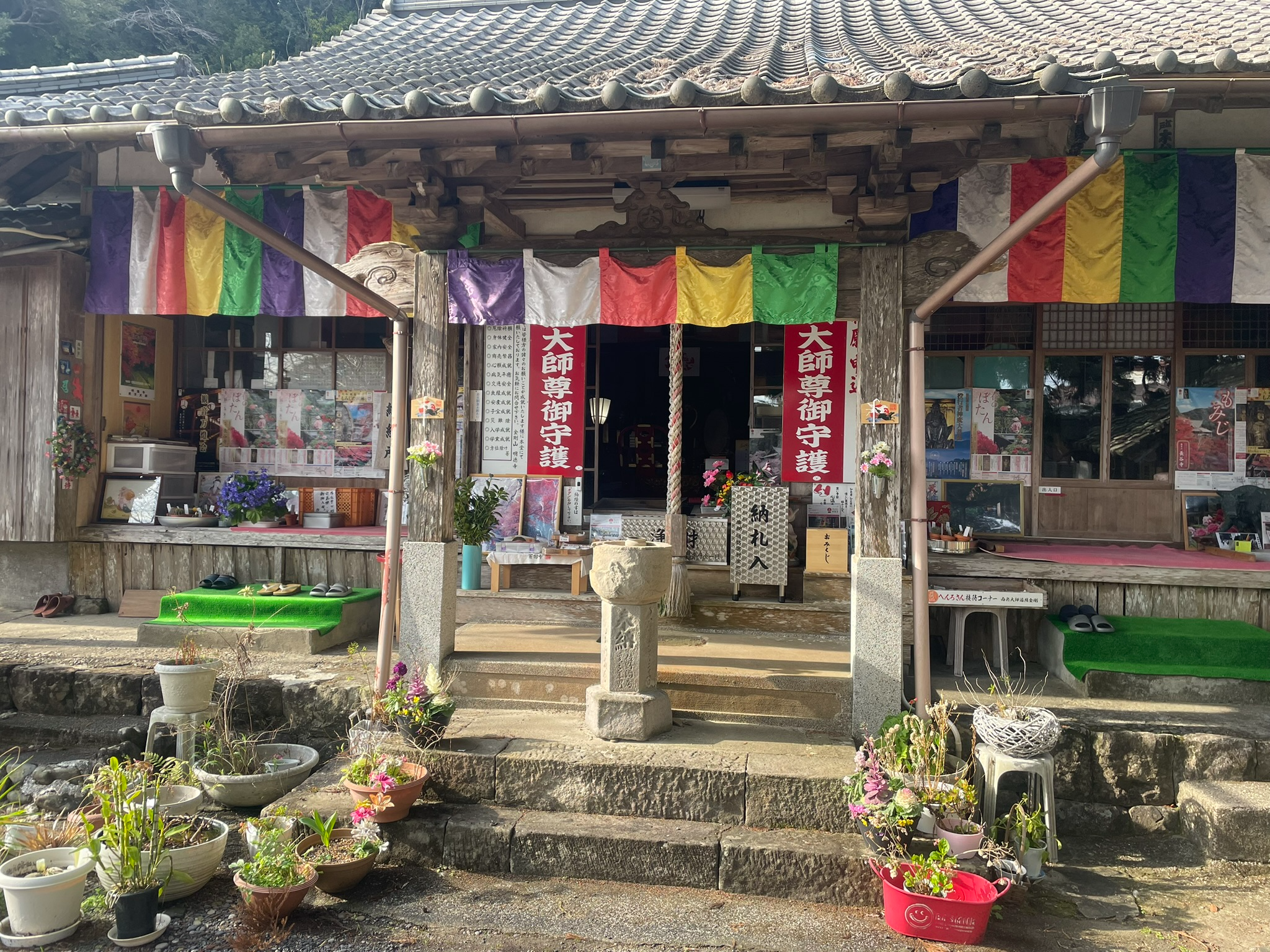
Walking along in a daydream, the monotony of the coastal road offering a different type of mental challenge, I passed a cool looking Daishi, Myotokuji, which supposedly had a Zenkonyado where pilgrims could stay. The multicolored prayer flags, representing the five elements, created a contemplative energy and the flora surrounding the temple added to the atmosphere. But it was still early in the afternoon and I had no food for dinner, so I decided to press ahead. I didn’t feel hungry, but wanted to keep my body stocked up with good stuff. Regardless, Zenkonyados, by tradition, should only be used as a last resort by pilgrims who happen to have found nowhere to stay for the night, but I already knew where I was staying that night.
After leaving Myotokuji, I crossed into Toyo Town. Soon, I would start the Gorogoro-ishi section, a difficult section where pilgrims used to have to navigate slippery and dangerous sections of coastline before the present road was built, its name standing for the rumbling sound (gorogoro) of rocks (ishi). I was a little disappointed that this section was now far easier for pilgrims to walk, however, according to my guide book, the lack of places to stop for food and drink meant that it was still deceptively difficult to this day.
Hitting the coastal road that hugged the East side of Cape Muroto, I settled into a rhythm that I could maintain for a couple of hours. I walked on the left side of the road so that I was nearer the sea. The road was quite literally hugging the coastline, with the salty spray of the sea as it crashed into the rocks providing a refreshing sea mist to help cool me down. The sun setting to my right, I was now shaded, for the most part, so could walk without my sedge hat. Despite being a nice idea practically, I was starting to find that this traditional style of hat had its downsides, one of which being its stability in winds. Given that I was now on the coast, the hat would often decide that it wanted to take flight off my head whenever a stronger gust of wind blew. This meant that it had primarily been retired to be hanging off the back of my rucksack, serving only as a placard to show that I was indeed a Henro.
As the kilometers went by, I couldn’t help but walk with a big smile on my face. ‘Feeling Good’ by Michael Buble was ringing in my head and, given that I was practically the only one around other than the cars that passed by, I sang from the top of my lungs as I walked along the Gorogoro-ishi. Perhaps a different style to the pilgrims who walked this coast a thousand years ago, but one that worked in its own strange way for me. As I walked, I focused on the waves as they neared the coast, finding it genuinely amazing how beautiful waves are. I loved how they built up inertia before hitting a tipping point where the peak of the wave would collapse onto itself. The section felt exposed enough to make me feel lucky to be alive, with the tsunami section warning signs making me feel a subtle adrenaline rush as I walked. The waves also reminded me of an important thing, that despite the chaos and churning of the waves, the rocks that formed the shoreline were as stable and undisturbed as ever. A rock would be poking out, a wave would come and capture it in its waters, and, soon after - with a periodicity that I quickly became attuned with -, it would reappear above the water’s surface. No different to life, I thought to myself. Where we live in a world that’s as chaotic and busy as ever, where we try hard to feel a semblance of control. However, the reality is that much of what happens is far outside our control and that, by going inward, we can be similar to the rocks that show stability amongst such noise. That there’s no need to try to control the external, but instead come to peace with observing and knowing that for every peak in our life, a trough will inevitably arise.
Caught up in perhaps leaning too much towards the philosophical, from afar, I could see another person heading toward me on the other side of the road. It looked like he was pulling a trolley full of shopping, but as he neared, it was clear that he was a Henro, his white vest a marker of this. He saw me, and stopped to start crossing towards me, but I decided to head to his side of the road, where there was a pavement that we could safely talk. He looked weathered, which I thought to myself was understandable given that he was likely a good month or two into his anticlockwise pilgrimage. But he had a huge smile on his face, and spoke perfect English. I looked at his cart, which had a few bags on it, a big foam roll mat, some cooking equipment, and some dandelion roots hanging off the side. I told him that I was impressed by his ingenuity, and he told me to pull the cart to see how heavy it was. It was heavy! Far heavier than my rucksack. On his feet, he wore shoes that had less shoe than shoe left to them, his laces holding together what was left of the upper fabric. Given that I’d started to complain in my head about the tread of my shoes already wearing, and that I’d likely have to purchase new ones in Kochi City, I decided that I needed to toughen up and suck things up. There and then, I decided I’d make my shoes last the whole way.
After talking for a minute or so, the man mentioned that he’d been walking around the island continuously for - if I remember correctly - the past twenty years. He would alternate clockwise and anticlockwise around the island, sleeping outside every night and foraging as much of his food as possible. He told me how he’d picked up the Thermarest atop his cart for 500 yen, which is around £2.50. Despite not having many teeth left, I could see nothing but life radiate through his eyes, with his mind as sharp and young as could be. He was happy. He had no attachments nor work to pin him down. He simply walked and walked, towing everything that he owned behind him. Little did he know that he proved to be a big inspiration to me for the rest of my trip - a living, embodied example of many of the values that were important to me.
Both needing to push on for an hour or so before the light faded, we said our goodbyes and wished each other good luck. Leaving him, I felt as if I’d just met a celebrity along the Henro. I couldn’t imagine that many others had been walking continuously for two decades…
Pushing on to where I’d be staying that night, the road felt never ending. Looking at my map, I was convinced that I’d hit the campsite around the next bend, but I was wrong a few times. My mind was broken, and my body tired, so I slowly made my way along the final stretch, stopping regularly to rest and find some energy from within. Finally, ahead on the left, I could see what looked like a run-down set of garages. It must be Riders Paradise - the motorbike shop slash café slash campsite that I’d pay 250 yen to pitch my tent at that night.
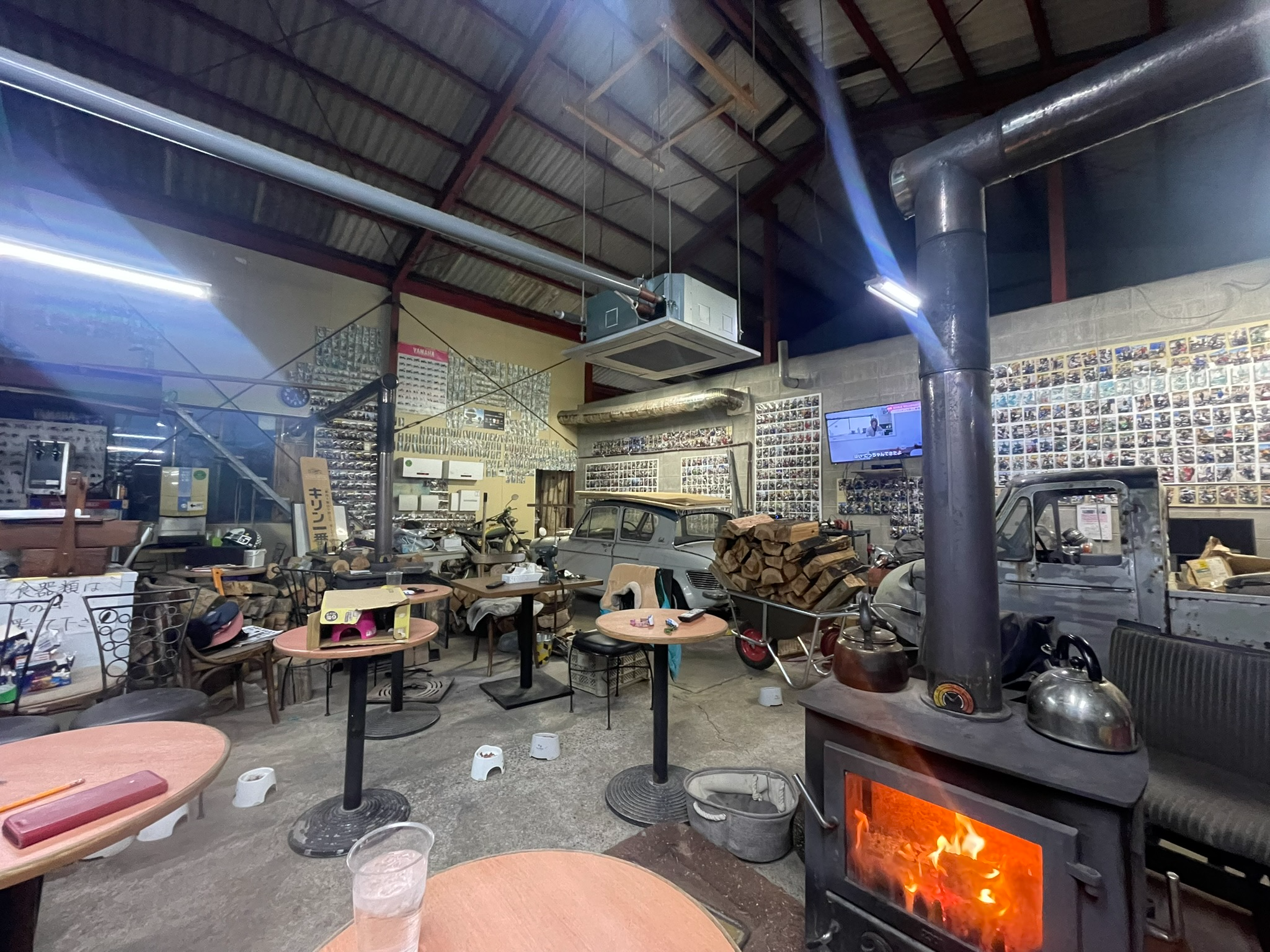
Relieved that I’d arrived, I looked for a door that might resemble and entrance to a reception of some sort. I walked across the yard and could see no other tents around, but I assumed they would be in a field nearby or something. I headed towards the big Reggae-inspired stripes covering one of the exterior walls and, seeing a sliding door half open, I knocked and called “Sumimasen, konban wa” - excuse me, good evening in Japanese. A lady shouted from across the room saying that she’d be with me in a moment. She then opened the door, and I was both amazed and confused as to what was inside. There were motorbikes all over the place and random bits and bobs like a coffee machine and a load of pictures with people on the walls, but then in the middle of the room there were two of the biggest log burners I’d ever seen, with a couple of tables and chairs beside them.
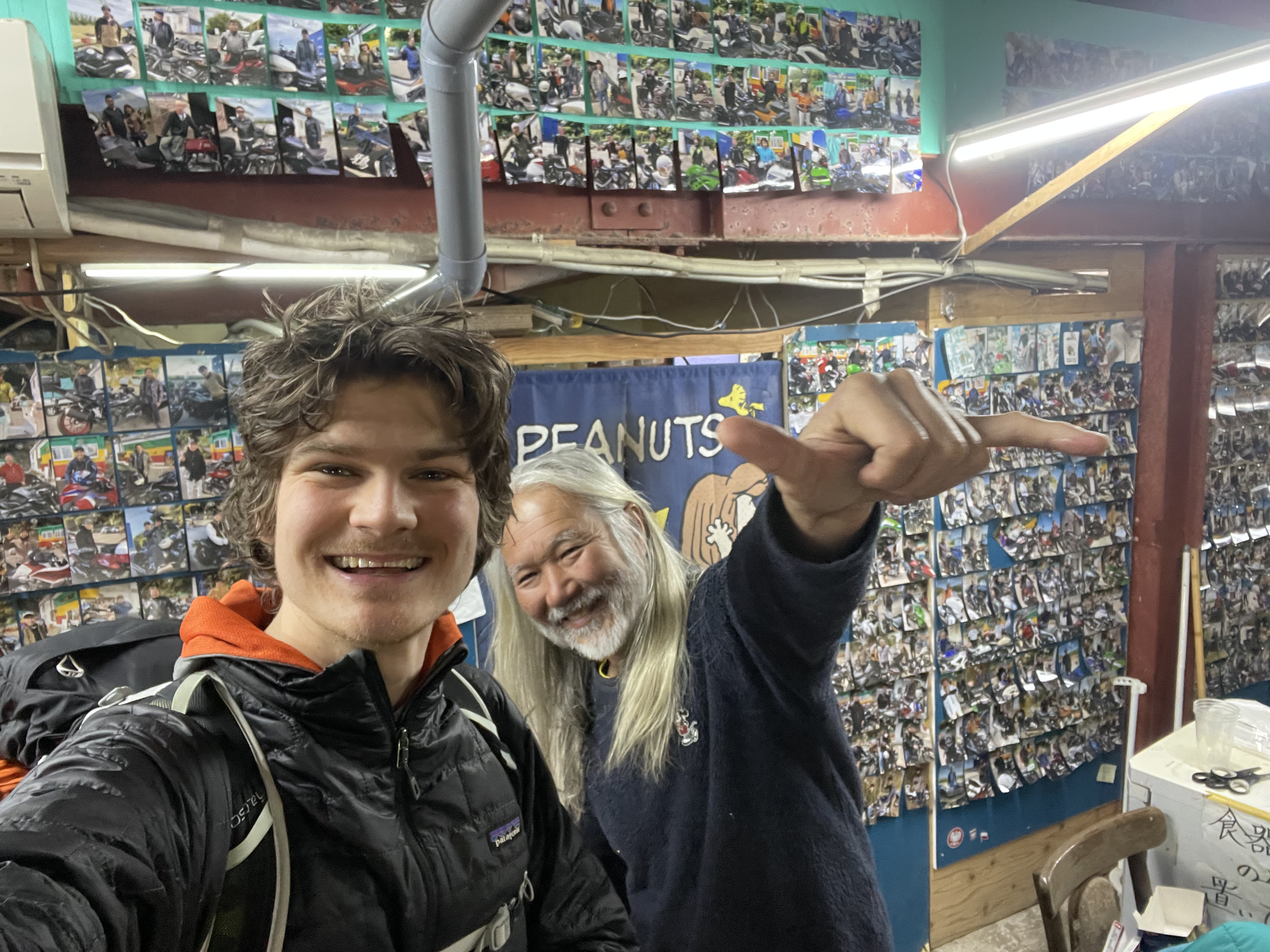
I asked for the lady’s name. She was called Mami-san. After sitting down, she proceeded to bring me a glass of water and told me to get comfortable in front of the warm fire. I immediately felt at home and, soon, Mami-san’s husband, Hakimi-san walked in. He looked everything like a surfer, motorcycling dude - long silver hair, a tan that one only develops by being weathered when surfing the waves, and a big smile on his face. I asked him where I would be camping that night, so that I knew where to pitch my tent once the sun had set. He took me out to the yard and walked me to the other end, where there was a questionably level patch of grass and dirt that he said people usually pitched their tents on. Around the corner, there was a long, slightly flatter and softer patch of grass that overlooked the sea, however, I didn’t fancy camping there as the winds were blowing strong that evening. I told him that I’d pitch between the hedge that divided the beach and the yard, and he pointed out the porta-potty behind his bike garage.
Hoping that I could still eat something, I asked Hakimi-san whether there was any chance I could still buy some food. Thankfully, he said yes, and asked what I wanted while pointing to the small menu on a chalkboard sign. Given my limited Japanese, I picked the top thing on the menu, to which he replied - “small, medium or large”. Not knowing where the next place to eat along the cape was, I went with the large. He then asked if I wanted breakfast in the morning, an offer I couldn’t turn down. He did some sums on a piece of paper and I paid him the 1450 yen for the two meals and place to pitch. I asked how long he’d had the shop for and where he lived. He said that he used to live further down the cape in a village called Ozaki, but that the costs of running a bike shop in Japan had become so high that he’d decided to sell his house, now living on the side of the shop with his wife. I asked him where his favourite surf spot was, to which he replied ‘Ozaki’. I could tell that his heart was still in this little surf village down the coast.
Ten or so minutes later, Mami-san came out with a huge plate of food, telling me that it was yaki soba, a traditional Japanese dish of fried soba noodles and veg with a thick brown sauce and some Japanese omelette on top. I tucked into the mammoth plate of noodles and the saltiness was exactly what I needed after a long day of walking in the sun. I slowly slurped the noodles, appreciating having my first warm dinner of the trip. Before someone asks, not slurping is actually considered rude in Japan, as slurping and the sound that comes along with it is a way of showing the cook that you are enjoying your food. This was very different to the UK, where one slurp would have the whole café casting their eyes on you.
After eating my food, I had some important video calls to make with the two prospective supervisors for the PhD programmes I’d been offered places on. The first was at 7:30 pm Japanese time - around 10:30 am in the UK. I logged into my emails and hopped on a video call with the first supervisor. I was so elated with joy, sat in front of a warm fire with my feet out, that I found it a little difficult to talk about anything but the first few days of the trip. Luckily, the supervisor has done her fair share of long cycling and hiking trips, so she understood the beauty of living in such a simple way. Wanting to take things seriously, as the decision would be regarding what I’d do for the next four years, I asked some questions that were on my mind about the project. Hitting 8 pm, I dropped off my first call and moved outside to sit on a log to make my second video call - Hakimi- and Mami-san, rightly so, wanting some alone time. I called the second supervisor and sat under the light of my head torch, asking equally serious questions about the proposed project. Coming off the call, I now had a decision to make, but I think my gut already knew what was right. Regardless, both projects and supervisors were amazing, so I couldn’t really go wrong either way. Pitching my tent in the dark, I lay down staring at the roof of my tent and made a decision about the PhD. I would be spending the next chapter of my life looking at heatwaves. But, for now, I could go back to being a pilgrim.
Waking up, my body was stiff from sleeping on such solid ground. But, since I’d promised to be sat at the table for breakfast at 6:15 am, I got my stuff together and changed while lying down before packing down my tent. You see, I’d had this tent for nearly a decade by now. It has been a great tent, with one of it’s strengths being how low down it was, meaning that it was good in strong winds and easy to stealth or wild camp in without disturbing the surroundings. The downside of this, however, was that I had to do anything in the tent lying down. To read, I’d either have to hold the book above my face until my arms were tired, or lie on my stomach with it in front of me. To change, I’d have to rustle about finding my clothes and put them on, taking care not to hit the outer of the tent to avoid being wet with condensation. However, it did have some advantages, one of them being that I could easily kneel in my tent at night, open the small door, and relieve my bladder without having to leave the tent at all. I’d grown to love this tent over the years, and was not ready to retire it, yet…
Packed up, I headed into the garage again and sat down to eat my breakfast. An egg, some salad, sweet bread, banana, and a strong black coffee would be more than enough fuel for a good part of the day. Before leaving, I asked Hakimi-san whether he could show me around the rest of the buildings. He first took me around the side to the other half of the current shed, where there were all kinds of old cars and bikes, one of them being an original Subaru 360 in light blue. In two adjacent corners of the shed, I could see some mattresses laying on top of some platforms with some transparent blinds surrounding them like one of those canopy beds that wealthy people have, except these were cooler and more rustic. I asked if this is where he slept, and he explained that these were in fact the rooms of the guesthouse - where people could come and sleep on a comfortable mattress for 500 yen a night. I kicked myself for not knowing last night, but then comforted myself by reminded myself of my goal to sleep in uncomfortable places. But this must have been the coolest, most eccentric guesthouse I’d ever seen. Heading across the yard, there was another shed full of bikes and cars. This one was three-stories and on the top lay a café - this being the actual café that daytime customers enjoyed relaxing at. There were big windows with views over the pacific, and the whole place just screamed the word ‘chill’. Heading back outside, I picked up my bag and said goodbye to Mami and Hakimi. I thanked them for their hospitality, and started walking with a refreshed sense of hopefulness.
That morning, I continued making my way towards the tip of Cape Muroto. The long road section continued for the best part of the morning and I tried my best to stay positive despite the monotony of the walking. I passed Ozaki beach, seeing a person enjoying the morning surf and imagining Hakimi-san doing the same. I walked for an hour or so, before stopping to rest the legs and fill up my water from a sink in a toilet. Approaching the end of the cape, I decided to take the scenic path onto the dyke. The area was a Unesco World Geopark due to its precious topography and geology, with many signs along the dyke with information about certain geological features. Despite being in awe with the beauty of the coastline, as always, I found it difficult to comprehend the timeframes in question when discussing the age of these rocks. 100 million years is a number that I don’t think humans can really resonate with, as it’s so much larger than the time that we are alive. I guess it puts our insignificance into perspective, though - that we’re merely a collection of atoms that constitute an organism that lives only for a snippet of time in the bigger picture.
At some point along the dyke, I tried to record a short video discussing how good the socks that my sponsor had kindly supplied me for my trip. But I struggled to do so, as I felt a strong misalignment internally between my values and what I was doing. I didn’t want to feed into the consumption narrative and tell people how good things were so that they are then more likely to buy them, but that’s exactly what I was doing. With this in mind, I decided not to share those marketing videos, even though the socks were pretty good. I’d only organically advertise the socks by wearing them for my activities.
Shortly before swinging back on myself at the tip of the cape, I detoured into the geopark once more and was clearly amused by the rocks, writing “cool volcanic rocks” in my guidebook. Having been a while since I visited a temple, in my tired and daydreamy state, I missed a turning to cross the road to the path that wiggled up the hillside to the next temple, Hotsumisakiji. At most, I had to walk back on myself for four hundred meteres, but at the time, I became a little frustrated with myself for going off track. But then I reminded myself that I was not partaking in anything remotely resembling a race. That I was on a pilgrimage to become a better person, with getting frustrated at petty things not being conducive to this overarching goal. Getting lost, after all, was an integral component of the pilgrimage.
Picking myself up and pausing to slowly drink some water, I soon started making my way up the punchy climb to the twenty-fourth temple. A few hours earlier, it had started to spit lightly on and off with rain, so I had my waterproofs on just to be safe. Up to now, I’d been lucky and not had any heavy rain during the whole trip, but I’d been warned by others that I’d passed along the trail that heavy rain was on its way. The issue is, however, that as soon as you start climbing anything remotely steep with a big heavy bag on your back, then waterproofs start performing the opposite function - you start sweating profusely and becoming soaked with sweat from the inside out. Underestimating the climb, I stopped at a round wooden rest hut halfway up to strip my waterproofs off, leaving me wearing only my t-shirt on top for the last push.
Cresting the hill, I arrived at the main temple gate and made my way to a bench outside the temple office to sit and relax out of the rain. Sitting down, I started speaking to a girl who was about to leave. She was called Kari - originally from Germany, but travelling Japan to fulfil her dream of visiting the land of anime. She was doing the Henro using a mix of transport modes - using trains and buses, also completing long sections on foot. She explained that she wouldn’t be able to finish the pilgrimage, as she’d be meeting a couple of friends in a few days time and continuing her travels around Japan with them. I told her that this was fine, that there’s no real need to have to finish everything, so long as you get something out of your journey. Perhaps it could be an important lesson in realising that imperfect is more often than not just fine. That there’s no need - not that it would be at all possible - to close the loop with everything that we do in life.
Thinking about food, I asked Kari whether she knew of anywhere to eat along the trail before the next temple. Unsurprisingly, as someone who was as far away from being local as I was, she had no suggestions. So we said our goodbyes and I imagined what could have been - sharing a nice lunch with a cool German girl who was closer in age to me than any Henro I’d met so far. Oh well, I’m sure another opportunity will present itself. I completed my rituals and quickly left the temple as I’d started to get a little cold having stopped when soaked through with sweat. I wound down the tarmac road before hitting the small road that hugged the West coast of Cape Muroto.
As I walked through a small village, I passed a small fruit shop beside the road, so nipped in to buy some snacks to tick me over until I could find a more substantial meal. I brought some oranges, kiwis, and tempeh, immediately eating the whole block of tempeh outside the shop and snacking on the fruit as I walked. Leaving the shop, the heavens really decided to open, and I now realised what people mean by Japanese rain - it was heavy, persistent, and cold. A little built up with energy, I tried swinging off the route to a restaurant marked on my map. Crossing the football pitch sized car park, I arrived at a door with a closed sign hanging in the window. I felt a little stressed, so decided to take a pause for a couple of minutes under the roof of a toilet block before going back out into the rain. I continued walking along the road, weaving my way through the quiet coastal communities, until I happened upon a building that looked like a café or restaurant. The door half open, I poked my head in to ask whether they were open for food. The kind old lady signalled for me to come in and to sit down beside a table. The place was warm and cosy, with hot plates in the centre of each table radiating their heat and Japanese television playing in the background. I asked her to pick what she wanted for me, explaining that vegetarian would be ideal, but that I was not too fussy about my food. She fired up her griddle, threw together some cabbage and noodles, before mixing in some more of that sticky sweet brown sauce. I’d be having yaki-soba again.
Having made the most of the warmth of the café, I started making my way to the next temple. As I walked, however, my stomach began to feel very strange, as if I was cramping up and feeling sick at the same time. I wasn’t sure what was going on, and thought that I was perhaps just digesting all the noodles I’d consumed. But it soon became apparent that my stomach was off. My pace slowed right down as I slowly made my way to Shinshoji, the twenty-fifth temple. Arriving, who else was sat next to the Daishi hall but Kari, the girl I’d met at the last temple. I explained that my stomach was playing up and that I wasn’t sure if I could walk any longer that day. Thinking on my feet, after mentioning an Izakaya that she’d seen on her phone, I asked whether she wanted to spend the rest of the afternoon together, not that I’d be the best company. We both needed to head to the supermarket anyway, so we decided that we’d go to the shops followed by a meal at the local Izakaya. In no rush, we sat at the temple talking for some time, discussing what we were both up to in life, our aspirations, why we were doing the Henro. She explained how she was an exhibition designer, which I hadn’t heard of before. They’re the people who design and curate exhibitions for galleries, museums, and other places alike. She explained that it was tough at the top, but we agreed that if you have a dream and something that you love doing, then you should set your heart to it and never look back. Having talked in reasonable depth about things we’d both clearly been contemplating on our pilgrimages, we picked up our bags and headed to find some food.
After shopping for breakfast and lunch for the next day, we headed to the Izakaya. I’d never been to one before, but Kari explained that they were bar-like places where you could also eat some light bites. We walked in and were taken through a sliding wooden door to a room with sunken seats forming a booth. This was pretty cool, I thought to myself - we’re even allowed to kick our shoes off! Although I wasn’t sure if week old smelly socks were the most pleasant of smells. I just had to hope that Kari understood… Sitting down, Kari explained that the ordering was all done through the tablet in front of us. I said I’d eat anything, so we proceeded to order an array of traditional Japanese dishes for us to share. Despite feeling hungry, my stomach was not playing ball and I had to hand most of the eating over to Kari as I popped in and out of the bathroom. In the interludes, however, she mentioned how she loved travelling, especially planning out her travels and researching things to do before heading to somewhere. She showed me her stamp book, filled with stamps from the various places she’d been to - temples included - in Japan. She talked about how she loved photography, and often created scrapbooks upon returning home. As far away from my style of travelling as possible, but a refreshing style, nonetheless, and I left the restaurant feeling inspired. The different perspective and her love and passion for travel was intoxicating. We paid our bill, walked to the nearest bus stop, and said our goodbyes as she hopped on the bus up the coast to a hotel she was staying at that night.
Feeling groovier than earlier in the afternoon, I enjoyed walking in the dark for a few kilometers to a Henro hut that was marked in my guidebook. The dark was fun, allowing me to go more inward and to contemplate some important things. Not long after, I arrived at the hut to see what I assumed to be another pilgrim sleeping on one of the benches under the hut. Not wanting to scare him, I lightly tapped on his shoulder and asked whether it was OK for me to sleep on the concrete floor next to him. He said yes, no problem. I felt tight for waking him up, but knew that I’d be a bit freaked out if I woke up in the middle of the night to see a stranger sleeping next to me. Tired, I put down my sleeping pad, unpacked my sleeping bag, and slept like log for most of the night. It’s interesting how you can become cosy sleeping on a concrete floor after just a week or so…
Waking up with the sun, both I and the other Henro started packing up our stuff and getting changed. His name was Daisuke Yagi-san, and he’d taken time off work as a care worker to walk the pilgrimage. He’d got caught in the heavy rain the day before atop the hill that the next temple lay, so decided to turn back to sleep at this rest hut, having spotted it before heading up to the temple. That morning, he’d press ahead to the twenty-seventh temple, having no need to reclimb the hill. Hungry, I ate my breakfast, and gave him a banana. He returned the gesture by handing me a strange jelly looking thing, explaining that it was red bean jelly - a great snack for the road, packing a lot of punch for its size. I read the back, and he certainly wasn’t wrong. Both itching to get going to dent a good part of the day in the morning, we parted ways for the time being.
I swung up and down the hill, stopping at Kongochoji along the way, before hitting the road that hugged the coast once more. I bathed in the monotony of the walking, using it as an opportunity to observe the surrounding nature. I was starting to notice subtler and subtler things around me, with even the smallest of flowers bringing the biggest of smiles to my face. The colours of spring were beginning to appear and, soon, the famous Sakura blossoms of Japan would join the show. I followed the road to Hane, before hitting a trail that took a more direct, scenic way across a small peninsula. Soon, I was at Nahari Town, which had a couple of bigger shops that would open in 10 minutes time at 10 am. I sat outside the entrance of Sunshine - a Japanese supermarket - to wait for it to open, before going in and stocking up on food. I sat outside, eating what I wrote in my guidebook as my “first proper salad”. Perhaps I’d forgotten what I’d been eating at the start of the pilgrimage, given that I thought I’d started eating these super salads earlier on. Regardless, this salad was clearly a good one, and I felt full of energy and strength to tackle the next section of the pilgrimage that would see me slowly make my way along a slightly more populated - although nowhere near as populated as the North coast - part of Shikoku.
Walking through Yasuda Town, I decided to head into the Nagomi - a small community community centre) - to ask whether they knew of anywhere I could stash my bag at the bottom of the mountain before heading up to the next temple - Konomineji. I could see on my map that it was an out and back that would take a couple of hours, so I thought that it would be silly not to stash my bag at the bottom of the climb. The two ladies at the centre were lovely, but they were a little concerned and amazed at the same time by what I was doing. They didn’t know how I could cover such distances in a day, especially without a sim card, and how I was able to sleep outside on such a thin sleeping mat. I reassured them, however, that despite looking irresponsible from the outside, I was in fact wholly responsible and comfortable; that we need less luxuries than we think. I digress. They said that there was a shop called Konomine that I’d likely be able to leave my bag at, so I thanked them and made my way to the bottom of the mountain. Unable to see anything representing a shop, I realised that I’d gone to Konomine Jinja, this being a shrine, not a shop. Oh well, as I said, there’s never an abandoned house too far off, so I quickly found a building to stash my bag behind, covering it with an old tractor tyre. Packing my wallet, a jacket, and some water into my packable rucksack, I started galloping my way up the road, now feeling ridiculously light.
Starting to feel an energy that I was certain was highly spiritual, I enjoyed working a little harder as I climbed toward the twenty-seventh temple. On the way up, I passed a few older Japanese Henro, and was starting to notice something interesting - many of the pilgrims were older Japanese people, often in their 70s and 80s. I was told that this was because it is difficult to book enough time off to complete the Henro on foot when working a job, so many pilgrims set foot on the journey following retirement. But this didn’t change the fact that there were people of this age undertaking such a big feat of mental and physical endurance. These pilgrims were as healthy and as sprightly as ever, walking up steep mountain paths and long staircases exactly how we should - in a healthier society - be able to do at that age. I now understood what people meant when they say that the Japanese are healthy - these pilgrims were concrete examples.
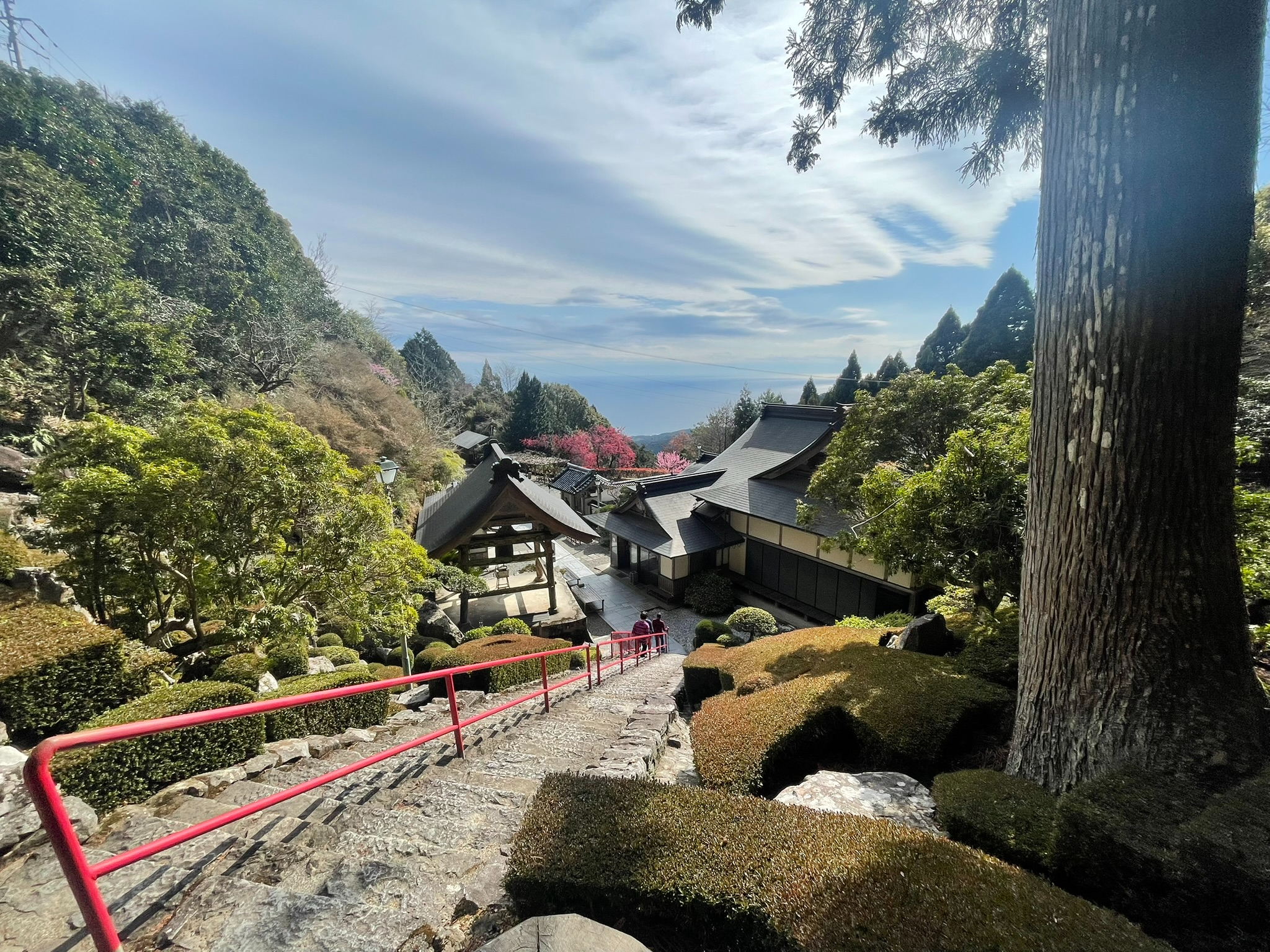
Arriving at the temple, I took some time to take in the peace and tranquility of it and its surroundings. The gardens were well maintained, creating a contemplative atmosphere. I sat down opposite the main hall to listen to other Henro chanting the Sutras - something that always seemed to tingle some things deep inside me. Before making my way back down the mountain, I asked the Henro sat beside me what the ‘secret’ was for good health and happiness in Japan, to which he replied that he did not know. Perhaps I’d slowly find out during my trip.
Picking my bag up where I’d left it a few hours before, I looked at my map and decided that I’d press ahead to a place called Oyama to camp for the night. Tired, stomach empty, I plodded along, hugging the coast the whole way to Oyama Michi-no-eki. Arriving, I scouted out the area to look for a reasonably flat patch to camp, and found a place right next to the ‘Lover’s Sanctuary’ in Kono Park. Unfortunately, I did not have a lover, but that wasn’t the point of this trip. Not wanting to pitch my tent yet, I sat beside a man on the terrace to watch the sunset. Talking to him, he said that he lived nearby, and was undertaking the pilgrimage in sections. He was enjoying some food and a cold beer and looked like the kind of person who was peaceful and content within - enjoying the little things, carrying only the bare essentials on his back. We talked a little, my Japanese limiting the depth of conversation, before another person who was undoubtedly a Henro turned up. Decked out from head to toe in all the pilgrim attire, white trousers and shoes included, I asked whether he was also thinking of camping there that night. He said no, explaining that it was too early for him to sleep, and that he preferred to walk later into the evening until he felt like sleeping. In terms of where he was sleeping each night, he said that he only had a sleeping bag - no pad. He just lay on whatever surface he could find, so long as it was somewhat sheltered from the rain. I thought to myself that this guy was pretty hardcore, and that I should stop complaining about my thin camping mat.
After talking to and listening in on the two Japanese Henro’s conversations for a good part of an hour, the decked out stormtrooper was ready to leave and continue walking along the coast. I handed him a couple of sweet pans - strangely sweet Japanese bread - I’d been given as osettai just down the road. I wasn’t too hungry, having polished off the nuts that I had left, and, to my delight, the matcha flavoured pan that I gave him was his favourite. He gave me a protein bar in return before heading off. Asking the older Henro where he’d camp, he pointed to a sheltered section beside the building, explaining that his tent was a freestanding one, meaning that he didn’t need to peg it down. I’d contemplated getting such a tent before my trip, but decided to make do with what I already had. That night though, it would have been nice. Instead, I walked to the park and pitched my tent before doing some writing whilst watching the most serene, cloudless sunset of the trip so far. Once the sun had set below the horizon, I headed to bed for a long night’s sleep.
Waking up, the inside of my tent was saturated with water, which confused me as it certainly hadn’t rained overnight. I must have pitched on a bit of dirt that was prone to generating lots of condensation. Packing up my wet tent, I was quick to get moving such that my hands didn’t get too cold in the cooler morning air. The older Japanese Henro had already packed down and left by the time I got moving towards Aki City. After an hour or so of walking, I arrived at Aki and decided that I’d take a detour off the Henro path to what was marked in my guidebook as ‘Samurai Residence Street’. It sounded cool, so I thought I’d go and take a look given that I was in no real rush to get anywhere. I passed through the suburbs of Aki, double-checking that I was going the right way a few times before arriving at the Samurai Residences. Confused, as there seemed to be nothing special about the area, I became a little agitated for taking a detour with no real reward. But, as always, I tried to view it as an important lesson - not to get your hopes up too much. Having not seen much, I headed back towards Aki via a different road before picking up some bits of food for breakfast. I looked at the map and realised that I’d get close to Kochi that night, this being the biggest city up to now by far. All I had to do was hug the coast for a few hours before heading inland towards Kochi’s suburbs.
Walking along the coast in heat that seemed to be increasing in intensity as the days went by, I stripped off the bottom part of my trousers for the first time on the pilgrimage. Passing through the villages of Akano, Ajiki, and Nishibun, I soon bumped into two Dutch pilgrims as I walked through a beachside pine forest. Anne Marie and Peter were a couple in their sixties or seventies who were walking the Henro together, having headed straight to Tokushima after finishing the Kumano Kodo - another, supposedly more taxing, although far shorter pilgrimage to the east of Shikoku. The Kumano Kodo, it transpires, is also the sister pilgrimage to the famous Camino de Santiago in Spain, with people who complete both being called dual-pilgrims. Cool, I thought, but I was content with only doing the Henro for now, not being one for ticking boxes and building up accolades unless I had a compelling reason to do so. But maybe I’d just not caught the bug yet.
The three of us walked together for the best part of the day, until arriving at the twenty-eighth temple, Dainichiji, not too far away from Kochi City. We mainly talked about life. Anne Marie was a Mathematics teacher, and their daughter had just completed a PhD in Mathematics at MIT. Peter was a psychologist, who had also spent a good part of his career teaching, but had recently retired to focus on other things. In 2021, seeing life slip away in front of him, he decided that, from then on, he wanted to spend at least half of each year walking. What started as a Camino, soon became a handful of Caminos, before spreading to a collection of different long-distance walks and pilgrimages across the world. When walking together with his wife, they’d rent out their place back home.
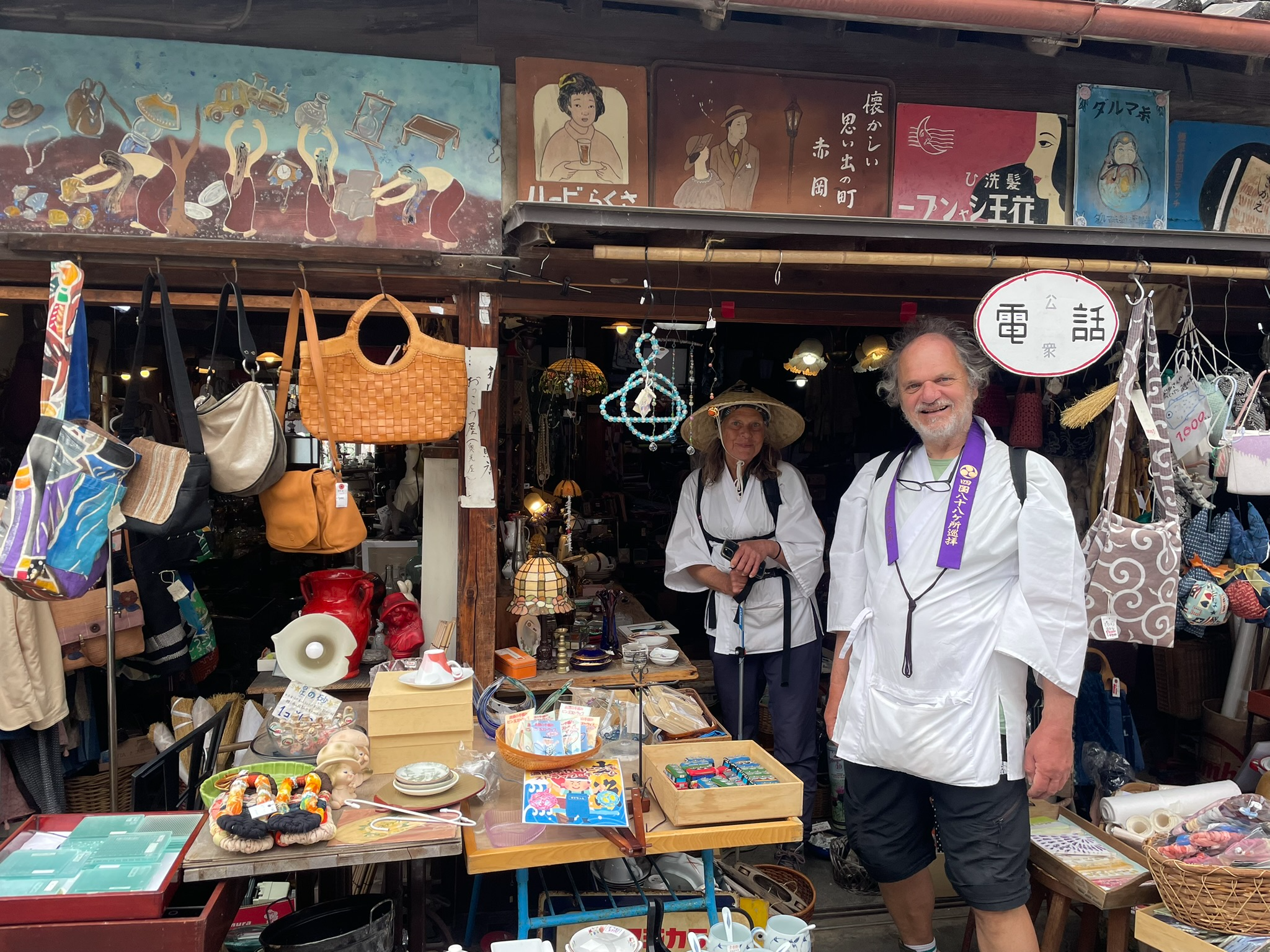
Making our way to a fresh supermarket to buy some lunch - having told them about my super salad secret - we found ourselves walking down an eloquent street lined with small, independent Japanese shops. On the left-hand side, there was an antique shop with the most beautiful array of little things for sale. I’ve always had a soft spot for nice pottery and this shop certainly had very nice pottery, for very good prices. In the left-most room of the shop, the owner was sat talking and enjoying some tea with a young Japanese couple. Intrigued by three Europeans shopping around, they started talking to us. Soon, the shop owner had brought out a table and some chairs, as well as some gyozas, biscuits, and green tea as osettai. I asked the owner where the pottery was made, and she explained that they were a collection of works from various local crafts people. Looking around the shop at the same time was an American Henro called George. We agreed that today was tough due to the heat, and parted ways for now without saying much else. Leaving the shop, we thanked the lovely owner and young couple, before swinging by the nearby supermarket to grab some food. As custom by now, I sat on the floor outside the shop enjoying my big salad and let the experienced Dutch continue making their way to the next temple.
For the next couple of hours, the walking was urban to say the least. Despite the Henro being 80% on roads, up to now, it hadn’t felt too urban, other than some of the stretches surrounding Tokushima. However, walking through the outskirts of Kochi, the roads became busier and the fumes from the car exhausts certainly made the air notably less fresh. Once again, however, I reminded myself not to complain and that this was a lesson in dealing with environments that weren’t necessarily ideal in my mind. Soon, I arrived at Dainichiji, feeling drained and low on energy. The Dutch Henro were getting ready to leave, having already performed their rituals, and were speaking to a German lady who said that she also hadn’t washed her trousers for over a week. This made me feel better for not having done a laundry yet…
Trying to decide what to do, I hung around the peaceful temple as the last pilgrims of the day came to collect their stamps. Deciding that I wanted to try to stay there, I asked whether the Tsuyado was available that night. Unfortunately, two French Henro had already beaten me to it, however, the nun offered for me to sleep in my tent on the temple grounds. Initially, I thought that this would be great, and put down my sleeping pad on a sheltered bench in a hut beside the temple office. However, I was soon overcome with restlessness and a desire to continue walking for the day - the evening sun luring me into some contemplative steps, the French Henro having passed on my offer to head to a local restaurant for dinner. Looking in my guidebook, I could see that there were a few Henro rest huts indicated on the map, all within a couple of hours of where I was. So I thought that I may as well walk until dusk and enjoy the nice sunset.
Crossing Toitajima bridge, I weaved my way through Kami City’s rice paddies. Feeling tremendously grateful to be alive and feeling deeply within me that life really is quite finite. There’s something about sunsets that invoke deep emotion - at least for me, anyway. I started the voice recorder on my phone and made a song up as I walked, its premise being how many of us take so many things for granted and that, the reality is, we could be gone any one of these days. One day, I’ll record this song properly and share it.
Having had my emotional release through singing, I passed not one, but three of the rest huts indicated on the map, with neither of them proving to be suitable to sleep in, unfortunately. Not too fussed about having to walk on further, I stopped at a Family Mart at a crossroads and bought some onigiri and egg omelette for dinner. Feeling energised, I left the convenience store and started walking down the straight road to my right. According to my map, it would take no longer than half an hour or so to make it to the next temple and another hour from there to the next Henro hut, Kamohara. Marching along the road with my head torch on, after around thirty minutes I started thinking where the left-hand turn to the temple was. Unsure, I checked my map and, to my disappointment, I’d managed to pop out of the Family Mart on the wrong road, so had been walking in a direction perpendicular to the route.
Picking myself up, I took a couple of small streets to rejoin the route shown in the map and soon made it to Kokubunji. Already dark, I was tired and really wanted to sleep. Looking around the temple, I couldn’t see a Tsuyado, but the disabled toilets on the grounds looked very cosy. However, in line with my vow not to sleep on any temple grounds or sacred sites without permission, I filled up my water bottles and continued making my way to the Henro hut around an hour away. A few kilometers before the rest hut, I could see a Lawson’s sign, and got excited that I’d be able to buy some food for breakfast the following morning. However, upon arriving at the entrance, it was clear that it was closed for the day. Instead, I continued walking towards the rest hut, picking up a warm can of coffee from a nearby vending machine to use as a hot water bottle in my sleeping bag. Finally, I arrived at the Henro hut. If you could call it that. I’d drawn the short straw, as it was essentially a glorified triangular shaped bus stop with a slanted bamboo bench wide enough for a small Japanese person to sit on. But I had no choice - it was late and dark, and I was done for the day, having been on my feet for well over 12 hours by now. At least I’d be sheltered from the rain. I put down my mat and slept with my hips digging into the outside wall of the hut, being awoken every so often by a car passing by on the road right beside me.
Having had a less than ideal night’s sleep and given that I’d been walking for ten days without rest, my body was feeling a little worse for wear - my mind tired. I decided that it was time for a rest day. This would allow me to recuperate, do some laundry, and wash in my first onsen, as well as spend some time looking around Kochi. It was also a Saturday, meaning that tomorrow morning the famous weekly Sunday market close to Kochi’s city centre would be on. Being one of the most well-known markets in Japan, and myself being a lover of markets, I decided that this must be fate. I’d rest and chill today, head to the markets tomorrow morning, and then keep moving on.
After waking up in the bus-stop like shelter having had less than ideal sleep, I was keen to get moving and to find a vending machine where I could hydrate with some green tea. Making my way to the thirtieth temple, Zenrakuji, I picked up a green tea and enjoyed it before entering the temple. Leaving the temple, I asked a local whether they knew of any nearby laundromats and onsens. He suggested an onsen close to the centre a few kilometers away and a laundromat just down the road. I waddled my way along the main road to the laundromat and proceeded to strip off all of my clothes in the convenience store toilet next door, leaving me wearing only my waterproofs. I guess this is one of the logistical hurdles one faces when packing so light - at some point, you’ll need to wash all of your clothes at once. This seemed like a good workaround, though, given that I only had to walk for an hour or so to the onsen, where I could wash and change into clean clothes. I sat in the laundromat eating my breakfast, enjoying resting my legs. Once washed, I threw what I could in the extortionately priced and environmentally awful tumble dryer and hung all of my wool clothing outside on a railing in the sun. Once the clothes in the dryer were done, I packed them up nicely in my bag, hung the rest of my clothes off my rucksack like a walking clothes hanger, and slowly made my way to the onsen.
It turns out that I misunderstood what onsens were during my first few weeks in Japan. I assumed that all of these big places with hot baths and saunas were onsens, however, it turns out that onsens are unique in the fact that they are natural hot springs. This means that the hot water in some of the baths in onsens was heated purely by nature. Pretty cool. Anyway, at the time I didn’t know this nor do I think I cared. I was simply excited to finally have a proper wash after ten days.
Walking in to the ‘super public bath house’, everything was new to me. A sign told customers to take their shoes off, which I proceeded to do, and to place them in a locker near the entrance. I then asked the receptionist if I could use the baths, mentioning that this was my first time in a bath house. He pointed to the little vending machine to the left, telling me to first buy a ticket there. Not understanding the Kanji menu, he told me to choose the first option - 1000 yen for use of the place all day. Pretty good deal, I thought - it turns out this would be one of the more expensive washes of my trip, though. Ticket in hand, I gave it to the receptionist, who then gave me a locker key. I walked under the parted blue curtains hanging over the entrance to the men’s baths and was greeted with a changing room full of naked Japanese men. No, this wasn’t a surprise to me, as I knew before heading to Japan that nearly all bath houses required you to be clothesless. It was just different to any situation I’d been in before, so I think my brain was just confused. I found my locker, stripped off, and made sure to bring my water bottle into the bath house. I was hoping to sweat out all the toxins in my body by sitting in the sauna for as long as possible. Before entering, I filled up my water bottle and weighed myself. I’d lost nearly five kilos since the start of my trip, but I didn’t panic, as I still felt strong and trusted that my body had reached a new equilibrium suited towards long-distance hiking.
I entered the first room containing rows of mirrors and sinks with chairs in front of them. This is where one washed themselves sparkly clean before entering the baths. I sat down on a small plastic chair and looked at myself in the mirror. I was tired. Weathered. I could see. These next few hours would bring me back to life, I thought to myself. I washed a few days worth of sun cream and sweat off before heading straight to the cold bath to bathe for a few minutes before the sauna. I grabbed a small foam mat to sit on in the sauna before opening the door and walking in. It was huge! Not only that, but for some strange reason, there was a big television in the front, with multiple rows of wooden benches tiered as if in a small stadium. I took a seat in the corner, not particularly impressed by the television present in what was meant to be a space to relax… I sat for twelve minutes or so - the length of time the clock in front of me suggested - and then went back into the cold pool. I repeated this four times, feeling pretty wiped out by the end. Still intrigued by the various different indoor and outdoor baths, I did the rounds with them before heading back to the first room to wash off again. My first time in a bath house certainly didn’t disappoint. I felt like a new man, or should I say, pilgrim.
Leaving the changing rooms, I headed to the lounge area where people relaxed following bathing. Fascinated by the Manga libraries at the other end of the room, I headed into one to lie down. However, once I sat down, I realised that all the magazines were pink, so I left. Later, I was told that that was the women’s Manga library. Spotting a vending machine with milkshake-like drinks in it, I put in a couple hundred yen and chose one at random. At the time, it was the most delicious thing I’d ever drunk - smooth, refreshing, and full of fat. Dehydrated, I sat down near a table and continued drinking lots of water, chatting to an American who had lived in Japan for the past half a decade or so. He used to be a travel guide around Cape Muroto, so knew Shikoku very well. He suggested some places for me to head to in Kochi, as well as some highlights along the next section of the Henro. I thanked him and left to find somewhere for lunch.
Passing through a large roofed shopping street, I made my way towards a market that the American had recommended. Arriving at Hirome Market - one of the most famous indoor food markets in Japan -, I bumped into group of Japanese people who seemed to be struggling to take a picture of all of them together. I offered to take a picture of them but, to my surprise, they asked if they could have a picture with me. They were interested in what I was doing and why I was in Kochi. I told them I was a Henro, and asked them what they were doing. They were a family, and the father explained that his daughter had married the day before, so they were out celebrating as a family. Asking where the husband was, the young woman replied saying that he was out playing golf. I was concerned, but I guess things are just different in Japan.
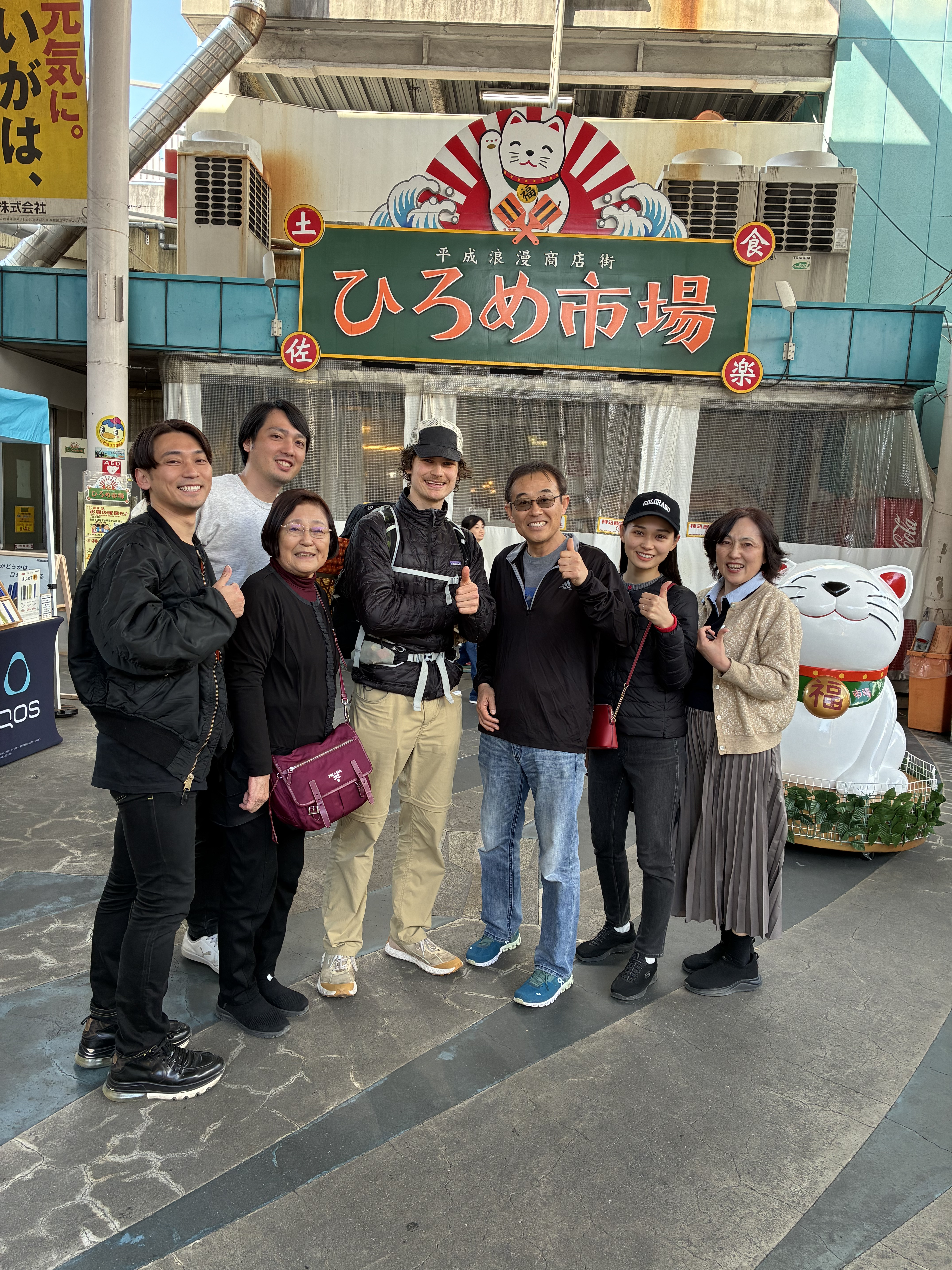
Entering the market was like entering the Tardis. From the outside, it doesn’t look too special - a small entrance with a cat painted above it and some curtains draped in front. But on the inside, woah, it was like something I’d never experienced before. Imagine the most popular London market, but everything is just cosier and cheaper. The atmosphere was incredible, with many locals and Japanese tourists enjoying the hundreds of different food stalls scattered around the market. I did a round of the whole market to see what was on offer, and decided on a Katsuo no Tataki stand that looked good. I ordered my food and then sat down to wait for someone to bring it over. Squeezing awkwardly between some people sat around a big table, wishing that I didn’t have my oversized sedge hat, I made conversation with some young Japanese university students who were in Kochi for the weekend. The bonito arrived and the tanginess of the ponzu sauce combined with the punchy green herb, shiso, was unbelievable. I was so happy and grateful to be eating such delicious food. As a side, I’d ordered some seaweed fritters. Their saltiness and crispiness was unlike anything I’d ever tasted. I was satisfied and satiated having eaten my tastiest meal of the trip so far. But the people sat to my right had other ideas. The couple, whose English was more limited than my Japanese, decided to start ordering some traditional Japanese foods from the various stalls for us to share together. I tried all kinds of different things and, by the end, was full to the brim. Some Germans who were excited to be in a place that served cheap beer then sat beside us and were happy to meet another English-speaking person.
Time passed quickly for the rest of the afternoon, as I talked to the young German, around my age -travelling with his Dad - about the motivation behind my pilgrimage. We discussed how we live in a hyper-stimulated world, where we’re often glued to our devices. I mentioned how I had no real interest in travelling much beyond Shikoku, as I’d come to Japan only with the intention of completing the Henro. We agreed that to keep chasing the next thing in life can end in burnout and depression, and that one should tread lightly when deciding to do something ambitious. Having eaten even more delicious food and tea that the Germans and Japanese couple kindly offered as osettai, I bid farewell to them for the time being, wanting to head to Kochi Castle to watch the sunset.
Sat watching the sunset, I reflected on my day of rest by writing in my journal. I thought to myself just how amazing the Japanese people were, and that there was no reason why I couldn’t learn from their generosity and practice it myself. The value and importance of social, human connection - in its rawest, purest sense - became apparent to me. I started experiencing what I’d heard about before visiting Japan - the Japanese people’s kindness and hospitality. I wanted to put myself out there, so I would talk to the locals whenever I bumped into them, and many of the best moments up to now had happened because I’d been confident without being arrogant. For me, the trip was as much a cultural experience as it was a spiritual journey.
Shortly after sitting down, I started talking to a lovely French woman stood nearby talking photos. I asked if she wanted to head back to the market with me to find some dinner. We walked there together and, after bumping into Kari wandering around the market with her two friends from home, we sat down next to three middle-aged Japanese people. At first, one particularly flirty lady thought that I was far older than I was, expressing amazement when I told her I was only twenty-three. Perhaps I really had aged over the past couple of weeks, or perhaps she’d had one too many cocktails? Despite this, she was incredibly kind and walked with me around the market, helping me decide what to eat for dinner. I ordered a Japanese omelette and some small bits to fill me up for the night. Polishing off my food, I said my farewells and walked across the river South of the city centre to find a place to camp. Looking for a spot in the dark, I gave up and settled for a small patch of grass in the woods beside what seemed to be a cemetery.
I awoke to a local doing hill sprints on the path only a couple of meters away from my tent. Opening my tent door, I realised that I was far closer to the cemetery than I thought, but thankfully I was still far enough from any graves not to feel like I’d disrespected anyone. Packing up my stuff, I headed back across the bridge to the street where the Sunday Market was held. Not 7 am yet, I was worried that the market may not be open yet, however, to my surprise, whilst walking through the shopping street to the market’s entrance, there were already many people around. I walked down the street, looking for something tasty for breakfast. I tried some local honey, before buying some oranges to enjoy whilst sitting down watching people pass by. Seeing some rice balls that looked tasty, I bought some to have for breakfast with some purple sweet potato from a nearby stand. One stall was selling organic tea with plants that all grew on their farm and the girl running the stand spoke excellent English. She said that she’d been for an exchange in Canada during school, something uncommon in the UK, I told her. Her hope was to study abroad when older, and she explained how she always enjoyed the opportunity to practice her English. Feeling full of good food, I left the market and started making my way to the next temple.
Walking towards Chikurinji, I became a little lost as the detail on my map made it difficult to navigate the small side streets. I asked a local lady for directions to the temple, and she pointed up the hill. Reaching the temple atop the punchy climb, I bumped into George again. We talked about the heat making things more difficult, and George mentioned that he started making sure that he carved out time in the day at around 1 pm to sit down and write. I took inspiration, and viewed it as an important reminder not to rush around Shikoku. Yes, I wanted to walk all day, but if something caught my eye, or I felt like I wanted to rest, then I should do so. I reminded myself that I was out there to slow down and be present. To disconnect to reconnect with that that truly mattered. After pausing to think about things, George offered me to borrow his battery pack to charge my phone that had been dead for the past couple of days. I accepted his offer and made my way to the next temple, before leaving his battery pack with the nun at the temple office. She seemed a little confused as to what I was doing, but eventually gathered that my friend would pick it up when he passed by.
My next stop would be Katsurahama - a beach that the American I met at the onsen suggested that I visited. I walked across a cool looking bridge with a free public campsite called Tanazeki Park beneath it. People were enjoying spending the weekend cooking over barbecues and sleeping under the stars, which made me feel happy. After crossing the bridge, I dropped down some stairs to the beach and, after bumping into the French woman I’d shared dinner with the previous night, I parked myself on the warm black sand. Tired, I took a nap, feeling the warmth of the sand beneath me. After half an hour or so, I was awoken by rain starting to drizzle on my face. I picked up my bag and continued on my journey.
Soon after the thirty-third temple, the proper rain started. It was as if God had decided to release all of it’s stored water at once, the rain falling dense and hard. Not wanting to get cold, I continued walking intently towards the next temple, Tanemaji, passing Sakura blossoms that were starting to appear. Performing my rituals at the temple, my hands were becoming cold, and my rain jacket had long ago saturated, meaning that I was soaked through. Not knowing where I’d sleep that night, I asked the nun at the temple office whether there was a Tsuyado at the next temple. Given that it was only 4 pm, I, for some bizarre reason, decided that I’d continue walking, despite the torrential rain. She said that the Tsuyado was closed, but that they had space in their Tsuyado. In my haste, I decided that it was too early to stop walking. Clearly, I was too restless and scared of spending time doing nothing. Despite my earlier reflections, I put my foot down and marched my way towards Kiyotakiji, hoping to make it up and down the hill that it lay atop before losing light.
Losing light quicker than expected due to the dense clouds hanging in the sky above, I upped my pace as I arrived at the bottom of the hill to the temple. Under a road bridge, I bumped into a Japanese Henro sheltering from the rain, unable to find her accommodation for the night. I asked if there’s anything I could do to help, but she said she knew where it was, she just needed to check the map. Pushing on, I put on my head torch as the foliage above blocked any light that was left. Arriving at the top of the long staircase leading to the main gate, I looked around in the subtle hope that there’d be someone who felt bad for me being soaked through and perhaps offering me a place to stay for the night. Having no luck, I accepted that I’d have to push on for the evening to pitch my tent next to the river. Before leaving, I picked up a staff from a box of staffs next to the temple as I was concerned about the slippery downhill back towards Tosa City. Walking down the dark streets in the dim light of my head torch, I arrived at a Family Mart. Hungry and wet, I took off my jacket and hung it on the staff in the shop’s entrance. I bought some rice and pickled vegetables, heating the rice up in the microwave to help try to warm myself from the inside out. I called my parents whilst waiting for my clothes to dry off a little and soon headed back out into the rain with some peanuts and yogurt in my bag for breakfast.
Having also bought a big bottle shaped can of warm coffee to shove down the front of my jacket, I started warming up as I walked the last few kilometers to where I hoped to camp. Arriving at the river bank, I didn’t like the look of the lumpy grass but, luckily, there were a couple of rest huts with some thin benches that were sheltered from the rain. I chanced it and quietly stripped off my wet clothes, hanging them on the other benches, before snuggling into my sleeping bag on a make shift bed I’d made by pushing some worn out chairs towards the bench. With a local peering at me through his window, I turned around and fell fast asleep.
This was my account of the first few days of my pilgrimage in Kochi prefecture, Shikoku. Being the prefecture of ascetic training, I had to dig deep many times. The next post continues down toward another cape, Cape Ashizuri, before finally hitting Ehime prefecture.
Passing through the small fishing village of Kannoura, I felt full to the brim with the omurice that I had eaten for lunch. Not being able to resist the temptation of eating the snack bar I’d been given, I enjoyed it as I walked through Kannoura. I walked past a few inlets where fishing boats were tied up, the sun shining, and the reflections on the water’s still surface as clear as any I’d seen. Like most other fishing villages, this one was also quiet, with the occasional small Japanese car or truck passing by and a local tending to their garden. Turning the corner, I passed the Germans that I shared lunch with as they took a break overlooking the small docks. I wished them good luck for the rest of the journey and told them to make sure that they protect their skin. The Japanese sun was starting to become more intense and their pale complexion meant that they were starting to show signs of burning.
After passing the two German Henro, my mind started falling into a comparison trap. I kept going round in circles in my head, wondering whether I was doing the pilgrimage the wrong way. Maybe I was walking too far every day, pushing my body too much. Maybe I should find some people to tag along with so that I would no longer be walking alone. But then I tried to remind myself why I was doing the pilgrimage and how I wanted to do it. I wanted to be alone for hours at a time, in my own head, to have to face the truth. I wanted to be walking for most of the day - simply eating, sleeping, and walking. I wanted to strip things back to the essential. I remembered that there is more than one way to skin a cat, and that I should trust my intuition on these things. Continuing without comparing was what I had to do.
Walking along in a daydream, the monotony of the coastal road offering a different type of mental challenge, I passed a cool looking Daishi, Myotokuji, which supposedly had a Zenkonyado where pilgrims could stay. The multicolored prayer flags, representing the five elements, created a contemplative energy and the flora surrounding the temple added to the atmosphere. But it was still early in the afternoon and I had no food for dinner, so I decided to press ahead. I didn’t feel hungry, but wanted to keep my body stocked up with good stuff. Regardless, Zenkonyados, by tradition, should only be used as a last resort by pilgrims who happen to have found nowhere to stay for the night, but I already knew where I was staying that night.
After leaving Myotokuji, I crossed into Toyo Town. Soon, I would start the Gorogoro-ishi section, a difficult section where pilgrims used to have to navigate slippery and dangerous sections of coastline before the present road was built, its name standing for the rumbling sound (gorogoro) of rocks (ishi). I was a little disappointed that this section was now far easier for pilgrims to walk, however, according to my guide book, the lack of places to stop for food and drink meant that it was still deceptively difficult to this day.
Hitting the coastal road that hugged the East side of Cape Muroto, I settled into a rhythm that I could maintain for a couple of hours. I walked on the left side of the road so that I was nearer the sea. The road was quite literally hugging the coastline, with the salty spray of the sea as it crashed into the rocks providing a refreshing sea mist to help cool me down. The sun setting to my right, I was now shaded, for the most part, so could walk without my sedge hat. Despite being a nice idea practically, I was starting to find that this traditional style of hat had its downsides, one of which being its stability in winds. Given that I was now on the coast, the hat would often decide that it wanted to take flight off my head whenever a stronger gust of wind blew. This meant that it had primarily been retired to be hanging off the back of my rucksack, serving only as a placard to show that I was indeed a Henro.
As the kilometers went by, I couldn’t help but walk with a big smile on my face. ‘Feeling Good’ by Michael Buble was ringing in my head and, given that I was practically the only one around other than the cars that passed by, I sang from the top of my lungs as I walked along the Gorogoro-ishi. Perhaps a different style to the pilgrims who walked this coast a thousand years ago, but one that worked in its own strange way for me. As I walked, I focused on the waves as they neared the coast, finding it genuinely amazing how beautiful waves are. I loved how they built up inertia before hitting a tipping point where the peak of the wave would collapse onto itself. The section felt exposed enough to make me feel lucky to be alive, with the tsunami section warning signs making me feel a subtle adrenaline rush as I walked. The waves also reminded me of an important thing, that despite the chaos and churning of the waves, the rocks that formed the shoreline were as stable and undisturbed as ever. A rock would be poking out, a wave would come and capture it in its waters, and, soon after - with a periodicity that I quickly became attuned with -, it would reappear above the water’s surface. No different to life, I thought to myself. Where we live in a world that’s as chaotic and busy as ever, where we try hard to feel a semblance of control. However, the reality is that much of what happens is far outside our control and that, by going inward, we can be similar to the rocks that show stability amongst such noise. That there’s no need to try to control the external, but instead come to peace with observing and knowing that for every peak in our life, a trough will inevitably arise.
Caught up in perhaps leaning too much towards the philosophical, from afar, I could see another person heading toward me on the other side of the road. It looked like he was pulling a trolley full of shopping, but as he neared, it was clear that he was a Henro, his white vest a marker of this. He saw me, and stopped to start crossing towards me, but I decided to head to his side of the road, where there was a pavement that we could safely talk. He looked weathered, which I thought to myself was understandable given that he was likely a good month or two into his anticlockwise pilgrimage. But he had a huge smile on his face, and spoke perfect English. I looked at his cart, which had a few bags on it, a big foam roll mat, some cooking equipment, and some dandelion roots hanging off the side. I told him that I was impressed by his ingenuity, and he told me to pull the cart to see how heavy it was. It was heavy! Far heavier than my rucksack. On his feet, he wore shoes that had less shoe than shoe left to them, his laces holding together what was left of the upper fabric. Given that I’d started to complain in my head about the tread of my shoes already wearing, and that I’d likely have to purchase new ones in Kochi City, I decided that I needed to toughen up and suck things up. There and then, I decided I’d make my shoes last the whole way.
After talking for a minute or so, the man mentioned that he’d been walking around the island continuously for - if I remember correctly - the past twenty years. He would alternate clockwise and anticlockwise around the island, sleeping outside every night and foraging as much of his food as possible. He told me how he’d picked up the Thermarest atop his cart for 500 yen, which is around £2.50. Despite not having many teeth left, I could see nothing but life radiate through his eyes, with his mind as sharp and young as could be. He was happy. He had no attachments nor work to pin him down. He simply walked and walked, towing everything that he owned behind him. Little did he know that he proved to be a big inspiration to me for the rest of my trip - a living, embodied example of many of the values that were important to me.
Both needing to push on for an hour or so before the light faded, we said our goodbyes and wished each other good luck. Leaving him, I felt as if I’d just met a celebrity along the Henro. I couldn’t imagine that many others had been walking continuously for two decades…
Pushing on to where I’d be staying that night, the road felt never ending. Looking at my map, I was convinced that I’d hit the campsite around the next bend, but I was wrong a few times. My mind was broken, and my body tired, so I slowly made my way along the final stretch, stopping regularly to rest and find some energy from within. Finally, ahead on the left, I could see what looked like a run-down set of garages. It must be Riders Paradise - the motorbike shop slash café slash campsite that I’d pay 250 yen to pitch my tent at that night.
Relieved that I’d arrived, I looked for a door that might resemble and entrance to a reception of some sort. I walked across the yard and could see no other tents around, but I assumed they would be in a field nearby or something. I headed towards the big Reggae-inspired stripes covering one of the exterior walls and, seeing a sliding door half open, I knocked and called “Sumimasen, konban wa” - excuse me, good evening in Japanese. A lady shouted from across the room saying that she’d be with me in a moment. She then opened the door, and I was both amazed and confused as to what was inside. There were motorbikes all over the place and random bits and bobs like a coffee machine and a load of pictures with people on the walls, but then in the middle of the room there were two of the biggest log burners I’d ever seen, with a couple of tables and chairs beside them.
I asked for the lady’s name. She was called Mami-san. After sitting down, she proceeded to bring me a glass of water and told me to get comfortable in front of the warm fire. I immediately felt at home and, soon, Mami-san’s husband, Hakimi-san walked in. He looked everything like a surfer, motorcycling dude - long silver hair, a tan that one only develops by being weathered when surfing the waves, and a big smile on his face. I asked him where I would be camping that night, so that I knew where to pitch my tent once the sun had set. He took me out to the yard and walked me to the other end, where there was a questionably level patch of grass and dirt that he said people usually pitched their tents on. Around the corner, there was a long, slightly flatter and softer patch of grass that overlooked the sea, however, I didn’t fancy camping there as the winds were blowing strong that evening. I told him that I’d pitch between the hedge that divided the beach and the yard, and he pointed out the porta-potty behind his bike garage.
Hoping that I could still eat something, I asked Hakimi-san whether there was any chance I could still buy some food. Thankfully, he said yes, and asked what I wanted while pointing to the small menu on a chalkboard sign. Given my limited Japanese, I picked the top thing on the menu, to which he replied - “small, medium or large”. Not knowing where the next place to eat along the cape was, I went with the large. He then asked if I wanted breakfast in the morning, an offer I couldn’t turn down. He did some sums on a piece of paper and I paid him the 1450 yen for the two meals and place to pitch. I asked how long he’d had the shop for and where he lived. He said that he used to live further down the cape in a village called Ozaki, but that the costs of running a bike shop in Japan had become so high that he’d decided to sell his house, now living on the side of the shop with his wife. I asked him where his favourite surf spot was, to which he replied ‘Ozaki’. I could tell that his heart was still in this little surf village down the coast.
Ten or so minutes later, Mami-san came out with a huge plate of food, telling me that it was yaki soba, a traditional Japanese dish of fried soba noodles and veg with a thick brown sauce and some Japanese omelette on top. I tucked into the mammoth plate of noodles and the saltiness was exactly what I needed after a long day of walking in the sun. I slowly slurped the noodles, appreciating having my first warm dinner of the trip. Before someone asks, not slurping is actually considered rude in Japan, as slurping and the sound that comes along with it is a way of showing the cook that you are enjoying your food. This was very different to the UK, where one slurp would have the whole café casting their eyes on you.
After eating my food, I had some important video calls to make with the two prospective supervisors for the PhD programmes I’d been offered places on. The first was at 7:30 pm Japanese time - around 10:30 am in the UK. I logged into my emails and hopped on a video call with the first supervisor. I was so elated with joy, sat in front of a warm fire with my feet out, that I found it a little difficult to talk about anything but the first few days of the trip. Luckily, the supervisor has done her fair share of long cycling and hiking trips, so she understood the beauty of living in such a simple way. Wanting to take things seriously, as the decision would be regarding what I’d do for the next four years, I asked some questions that were on my mind about the project. Hitting 8 pm, I dropped off my first call and moved outside to sit on a log to make my second video call - Hakimi- and Mami-san, rightly so, wanting some alone time. I called the second supervisor and sat under the light of my head torch, asking equally serious questions about the proposed project. Coming off the call, I now had a decision to make, but I think my gut already knew what was right. Regardless, both projects and supervisors were amazing, so I couldn’t really go wrong either way. Pitching my tent in the dark, I lay down staring at the roof of my tent and made a decision about the PhD. I would be spending the next chapter of my life looking at heatwaves. But, for now, I could go back to being a pilgrim.
Waking up, my body was stiff from sleeping on such solid ground. But, since I’d promised to be sat at the table for breakfast at 6:15 am, I got my stuff together and changed while lying down before packing down my tent. You see, I’d had this tent for nearly a decade by now. It has been a great tent, with one of it’s strengths being how low down it was, meaning that it was good in strong winds and easy to stealth or wild camp in without disturbing the surroundings. The downside of this, however, was that I had to do anything in the tent lying down. To read, I’d either have to hold the book above my face until my arms were tired, or lie on my stomach with it in front of me. To change, I’d have to rustle about finding my clothes and put them on, taking care not to hit the outer of the tent to avoid being wet with condensation. However, it did have some advantages, one of them being that I could easily kneel in my tent at night, open the small door, and relieve my bladder without having to leave the tent at all. I’d grown to love this tent over the years, and was not ready to retire it, yet…
Packed up, I headed into the garage again and sat down to eat my breakfast. An egg, some salad, sweet bread, banana, and a strong black coffee would be more than enough fuel for a good part of the day. Before leaving, I asked Hakimi-san whether he could show me around the rest of the buildings. He first took me around the side to the other half of the current shed, where there were all kinds of old cars and bikes, one of them being an original Subaru 360 in light blue. In two adjacent corners of the shed, I could see some mattresses laying on top of some platforms with some transparent blinds surrounding them like one of those canopy beds that wealthy people have, except these were cooler and more rustic. I asked if this is where he slept, and he explained that these were in fact the rooms of the guesthouse - where people could come and sleep on a comfortable mattress for 500 yen a night. I kicked myself for not knowing last night, but then comforted myself by reminded myself of my goal to sleep in uncomfortable places. But this must have been the coolest, most eccentric guesthouse I’d ever seen. Heading across the yard, there was another shed full of bikes and cars. This one was three-stories and on the top lay a café - this being the actual café that daytime customers enjoyed relaxing at. There were big windows with views over the pacific, and the whole place just screamed the word ‘chill’. Heading back outside, I picked up my bag and said goodbye to Mami and Hakimi. I thanked them for their hospitality, and started walking with a refreshed sense of hopefulness.
That morning, I continued making my way towards the tip of Cape Muroto. The long road section continued for the best part of the morning and I tried my best to stay positive despite the monotony of the walking. I passed Ozaki beach, seeing a person enjoying the morning surf and imagining Hakimi-san doing the same. I walked for an hour or so, before stopping to rest the legs and fill up my water from a sink in a toilet. Approaching the end of the cape, I decided to take the scenic path onto the dyke. The area was a Unesco World Geopark due to its precious topography and geology, with many signs along the dyke with information about certain geological features. Despite being in awe with the beauty of the coastline, as always, I found it difficult to comprehend the timeframes in question when discussing the age of these rocks. 100 million years is a number that I don’t think humans can really resonate with, as it’s so much larger than the time that we are alive. I guess it puts our insignificance into perspective, though - that we’re merely a collection of atoms that constitute an organism that lives only for a snippet of time in the bigger picture.
At some point along the dyke, I tried to record a short video discussing how good the socks that my sponsor had kindly supplied me for my trip. But I struggled to do so, as I felt a strong misalignment internally between my values and what I was doing. I didn’t want to feed into the consumption narrative and tell people how good things were so that they are then more likely to buy them, but that’s exactly what I was doing. With this in mind, I decided not to share those marketing videos, even though the socks were pretty good. I’d only organically advertise the socks by wearing them for my activities.
Shortly before swinging back on myself at the tip of the cape, I detoured into the geopark once more and was clearly amused by the rocks, writing “cool volcanic rocks” in my guidebook. Having been a while since I visited a temple, in my tired and daydreamy state, I missed a turning to cross the road to the path that wiggled up the hillside to the next temple, Hotsumisakiji. At most, I had to walk back on myself for four hundred meteres, but at the time, I became a little frustrated with myself for going off track. But then I reminded myself that I was not partaking in anything remotely resembling a race. That I was on a pilgrimage to become a better person, with getting frustrated at petty things not being conducive to this overarching goal. Getting lost, after all, was an integral component of the pilgrimage.
Picking myself up and pausing to slowly drink some water, I soon started making my way up the punchy climb to the twenty-fourth temple. A few hours earlier, it had started to spit lightly on and off with rain, so I had my waterproofs on just to be safe. Up to now, I’d been lucky and not had any heavy rain during the whole trip, but I’d been warned by others that I’d passed along the trail that heavy rain was on its way. The issue is, however, that as soon as you start climbing anything remotely steep with a big heavy bag on your back, then waterproofs start performing the opposite function - you start sweating profusely and becoming soaked with sweat from the inside out. Underestimating the climb, I stopped at a round wooden rest hut halfway up to strip my waterproofs off, leaving me wearing only my t-shirt on top for the last push.
Cresting the hill, I arrived at the main temple gate and made my way to a bench outside the temple office to sit and relax out of the rain. Sitting down, I started speaking to a girl who was about to leave. She was called Kari - originally from Germany, but travelling Japan to fulfil her dream of visiting the land of anime. She was doing the Henro using a mix of transport modes - using trains and buses, also completing long sections on foot. She explained that she wouldn’t be able to finish the pilgrimage, as she’d be meeting a couple of friends in a few days time and continuing her travels around Japan with them. I told her that this was fine, that there’s no real need to have to finish everything, so long as you get something out of your journey. Perhaps it could be an important lesson in realising that imperfect is more often than not just fine. That there’s no need - not that it would be at all possible - to close the loop with everything that we do in life.
Thinking about food, I asked Kari whether she knew of anywhere to eat along the trail before the next temple. Unsurprisingly, as someone who was as far away from being local as I was, she had no suggestions. So we said our goodbyes and I imagined what could have been - sharing a nice lunch with a cool German girl who was closer in age to me than any Henro I’d met so far. Oh well, I’m sure another opportunity will present itself. I completed my rituals and quickly left the temple as I’d started to get a little cold having stopped when soaked through with sweat. I wound down the tarmac road before hitting the small road that hugged the West coast of Cape Muroto.
As I walked through a small village, I passed a small fruit shop beside the road, so nipped in to buy some snacks to tick me over until I could find a more substantial meal. I brought some oranges, kiwis, and tempeh, immediately eating the whole block of tempeh outside the shop and snacking on the fruit as I walked. Leaving the shop, the heavens really decided to open, and I now realised what people mean by Japanese rain - it was heavy, persistent, and cold. A little built up with energy, I tried swinging off the route to a restaurant marked on my map. Crossing the football pitch sized car park, I arrived at a door with a closed sign hanging in the window. I felt a little stressed, so decided to take a pause for a couple of minutes under the roof of a toilet block before going back out into the rain. I continued walking along the road, weaving my way through the quiet coastal communities, until I happened upon a building that looked like a café or restaurant. The door half open, I poked my head in to ask whether they were open for food. The kind old lady signalled for me to come in and to sit down beside a table. The place was warm and cosy, with hot plates in the centre of each table radiating their heat and Japanese television playing in the background. I asked her to pick what she wanted for me, explaining that vegetarian would be ideal, but that I was not too fussy about my food. She fired up her griddle, threw together some cabbage and noodles, before mixing in some more of that sticky sweet brown sauce. I’d be having yaki-soba again.
Having made the most of the warmth of the café, I started making my way to the next temple. As I walked, however, my stomach began to feel very strange, as if I was cramping up and feeling sick at the same time. I wasn’t sure what was going on, and thought that I was perhaps just digesting all the noodles I’d consumed. But it soon became apparent that my stomach was off. My pace slowed right down as I slowly made my way to Shinshoji, the twenty-fifth temple. Arriving, who else was sat next to the Daishi hall but Kari, the girl I’d met at the last temple. I explained that my stomach was playing up and that I wasn’t sure if I could walk any longer that day. Thinking on my feet, after mentioning an Izakaya that she’d seen on her phone, I asked whether she wanted to spend the rest of the afternoon together, not that I’d be the best company. We both needed to head to the supermarket anyway, so we decided that we’d go to the shops followed by a meal at the local Izakaya. In no rush, we sat at the temple talking for some time, discussing what we were both up to in life, our aspirations, why we were doing the Henro. She explained how she was an exhibition designer, which I hadn’t heard of before. They’re the people who design and curate exhibitions for galleries, museums, and other places alike. She explained that it was tough at the top, but we agreed that if you have a dream and something that you love doing, then you should set your heart to it and never look back. Having talked in reasonable depth about things we’d both clearly been contemplating on our pilgrimages, we picked up our bags and headed to find some food.
After shopping for breakfast and lunch for the next day, we headed to the Izakaya. I’d never been to one before, but Kari explained that they were bar-like places where you could also eat some light bites. We walked in and were taken through a sliding wooden door to a room with sunken seats forming a booth. This was pretty cool, I thought to myself - we’re even allowed to kick our shoes off! Although I wasn’t sure if week old smelly socks were the most pleasant of smells. I just had to hope that Kari understood… Sitting down, Kari explained that the ordering was all done through the tablet in front of us. I said I’d eat anything, so we proceeded to order an array of traditional Japanese dishes for us to share. Despite feeling hungry, my stomach was not playing ball and I had to hand most of the eating over to Kari as I popped in and out of the bathroom. In the interludes, however, she mentioned how she loved travelling, especially planning out her travels and researching things to do before heading to somewhere. She showed me her stamp book, filled with stamps from the various places she’d been to - temples included - in Japan. She talked about how she loved photography, and often created scrapbooks upon returning home. As far away from my style of travelling as possible, but a refreshing style, nonetheless, and I left the restaurant feeling inspired. The different perspective and her love and passion for travel was intoxicating. We paid our bill, walked to the nearest bus stop, and said our goodbyes as she hopped on the bus up the coast to a hotel she was staying at that night.
Feeling groovier than earlier in the afternoon, I enjoyed walking in the dark for a few kilometers to a Henro hut that was marked in my guidebook. The dark was fun, allowing me to go more inward and to contemplate some important things. Not long after, I arrived at the hut to see what I assumed to be another pilgrim sleeping on one of the benches under the hut. Not wanting to scare him, I lightly tapped on his shoulder and asked whether it was OK for me to sleep on the concrete floor next to him. He said yes, no problem. I felt tight for waking him up, but knew that I’d be a bit freaked out if I woke up in the middle of the night to see a stranger sleeping next to me. Tired, I put down my sleeping pad, unpacked my sleeping bag, and slept like log for most of the night. It’s interesting how you can become cosy sleeping on a concrete floor after just a week or so…
Waking up with the sun, both I and the other Henro started packing up our stuff and getting changed. His name was Daisuke Yagi-san, and he’d taken time off work as a care worker to walk the pilgrimage. He’d got caught in the heavy rain the day before atop the hill that the next temple lay, so decided to turn back to sleep at this rest hut, having spotted it before heading up to the temple. That morning, he’d press ahead to the twenty-seventh temple, having no need to reclimb the hill. Hungry, I ate my breakfast, and gave him a banana. He returned the gesture by handing me a strange jelly looking thing, explaining that it was red bean jelly - a great snack for the road, packing a lot of punch for its size. I read the back, and he certainly wasn’t wrong. Both itching to get going to dent a good part of the day in the morning, we parted ways for the time being.
I swung up and down the hill, stopping at Kongochoji along the way, before hitting the road that hugged the coast once more. I bathed in the monotony of the walking, using it as an opportunity to observe the surrounding nature. I was starting to notice subtler and subtler things around me, with even the smallest of flowers bringing the biggest of smiles to my face. The colours of spring were beginning to appear and, soon, the famous Sakura blossoms of Japan would join the show. I followed the road to Hane, before hitting a trail that took a more direct, scenic way across a small peninsula. Soon, I was at Nahari Town, which had a couple of bigger shops that would open in 10 minutes time at 10 am. I sat outside the entrance of Sunshine - a Japanese supermarket - to wait for it to open, before going in and stocking up on food. I sat outside, eating what I wrote in my guidebook as my “first proper salad”. Perhaps I’d forgotten what I’d been eating at the start of the pilgrimage, given that I thought I’d started eating these super salads earlier on. Regardless, this salad was clearly a good one, and I felt full of energy and strength to tackle the next section of the pilgrimage that would see me slowly make my way along a slightly more populated - although nowhere near as populated as the North coast - part of Shikoku.
Walking through Yasuda Town, I decided to head into the Nagomi - a small community community centre) - to ask whether they knew of anywhere I could stash my bag at the bottom of the mountain before heading up to the next temple - Konomineji. I could see on my map that it was an out and back that would take a couple of hours, so I thought that it would be silly not to stash my bag at the bottom of the climb. The two ladies at the centre were lovely, but they were a little concerned and amazed at the same time by what I was doing. They didn’t know how I could cover such distances in a day, especially without a sim card, and how I was able to sleep outside on such a thin sleeping mat. I reassured them, however, that despite looking irresponsible from the outside, I was in fact wholly responsible and comfortable; that we need less luxuries than we think. I digress. They said that there was a shop called Konomine that I’d likely be able to leave my bag at, so I thanked them and made my way to the bottom of the mountain. Unable to see anything representing a shop, I realised that I’d gone to Konomine Jinja, this being a shrine, not a shop. Oh well, as I said, there’s never an abandoned house too far off, so I quickly found a building to stash my bag behind, covering it with an old tractor tyre. Packing my wallet, a jacket, and some water into my packable rucksack, I started galloping my way up the road, now feeling ridiculously light.
Starting to feel an energy that I was certain was highly spiritual, I enjoyed working a little harder as I climbed toward the twenty-seventh temple. On the way up, I passed a few older Japanese Henro, and was starting to notice something interesting - many of the pilgrims were older Japanese people, often in their 70s and 80s. I was told that this was because it is difficult to book enough time off to complete the Henro on foot when working a job, so many pilgrims set foot on the journey following retirement. But this didn’t change the fact that there were people of this age undertaking such a big feat of mental and physical endurance. These pilgrims were as healthy and as sprightly as ever, walking up steep mountain paths and long staircases exactly how we should - in a healthier society - be able to do at that age. I now understood what people meant when they say that the Japanese are healthy - these pilgrims were concrete examples.
Arriving at the temple, I took some time to take in the peace and tranquility of it and its surroundings. The gardens were well maintained, creating a contemplative atmosphere. I sat down opposite the main hall to listen to other Henro chanting the Sutras - something that always seemed to tingle some things deep inside me. Before making my way back down the mountain, I asked the Henro sat beside me what the ‘secret’ was for good health and happiness in Japan, to which he replied that he did not know. Perhaps I’d slowly find out during my trip.
Picking my bag up where I’d left it a few hours before, I looked at my map and decided that I’d press ahead to a place called Oyama to camp for the night. Tired, stomach empty, I plodded along, hugging the coast the whole way to Oyama Michi-no-eki. Arriving, I scouted out the area to look for a reasonably flat patch to camp, and found a place right next to the ‘Lover’s Sanctuary’ in Kono Park. Unfortunately, I did not have a lover, but that wasn’t the point of this trip. Not wanting to pitch my tent yet, I sat beside a man on the terrace to watch the sunset. Talking to him, he said that he lived nearby, and was undertaking the pilgrimage in sections. He was enjoying some food and a cold beer and looked like the kind of person who was peaceful and content within - enjoying the little things, carrying only the bare essentials on his back. We talked a little, my Japanese limiting the depth of conversation, before another person who was undoubtedly a Henro turned up. Decked out from head to toe in all the pilgrim attire, white trousers and shoes included, I asked whether he was also thinking of camping there that night. He said no, explaining that it was too early for him to sleep, and that he preferred to walk later into the evening until he felt like sleeping. In terms of where he was sleeping each night, he said that he only had a sleeping bag - no pad. He just lay on whatever surface he could find, so long as it was somewhat sheltered from the rain. I thought to myself that this guy was pretty hardcore, and that I should stop complaining about my thin camping mat.
After talking to and listening in on the two Japanese Henro’s conversations for a good part of an hour, the decked out stormtrooper was ready to leave and continue walking along the coast. I handed him a couple of sweet pans - strangely sweet Japanese bread - I’d been given as osettai just down the road. I wasn’t too hungry, having polished off the nuts that I had left, and, to my delight, the matcha flavoured pan that I gave him was his favourite. He gave me a protein bar in return before heading off. Asking the older Henro where he’d camp, he pointed to a sheltered section beside the building, explaining that his tent was a freestanding one, meaning that he didn’t need to peg it down. I’d contemplated getting such a tent before my trip, but decided to make do with what I already had. That night though, it would have been nice. Instead, I walked to the park and pitched my tent before doing some writing whilst watching the most serene, cloudless sunset of the trip so far. Once the sun had set below the horizon, I headed to bed for a long night’s sleep.
Waking up, the inside of my tent was saturated with water, which confused me as it certainly hadn’t rained overnight. I must have pitched on a bit of dirt that was prone to generating lots of condensation. Packing up my wet tent, I was quick to get moving such that my hands didn’t get too cold in the cooler morning air. The older Japanese Henro had already packed down and left by the time I got moving towards Aki City. After an hour or so of walking, I arrived at Aki and decided that I’d take a detour off the Henro path to what was marked in my guidebook as ‘Samurai Residence Street’. It sounded cool, so I thought I’d go and take a look given that I was in no real rush to get anywhere. I passed through the suburbs of Aki, double-checking that I was going the right way a few times before arriving at the Samurai Residences. Confused, as there seemed to be nothing special about the area, I became a little agitated for taking a detour with no real reward. But, as always, I tried to view it as an important lesson - not to get your hopes up too much. Having not seen much, I headed back towards Aki via a different road before picking up some bits of food for breakfast. I looked at the map and realised that I’d get close to Kochi that night, this being the biggest city up to now by far. All I had to do was hug the coast for a few hours before heading inland towards Kochi’s suburbs.
Walking along the coast in heat that seemed to be increasing in intensity as the days went by, I stripped off the bottom part of my trousers for the first time on the pilgrimage. Passing through the villages of Akano, Ajiki, and Nishibun, I soon bumped into two Dutch pilgrims as I walked through a beachside pine forest. Anne Marie and Peter were a couple in their sixties or seventies who were walking the Henro together, having headed straight to Tokushima after finishing the Kumano Kodo - another, supposedly more taxing, although far shorter pilgrimage to the east of Shikoku. The Kumano Kodo, it transpires, is also the sister pilgrimage to the famous Camino de Santiago in Spain, with people who complete both being called dual-pilgrims. Cool, I thought, but I was content with only doing the Henro for now, not being one for ticking boxes and building up accolades unless I had a compelling reason to do so. But maybe I’d just not caught the bug yet.
The three of us walked together for the best part of the day, until arriving at the twenty-eighth temple, Dainichiji, not too far away from Kochi City. We mainly talked about life. Anne Marie was a Mathematics teacher, and their daughter had just completed a PhD in Mathematics at MIT. Peter was a psychologist, who had also spent a good part of his career teaching, but had recently retired to focus on other things. In 2021, seeing life slip away in front of him, he decided that, from then on, he wanted to spend at least half of each year walking. What started as a Camino, soon became a handful of Caminos, before spreading to a collection of different long-distance walks and pilgrimages across the world. When walking together with his wife, they’d rent out their place back home.
Making our way to a fresh supermarket to buy some lunch - having told them about my super salad secret - we found ourselves walking down an eloquent street lined with small, independent Japanese shops. On the left-hand side, there was an antique shop with the most beautiful array of little things for sale. I’ve always had a soft spot for nice pottery and this shop certainly had very nice pottery, for very good prices. In the left-most room of the shop, the owner was sat talking and enjoying some tea with a young Japanese couple. Intrigued by three Europeans shopping around, they started talking to us. Soon, the shop owner had brought out a table and some chairs, as well as some gyozas, biscuits, and green tea as osettai. I asked the owner where the pottery was made, and she explained that they were a collection of works from various local crafts people. Looking around the shop at the same time was an American Henro called George. We agreed that today was tough due to the heat, and parted ways for now without saying much else. Leaving the shop, we thanked the lovely owner and young couple, before swinging by the nearby supermarket to grab some food. As custom by now, I sat on the floor outside the shop enjoying my big salad and let the experienced Dutch continue making their way to the next temple.
For the next couple of hours, the walking was urban to say the least. Despite the Henro being 80% on roads, up to now, it hadn’t felt too urban, other than some of the stretches surrounding Tokushima. However, walking through the outskirts of Kochi, the roads became busier and the fumes from the car exhausts certainly made the air notably less fresh. Once again, however, I reminded myself not to complain and that this was a lesson in dealing with environments that weren’t necessarily ideal in my mind. Soon, I arrived at Dainichiji, feeling drained and low on energy. The Dutch Henro were getting ready to leave, having already performed their rituals, and were speaking to a German lady who said that she also hadn’t washed her trousers for over a week. This made me feel better for not having done a laundry yet…
Trying to decide what to do, I hung around the peaceful temple as the last pilgrims of the day came to collect their stamps. Deciding that I wanted to try to stay there, I asked whether the Tsuyado was available that night. Unfortunately, two French Henro had already beaten me to it, however, the nun offered for me to sleep in my tent on the temple grounds. Initially, I thought that this would be great, and put down my sleeping pad on a sheltered bench in a hut beside the temple office. However, I was soon overcome with restlessness and a desire to continue walking for the day - the evening sun luring me into some contemplative steps, the French Henro having passed on my offer to head to a local restaurant for dinner. Looking in my guidebook, I could see that there were a few Henro rest huts indicated on the map, all within a couple of hours of where I was. So I thought that I may as well walk until dusk and enjoy the nice sunset.
Crossing Toitajima bridge, I weaved my way through Kami City’s rice paddies. Feeling tremendously grateful to be alive and feeling deeply within me that life really is quite finite. There’s something about sunsets that invoke deep emotion - at least for me, anyway. I started the voice recorder on my phone and made a song up as I walked, its premise being how many of us take so many things for granted and that, the reality is, we could be gone any one of these days. One day, I’ll record this song properly and share it.
Having had my emotional release through singing, I passed not one, but three of the rest huts indicated on the map, with neither of them proving to be suitable to sleep in, unfortunately. Not too fussed about having to walk on further, I stopped at a Family Mart at a crossroads and bought some onigiri and egg omelette for dinner. Feeling energised, I left the convenience store and started walking down the straight road to my right. According to my map, it would take no longer than half an hour or so to make it to the next temple and another hour from there to the next Henro hut, Kamohara. Marching along the road with my head torch on, after around thirty minutes I started thinking where the left-hand turn to the temple was. Unsure, I checked my map and, to my disappointment, I’d managed to pop out of the Family Mart on the wrong road, so had been walking in a direction perpendicular to the route.
Picking myself up, I took a couple of small streets to rejoin the route shown in the map and soon made it to Kokubunji. Already dark, I was tired and really wanted to sleep. Looking around the temple, I couldn’t see a Tsuyado, but the disabled toilets on the grounds looked very cosy. However, in line with my vow not to sleep on any temple grounds or sacred sites without permission, I filled up my water bottles and continued making my way to the Henro hut around an hour away. A few kilometers before the rest hut, I could see a Lawson’s sign, and got excited that I’d be able to buy some food for breakfast the following morning. However, upon arriving at the entrance, it was clear that it was closed for the day. Instead, I continued walking towards the rest hut, picking up a warm can of coffee from a nearby vending machine to use as a hot water bottle in my sleeping bag. Finally, I arrived at the Henro hut. If you could call it that. I’d drawn the short straw, as it was essentially a glorified triangular shaped bus stop with a slanted bamboo bench wide enough for a small Japanese person to sit on. But I had no choice - it was late and dark, and I was done for the day, having been on my feet for well over 12 hours by now. At least I’d be sheltered from the rain. I put down my mat and slept with my hips digging into the outside wall of the hut, being awoken every so often by a car passing by on the road right beside me.
Having had a less than ideal night’s sleep and given that I’d been walking for ten days without rest, my body was feeling a little worse for wear - my mind tired. I decided that it was time for a rest day. This would allow me to recuperate, do some laundry, and wash in my first onsen, as well as spend some time looking around Kochi. It was also a Saturday, meaning that tomorrow morning the famous weekly Sunday market close to Kochi’s city centre would be on. Being one of the most well-known markets in Japan, and myself being a lover of markets, I decided that this must be fate. I’d rest and chill today, head to the markets tomorrow morning, and then keep moving on.
After waking up in the bus-stop like shelter having had less than ideal sleep, I was keen to get moving and to find a vending machine where I could hydrate with some green tea. Making my way to the thirtieth temple, Zenrakuji, I picked up a green tea and enjoyed it before entering the temple. Leaving the temple, I asked a local whether they knew of any nearby laundromats and onsens. He suggested an onsen close to the centre a few kilometers away and a laundromat just down the road. I waddled my way along the main road to the laundromat and proceeded to strip off all of my clothes in the convenience store toilet next door, leaving me wearing only my waterproofs. I guess this is one of the logistical hurdles one faces when packing so light - at some point, you’ll need to wash all of your clothes at once. This seemed like a good workaround, though, given that I only had to walk for an hour or so to the onsen, where I could wash and change into clean clothes. I sat in the laundromat eating my breakfast, enjoying resting my legs. Once washed, I threw what I could in the extortionately priced and environmentally awful tumble dryer and hung all of my wool clothing outside on a railing in the sun. Once the clothes in the dryer were done, I packed them up nicely in my bag, hung the rest of my clothes off my rucksack like a walking clothes hanger, and slowly made my way to the onsen.
It turns out that I misunderstood what onsens were during my first few weeks in Japan. I assumed that all of these big places with hot baths and saunas were onsens, however, it turns out that onsens are unique in the fact that they are natural hot springs. This means that the hot water in some of the baths in onsens was heated purely by nature. Pretty cool. Anyway, at the time I didn’t know this nor do I think I cared. I was simply excited to finally have a proper wash after ten days.
Walking in to the ‘super public bath house’, everything was new to me. A sign told customers to take their shoes off, which I proceeded to do, and to place them in a locker near the entrance. I then asked the receptionist if I could use the baths, mentioning that this was my first time in a bath house. He pointed to the little vending machine to the left, telling me to first buy a ticket there. Not understanding the Kanji menu, he told me to choose the first option - 1000 yen for use of the place all day. Pretty good deal, I thought - it turns out this would be one of the more expensive washes of my trip, though. Ticket in hand, I gave it to the receptionist, who then gave me a locker key. I walked under the parted blue curtains hanging over the entrance to the men’s baths and was greeted with a changing room full of naked Japanese men. No, this wasn’t a surprise to me, as I knew before heading to Japan that nearly all bath houses required you to be clothesless. It was just different to any situation I’d been in before, so I think my brain was just confused. I found my locker, stripped off, and made sure to bring my water bottle into the bath house. I was hoping to sweat out all the toxins in my body by sitting in the sauna for as long as possible. Before entering, I filled up my water bottle and weighed myself. I’d lost nearly five kilos since the start of my trip, but I didn’t panic, as I still felt strong and trusted that my body had reached a new equilibrium suited towards long-distance hiking.
I entered the first room containing rows of mirrors and sinks with chairs in front of them. This is where one washed themselves sparkly clean before entering the baths. I sat down on a small plastic chair and looked at myself in the mirror. I was tired. Weathered. I could see. These next few hours would bring me back to life, I thought to myself. I washed a few days worth of sun cream and sweat off before heading straight to the cold bath to bathe for a few minutes before the sauna. I grabbed a small foam mat to sit on in the sauna before opening the door and walking in. It was huge! Not only that, but for some strange reason, there was a big television in the front, with multiple rows of wooden benches tiered as if in a small stadium. I took a seat in the corner, not particularly impressed by the television present in what was meant to be a space to relax… I sat for twelve minutes or so - the length of time the clock in front of me suggested - and then went back into the cold pool. I repeated this four times, feeling pretty wiped out by the end. Still intrigued by the various different indoor and outdoor baths, I did the rounds with them before heading back to the first room to wash off again. My first time in a bath house certainly didn’t disappoint. I felt like a new man, or should I say, pilgrim.
Leaving the changing rooms, I headed to the lounge area where people relaxed following bathing. Fascinated by the Manga libraries at the other end of the room, I headed into one to lie down. However, once I sat down, I realised that all the magazines were pink, so I left. Later, I was told that that was the women’s Manga library. Spotting a vending machine with milkshake-like drinks in it, I put in a couple hundred yen and chose one at random. At the time, it was the most delicious thing I’d ever drunk - smooth, refreshing, and full of fat. Dehydrated, I sat down near a table and continued drinking lots of water, chatting to an American who had lived in Japan for the past half a decade or so. He used to be a travel guide around Cape Muroto, so knew Shikoku very well. He suggested some places for me to head to in Kochi, as well as some highlights along the next section of the Henro. I thanked him and left to find somewhere for lunch.
Passing through a large roofed shopping street, I made my way towards a market that the American had recommended. Arriving at Hirome Market - one of the most famous indoor food markets in Japan -, I bumped into group of Japanese people who seemed to be struggling to take a picture of all of them together. I offered to take a picture of them but, to my surprise, they asked if they could have a picture with me. They were interested in what I was doing and why I was in Kochi. I told them I was a Henro, and asked them what they were doing. They were a family, and the father explained that his daughter had married the day before, so they were out celebrating as a family. Asking where the husband was, the young woman replied saying that he was out playing golf. I was concerned, but I guess things are just different in Japan.
Entering the market was like entering the Tardis. From the outside, it doesn’t look too special - a small entrance with a cat painted above it and some curtains draped in front. But on the inside, woah, it was like something I’d never experienced before. Imagine the most popular London market, but everything is just cosier and cheaper. The atmosphere was incredible, with many locals and Japanese tourists enjoying the hundreds of different food stalls scattered around the market. I did a round of the whole market to see what was on offer, and decided on a Katsuo no Tataki stand that looked good. I ordered my food and then sat down to wait for someone to bring it over. Squeezing awkwardly between some people sat around a big table, wishing that I didn’t have my oversized sedge hat, I made conversation with some young Japanese university students who were in Kochi for the weekend. The bonito arrived and the tanginess of the ponzu sauce combined with the punchy green herb, shiso, was unbelievable. I was so happy and grateful to be eating such delicious food. As a side, I’d ordered some seaweed fritters. Their saltiness and crispiness was unlike anything I’d ever tasted. I was satisfied and satiated having eaten my tastiest meal of the trip so far. But the people sat to my right had other ideas. The couple, whose English was more limited than my Japanese, decided to start ordering some traditional Japanese foods from the various stalls for us to share together. I tried all kinds of different things and, by the end, was full to the brim. Some Germans who were excited to be in a place that served cheap beer then sat beside us and were happy to meet another English-speaking person.
Time passed quickly for the rest of the afternoon, as I talked to the young German, around my age -travelling with his Dad - about the motivation behind my pilgrimage. We discussed how we live in a hyper-stimulated world, where we’re often glued to our devices. I mentioned how I had no real interest in travelling much beyond Shikoku, as I’d come to Japan only with the intention of completing the Henro. We agreed that to keep chasing the next thing in life can end in burnout and depression, and that one should tread lightly when deciding to do something ambitious. Having eaten even more delicious food and tea that the Germans and Japanese couple kindly offered as osettai, I bid farewell to them for the time being, wanting to head to Kochi Castle to watch the sunset.
Sat watching the sunset, I reflected on my day of rest by writing in my journal. I thought to myself just how amazing the Japanese people were, and that there was no reason why I couldn’t learn from their generosity and practice it myself. The value and importance of social, human connection - in its rawest, purest sense - became apparent to me. I started experiencing what I’d heard about before visiting Japan - the Japanese people’s kindness and hospitality. I wanted to put myself out there, so I would talk to the locals whenever I bumped into them, and many of the best moments up to now had happened because I’d been confident without being arrogant. For me, the trip was as much a cultural experience as it was a spiritual journey.
Shortly after sitting down, I started talking to a lovely French woman stood nearby talking photos. I asked if she wanted to head back to the market with me to find some dinner. We walked there together and, after bumping into Kari wandering around the market with her two friends from home, we sat down next to three middle-aged Japanese people. At first, one particularly flirty lady thought that I was far older than I was, expressing amazement when I told her I was only twenty-three. Perhaps I really had aged over the past couple of weeks, or perhaps she’d had one too many cocktails? Despite this, she was incredibly kind and walked with me around the market, helping me decide what to eat for dinner. I ordered a Japanese omelette and some small bits to fill me up for the night. Polishing off my food, I said my farewells and walked across the river South of the city centre to find a place to camp. Looking for a spot in the dark, I gave up and settled for a small patch of grass in the woods beside what seemed to be a cemetery.
I awoke to a local doing hill sprints on the path only a couple of meters away from my tent. Opening my tent door, I realised that I was far closer to the cemetery than I thought, but thankfully I was still far enough from any graves not to feel like I’d disrespected anyone. Packing up my stuff, I headed back across the bridge to the street where the Sunday Market was held. Not 7 am yet, I was worried that the market may not be open yet, however, to my surprise, whilst walking through the shopping street to the market’s entrance, there were already many people around. I walked down the street, looking for something tasty for breakfast. I tried some local honey, before buying some oranges to enjoy whilst sitting down watching people pass by. Seeing some rice balls that looked tasty, I bought some to have for breakfast with some purple sweet potato from a nearby stand. One stall was selling organic tea with plants that all grew on their farm and the girl running the stand spoke excellent English. She said that she’d been for an exchange in Canada during school, something uncommon in the UK, I told her. Her hope was to study abroad when older, and she explained how she always enjoyed the opportunity to practice her English. Feeling full of good food, I left the market and started making my way to the next temple.
Walking towards Chikurinji, I became a little lost as the detail on my map made it difficult to navigate the small side streets. I asked a local lady for directions to the temple, and she pointed up the hill. Reaching the temple atop the punchy climb, I bumped into George again. We talked about the heat making things more difficult, and George mentioned that he started making sure that he carved out time in the day at around 1 pm to sit down and write. I took inspiration, and viewed it as an important reminder not to rush around Shikoku. Yes, I wanted to walk all day, but if something caught my eye, or I felt like I wanted to rest, then I should do so. I reminded myself that I was out there to slow down and be present. To disconnect to reconnect with that that truly mattered. After pausing to think about things, George offered me to borrow his battery pack to charge my phone that had been dead for the past couple of days. I accepted his offer and made my way to the next temple, before leaving his battery pack with the nun at the temple office. She seemed a little confused as to what I was doing, but eventually gathered that my friend would pick it up when he passed by.
My next stop would be Katsurahama - a beach that the American I met at the onsen suggested that I visited. I walked across a cool looking bridge with a free public campsite called Tanazeki Park beneath it. People were enjoying spending the weekend cooking over barbecues and sleeping under the stars, which made me feel happy. After crossing the bridge, I dropped down some stairs to the beach and, after bumping into the French woman I’d shared dinner with the previous night, I parked myself on the warm black sand. Tired, I took a nap, feeling the warmth of the sand beneath me. After half an hour or so, I was awoken by rain starting to drizzle on my face. I picked up my bag and continued on my journey.
Soon after the thirty-third temple, the proper rain started. It was as if God had decided to release all of it’s stored water at once, the rain falling dense and hard. Not wanting to get cold, I continued walking intently towards the next temple, Tanemaji, passing Sakura blossoms that were starting to appear. Performing my rituals at the temple, my hands were becoming cold, and my rain jacket had long ago saturated, meaning that I was soaked through. Not knowing where I’d sleep that night, I asked the nun at the temple office whether there was a Tsuyado at the next temple. Given that it was only 4 pm, I, for some bizarre reason, decided that I’d continue walking, despite the torrential rain. She said that the Tsuyado was closed, but that they had space in their Tsuyado. In my haste, I decided that it was too early to stop walking. Clearly, I was too restless and scared of spending time doing nothing. Despite my earlier reflections, I put my foot down and marched my way towards Kiyotakiji, hoping to make it up and down the hill that it lay atop before losing light.
Losing light quicker than expected due to the dense clouds hanging in the sky above, I upped my pace as I arrived at the bottom of the hill to the temple. Under a road bridge, I bumped into a Japanese Henro sheltering from the rain, unable to find her accommodation for the night. I asked if there’s anything I could do to help, but she said she knew where it was, she just needed to check the map. Pushing on, I put on my head torch as the foliage above blocked any light that was left. Arriving at the top of the long staircase leading to the main gate, I looked around in the subtle hope that there’d be someone who felt bad for me being soaked through and perhaps offering me a place to stay for the night. Having no luck, I accepted that I’d have to push on for the evening to pitch my tent next to the river. Before leaving, I picked up a staff from a box of staffs next to the temple as I was concerned about the slippery downhill back towards Tosa City. Walking down the dark streets in the dim light of my head torch, I arrived at a Family Mart. Hungry and wet, I took off my jacket and hung it on the staff in the shop’s entrance. I bought some rice and pickled vegetables, heating the rice up in the microwave to help try to warm myself from the inside out. I called my parents whilst waiting for my clothes to dry off a little and soon headed back out into the rain with some peanuts and yogurt in my bag for breakfast.
Having also bought a big bottle shaped can of warm coffee to shove down the front of my jacket, I started warming up as I walked the last few kilometers to where I hoped to camp. Arriving at the river bank, I didn’t like the look of the lumpy grass but, luckily, there were a couple of rest huts with some thin benches that were sheltered from the rain. I chanced it and quietly stripped off my wet clothes, hanging them on the other benches, before snuggling into my sleeping bag on a make shift bed I’d made by pushing some worn out chairs towards the bench. With a local peering at me through his window, I turned around and fell fast asleep.
This was my account of the first few days of my pilgrimage in Kochi prefecture, Shikoku. Being the prefecture of ascetic training, I had to dig deep many times. The next post continues down toward another cape, Cape Ashizuri, before finally hitting Ehime prefecture.